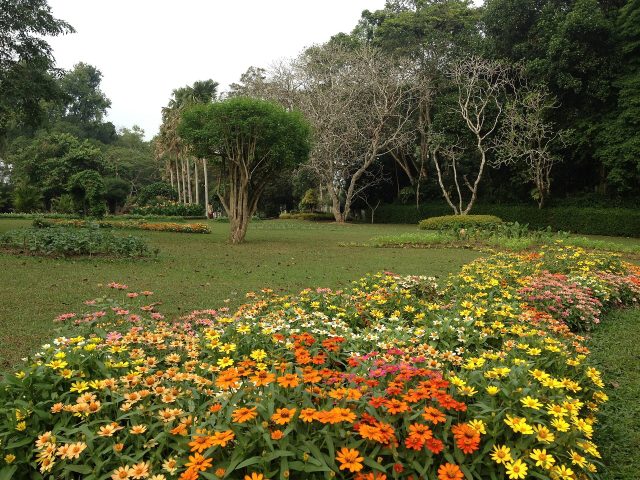
Kelaniya University is one of those places in Sri Lanka where the past and present exist side by side so naturally that you barely notice the transition. Tucked away in the quiet suburb of Rahama, just outside Colombo, it feels worlds apart from the capital’s hustle. The campus sprawls across a generous stretch of land, framed by towering palms and old trees that create a sense of seclusion, even though the city’s busy streets are only minutes away. There’s no tourist trail here, no crowds snapping photos—just the steady rhythm of academic life unfolding in its own unhurried way. That absence of spectacle is part of what makes the university feel less like an institution and more like a living, breathing organism.
Its origins trace back to 1959, when it emerged from a small college that was once part of a Buddhist educational center. But the story goes deeper. In the early 20th century, this land was home to Vidyalankara Pirivena, a religious school where students studied Buddhist philosophy, Sanskrit, and Pali. Today, the university still carries that legacy, remaining one of the island’s leading centers for Buddhist studies and the humanities. Monks can often be seen among the students, attending lectures or studying in the library, where ancient palm-leaf manuscripts are preserved alongside modern texts. It’s a place where tradition isn’t just remembered—it’s still very much alive.
The architecture of the campus reflects this blend of old and new. The main administrative building, with its high ceilings and wide verandas, is a relic of the colonial era, once a boys’ school under British rule. Nearby, the Faculty of Arts stands out with its walls adorned by murals depicting Buddhist themes, painted by local artists. Then there’s the small temple on campus, unassuming but deeply peaceful. Its white walls and golden stupa are visible from a distance, and students often retreat there between classes, drawn by the quiet it offers. The buildings don’t compete for attention; they simply exist, each with its own story.
Beyond academics, Kelaniya is a hub of cultural activity. The university regularly hosts festivals celebrating traditional music, dance, and theater, while student clubs organize exhibitions and discussions on everything from environmental issues to contemporary art. The campus comes alive during Vesak, the annual Buddhist festival, when trees are draped in strings of lights and students and faculty work together to prepare food for visitors. For a few days, the university feels like a large, extended family, welcoming everyone who walks through its gates.
Though Kelaniya is first and foremost a place of learning, its grounds are open to the public. Locals often stroll through the campus on weekends, when the usual student bustle fades, leaving quiet pathways to explore. There’s a botanical garden to wander through, a lotus pond to sit beside, and no high walls to mark the boundary between the university and the rest of Rahama. It’s as if the campus belongs to the town as much as it does to the students. Tourists rarely find their way here—perhaps because it’s not in the guidebooks, or maybe because there’s nothing to photograph in the conventional sense. But that’s precisely what makes Kelaniya special. It doesn’t try to impress; it just exists, quietly and authentically.
For those curious about Sri Lanka’s history, the university offers an unexpected glimpse into how education on the island has evolved. From religious schools to modern universities, from colonial influences to post-independence growth, the layers are all here. The university museum holds exhibits on Buddhist history, along with collections of artifacts, household items, and art from different eras. The old photographs are particularly striking—images of students and teachers from decades past, their faces full of the same hopes and ambitions you’d see in the lecture halls today.
Time moves differently at Kelaniya. There’s no rush, no urgency, not even during exam season. Students cycle between buildings or walk at their own pace, professors linger over tea in the campus café, and under the shade of the trees, you’ll always find someone reading or lost in thought. It’s a place where the small moments matter, where the rhythm of life isn’t dictated by deadlines but by the natural flow of days. That’s why so many graduates look back on their years here with fondness—not just for the knowledge they gained, but for the atmosphere that shaped them.
If you ever find yourself in Rahama, it’s worth taking an hour to wander through the university. Walk its paths, step into the temple, sit by the pond. There are no grand monuments here, no attractions clamoring for attention. But that’s the beauty of Kelaniya. It’s a place where you can feel the pulse of real Sri Lanka—not the postcard version, but the one that exists in quiet conversations, in the rustle of leaves, and in the unhurried pace of everyday life.