Avenida Paulista isn’t just a street—it’s the pulse of São Paulo, a place where the city’s relentless energy and quiet contradictions unfold side by side. Stretching nearly three kilometers through the Bela Vista district, it’s a thoroughfare that bridges eras: the sleek glass towers of global finance stand shoulder to shoulder with the faded grandeur of old mansions, once home to coffee barons who shaped Brazil’s economy. Day or night, weekday or weekend, the avenue hums with life. Here, corporate executives rub shoulders with street musicians, lunch meetings spill into afternoon strolls past bookshops and cafés, and the city’s modern ambitions collide with a lingering sense of nostalgia.
The story of Avenida Paulista begins in the late 19th century, when São Paulo was transforming from a provincial town into the heart of Brazil’s coffee boom. The street was conceived in 1891 by Joaquim Eugênio de Lima, a wealthy landowner who envisioned an exclusive enclave for the elite. Back then, it was lined with opulent mansions inspired by European architecture—ornate facades, stained glass, and manicured gardens. A few of these buildings still stand, though most have given way to office towers. One of the most striking survivors is Casa das Rosas, a 1935 mansion that now serves as a cultural center and museum, offering a glimpse into the lavish lifestyle of São Paulo’s early aristocracy.
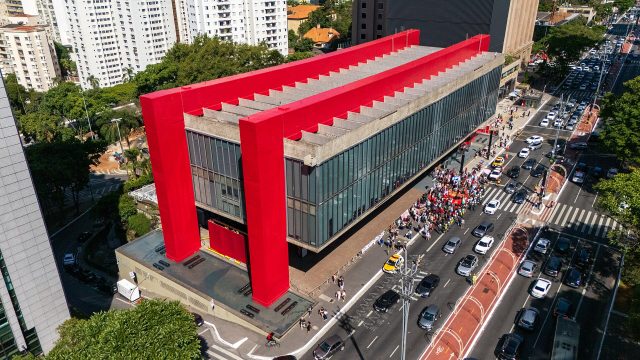
Architecture along Avenida Paulista tells the story of Brazil’s evolution over the past century and a half. The early 20th century brought eclectic styles, followed by the clean lines of modernism. Today, the street is a patchwork of influences: neoclassical columns share the skyline with futuristic glass-and-steel skyscrapers. The most iconic structure is the São Paulo Museum of Art, or MASP, designed by Lina Bo Bardi in 1968. Its bold red pillars and suspended structure make it look as if the museum is floating above the ground, leaving the plaza below open for weekend markets, concerts, and impromptu gatherings. The building isn’t just a landmark—it’s a symbol of the city’s cultural ambition.
Beyond its role as a financial hub, Avenida Paulista is São Paulo’s most important public square. It’s where the city gathers to celebrate, protest, and make its voice heard. In the 1990s, it became the epicenter of the movement to impeach President Fernando Collor. More recently, it has hosted marches for women’s rights, LGBTQ+ equality, and environmental causes. On Sundays, the street is closed to traffic, turning into a pedestrian paradise. Cyclists weave through crowds, families picnic on the sidewalks, and street artists set up easels along the curb. For a few hours, the city slows down, and the avenue becomes a place to linger rather than rush.
Even after business hours, Avenida Paulista refuses to quiet down. The sidewalks are lined with cafés, restaurants, and bars serving everything from hearty feijoada to delicate Japanese sushi. The Bela Vista neighborhood, which borders the avenue, has a strong Japanese community, a legacy of the early 20th-century immigration that shaped São Paulo’s identity. As evening falls, the street lights up—neon signs flicker against glass facades, and the hum of conversation mixes with the occasional sound of a busker’s guitar. It’s a place where the city’s diversity is on full display, where you can grab a coffee from a street vendor in the morning and a craft cocktail at a rooftop bar by night.
For many Paulistas, Avenida Paulista is more than a landmark—it’s a backdrop to their lives. It’s where first dates happen, where friends meet before heading to the airport, where birthdays and graduations are celebrated. At the corner of Avenida Angélica stands a bronze statue of Joaquim de Lima, the street’s founder, dressed in 19th-century attire and seemingly watching over the constant flow of people. Nearby, you might find a group of students strumming guitars or a performer juggling for spare change. The avenue doesn’t just connect places; it connects people, their stories weaving together in the space between the old and the new.
Yet for all its noise, Avenida Paulista has moments of unexpected stillness. If you take the elevator to one of the observation decks in the surrounding skyscrapers, the street below looks like a river of light, stretching toward the horizon. From above, the city’s scale becomes apparent—São Paulo is a sprawling metropolis of millions, each person with their own path, yet all somehow tied to this single avenue. It’s this duality that makes Avenida Paulista so compelling: it’s both a symbol of progress and a reminder of the past, a place where Brazil’s contradictions feel less like conflicts and more like the natural rhythm of life.
There’s no single way to experience Avenida Paulista. You can spend an afternoon wandering through MASP’s galleries, then lose yourself in the stacks of a secondhand bookstore. You can grab a pastel from a street vendor and watch the world go by from a bench, or join the Sunday crowds for a bike ride down the car-free avenue. It’s a place that rewards curiosity, where every visit reveals something new—a hidden mural, a pop-up performance, a conversation overheard at a café. Whether you’re a first-time visitor or someone who’s walked these sidewalks a hundred times, Avenida Paulista always has another layer to uncover. That’s the magic of it: it’s never just a street, but a living, breathing part of the city.