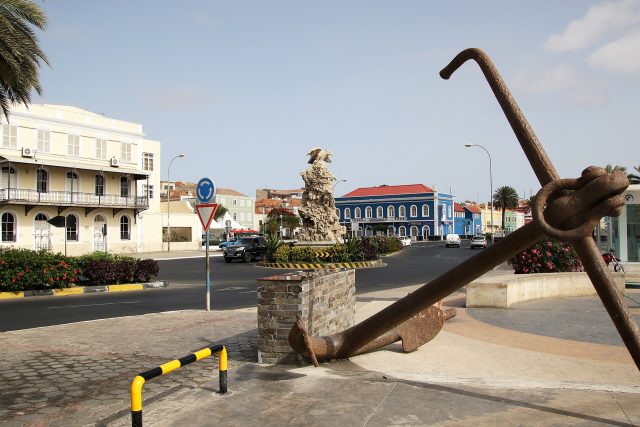
Mindelo’s old theatre is a place where time seems to pause. Tucked away in the city’s heart, it stands on a quiet square—once noisy with the old port’s bustle, now shaped by the slow rhythm of daily life. The building doesn’t draw attention: a soft pastel exterior, tall arched windows, and heavy wooden doors worn by salt air and sun. It wasn’t built to impress, only to last.
The theatre opened in 1886, when Mindelo was a key Atlantic port, a stop for ships between Europe and the Americas. For a while, the city became a mix of cultures, languages, and stories. The theatre turned into more than a venue—it was a gathering spot where Cape Verdeans, sailors, and travelers shared music, plays, and conversations under gaslight. Under colonial rule, it became a quiet rebellion: performances in Kriolu, local poetry, and shared music were ways to claim an identity that was otherwise dictated from afar.
The architecture is simple, borrowing from European styles but adapted to island life. The auditorium is small, with worn wooden seats and velvet curtains that have framed countless performances. The ceiling’s plasterwork is delicate, its edges softened by time, and the murals on the walls have faded into faint traces. Yet the theatre doesn’t feel abandoned. It feels lived-in, loved even when it wasn’t polished. Inside, the air smells of old wood and salt—a reminder of how closely Mindelo’s history is tied to the sea.
The theatre has faced its share of struggles. After independence in 1975, funding for the arts was scarce, and the building fell into disrepair. It closed, reopened, changed hands, but never lost its purpose. Today, it still hosts concerts, plays, and occasional film screenings, though less frequently than before. What remains unchanged is the way sound travels in the hall. The acoustics are striking—whether it’s a singer’s voice, a guitar’s strum, or even the creak of a seat. Every note feels close, as if the music is meant just for you.
Mindelo is Cape Verde’s cultural heart, and the theatre has helped shape that reputation. Some of the islands’ most beloved musicians began here, and it has been a stage for morna, the music that defines Cape Verdean identity. The songs—about love, longing, and leaving home—carry a weight that doesn’t fade. The theatre wasn’t just a place to hear music; it was where music became a language of its own, a way to express what words couldn’t.
For locals, the theatre is more than history. It’s part of the city’s daily life—a place to sit quietly, meet friends, or escape the afternoon heat. The square outside often hums with street musicians, their melodies drifting through the open doors. Sometimes, performances spill onto the pavement, blending with the city’s sounds. The theatre doesn’t fight modern life; it exists alongside it, a quiet constant in a changing place.
Visitors often find the theatre by accident. There are no crowds, no guided tours, no pressure. Just a quiet room where the past lingers in the details: scuffed floors, peeling paint, light filtering through high windows. You can almost hear the audience that once filled the seats, the laughter and applause that once filled the space. Time here doesn’t move in a straight line—it circles, as if the theatre still holds the energy of every performance it has ever hosted.
Mindelo is a city of contrasts—colonial architecture beside modern life, the port’s hum giving way to narrow alleys’ silence. The theatre embodies that duality. It doesn’t try to be grand or modern, and it doesn’t need to be. Its value is in its authenticity, in how it has witnessed the city’s changes without losing itself. There are no grand festivals here, no sold-out shows, just the steady presence of a place that has always been about more than entertainment. It’s a space where culture isn’t staged for an audience but simply exists, raw and real. That’s why it still matters to those who know it.