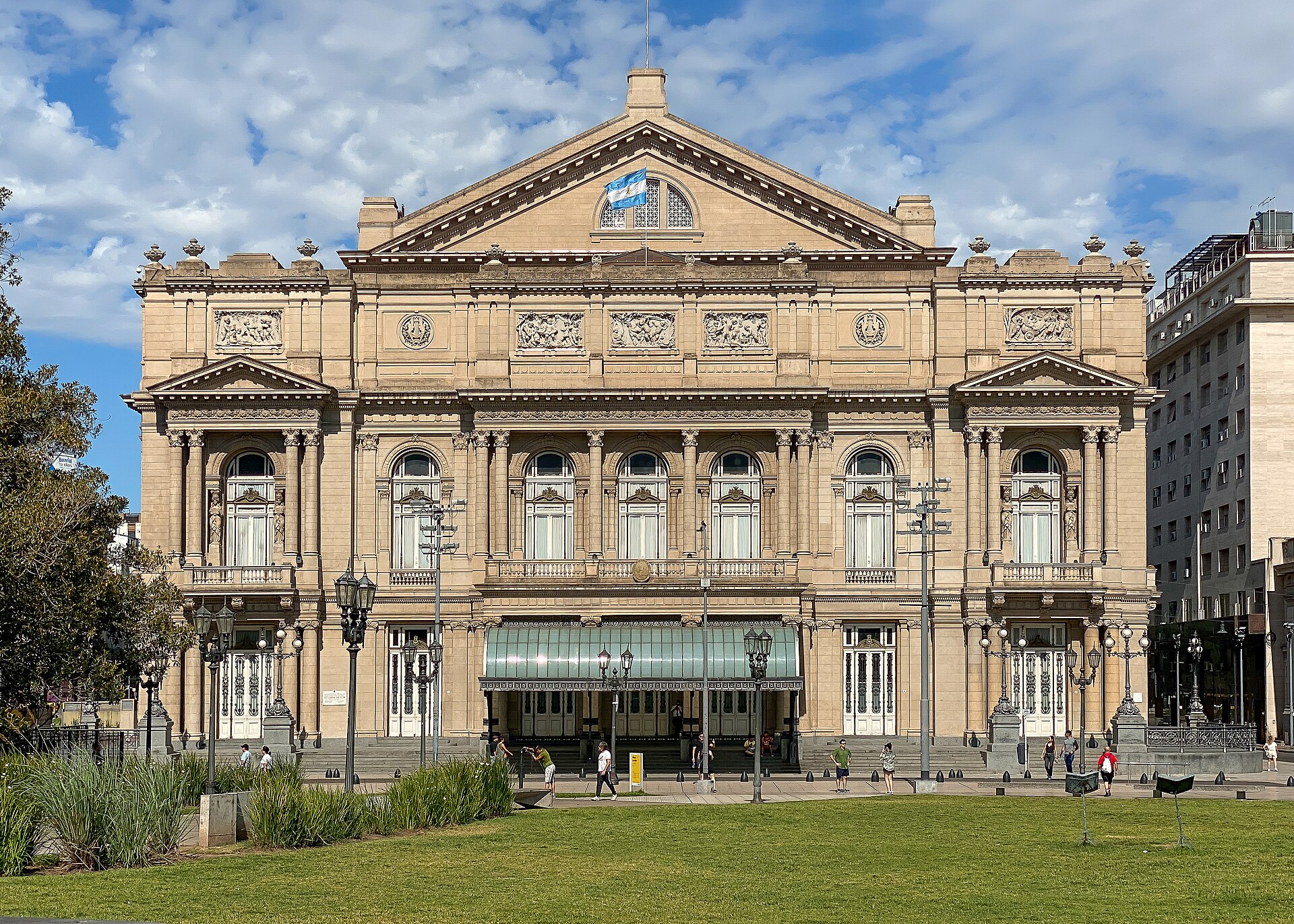
Colón Theatre is one of those places where Buenos Aires reveals its layered past—not just as a performance venue, but as a monument to the city’s ambition, craftsmanship, and the way art once shaped public life. Built over two decades, its construction spanned the turn of the 20th century, a period when Argentina was flush with wealth from agriculture and eager to prove itself on the world stage. The project outlasted two of its original architects, both of whom died before seeing it completed, and was finally inaugurated in 1908 with a mix of European grandeur and local pride.
The theatre’s reputation rests on more than just its size, though its auditorium is vast enough to seat over two thousand people. What sets it apart is the acoustics, consistently ranked among the best in the world. The secret lies in the horseshoe shape of the hall, the careful use of wood in the balconies, and the way sound disperses without harsh echoes. Even in the highest tiers, where the view of the stage is limited, the music arrives with startling clarity. The ceiling, painted in the mid-20th century by Raúl Soldi, adds a touch of modern artistry to the otherwise classical interior, its soft colors and flowing figures contrasting with the rigid symmetry of the architecture.
The materials tell their own story of a country that once imported the finest of everything. Italian marble lines the foyers, French stained glass filters the light, and Venetian mosaics glint under the chandeliers. At the time, Argentina was one of the richest nations in the world, and the theatre was built to reflect that status. But beyond the opulence, there are quieter details that hint at the social customs of the era. The so-called "widows' box," for instance, is a small balcony screened by a lattice, where women in mourning could attend performances without being seen by the public. It’s a reminder of how rigidly society was structured, and how even something as universal as opera could be shaped by local norms.
Over the decades, the theatre has hosted some of the most celebrated names in music and dance. Enrico Caruso sang here, as did Maria Callas and Luciano Pavarotti. Arturo Toscanini and Igor Stravinsky conducted the orchestra, while Vaslav Nijinsky and Rudolf Nureyev graced the stage. The programming remains ambitious, with a season running from March to December that includes opera, ballet, and symphonic concerts. The building itself is a living archive, its walls holding the echoes of countless performances.
For those who visit during the day, guided tours offer a glimpse behind the scenes. The tours, available in Spanish and English, last about fifty minutes and cover the main auditorium, the grand foyers, and the Golden Hall, where the gilded details and polished surfaces reflect the theatre’s original splendor. The tours run hourly, but in peak season, tickets can sell out quickly, so it’s worth arriving early.
The theatre’s location is as much a part of its identity as its architecture. It stands near the Obelisk on Avenida 9 de Julio, one of the widest streets in the world. The avenue itself is a symbol of Buenos Aires’ mid-century modernization, a broad thoroughfare cut through the heart of the city to ease traffic and create a grand civic space. The theatre, with its neoclassical facade, feels like a relic of an earlier era, yet it remains a vital part of the city’s cultural life.
For locals, the Colón is more than just a venue—it’s a place where music is taken seriously, where the experience of listening can outweigh the need for a perfect view. The cheapest seats are in the upper tiers, where the sightlines are poor but the sound is flawless. These are the seats favored by the city’s most devoted opera lovers, who come as much for the acoustics as for the performance itself. It’s a reminder that in a theatre like this, the magic isn’t just in what you see, but in what you hear.