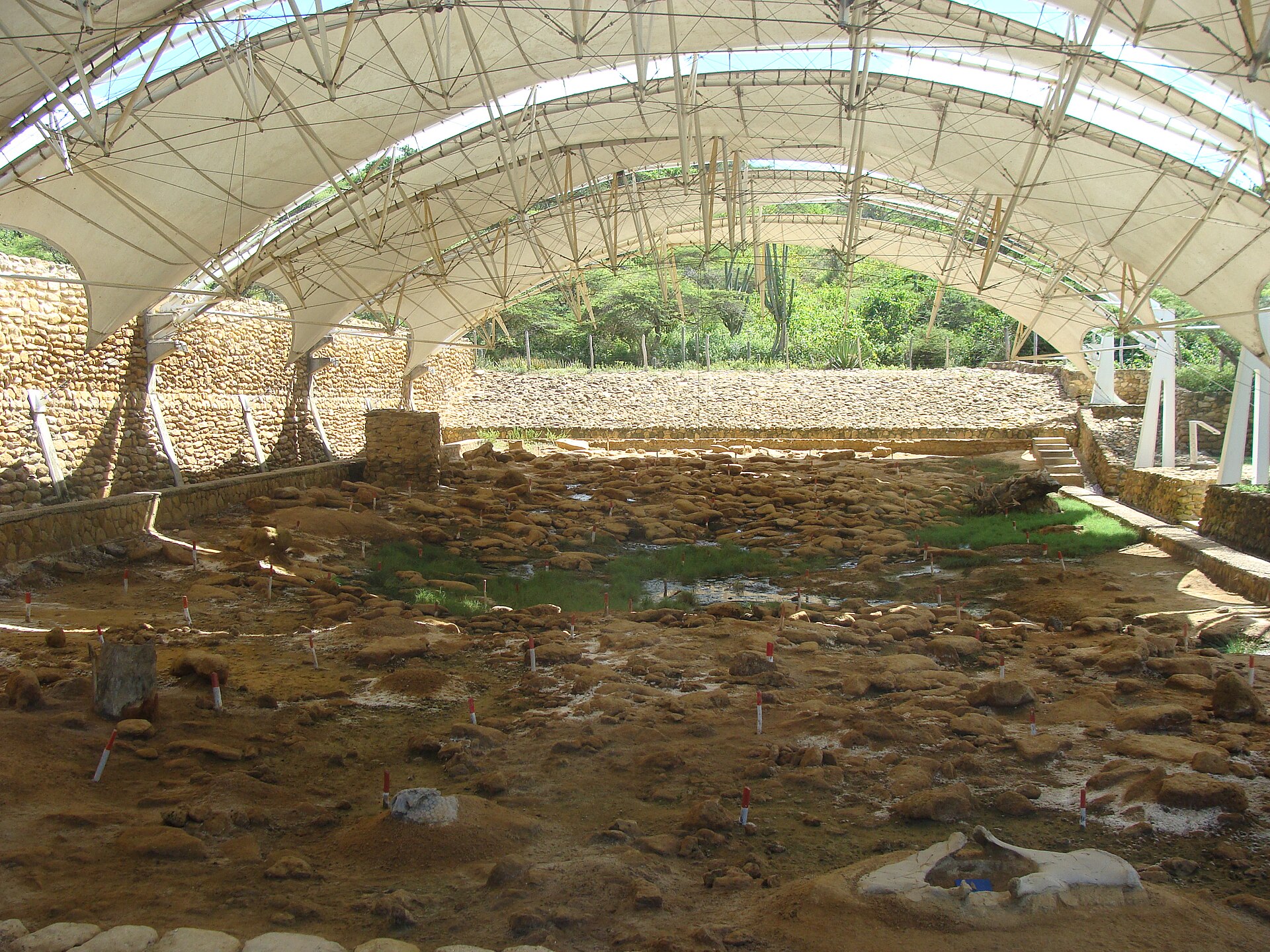
Taima Taima is one of those rare places where the past doesn’t just feel close—it feels alive. Tucked away in the arid landscapes northwest of Coro, Venezuela, this archaeological site sits quietly, far from the usual tourist trails. There are no crowds here, no souvenir stands or guided tour groups chattering in half a dozen languages. Instead, the wind moves through the dry brush, and the only voices you might hear belong to the occasional local passing through, checking on the land or simply walking the familiar paths.
The name itself carries echoes of the region’s indigenous roots, tied to old stories of spirits that once wandered these lands. Archaeologists have uncovered traces of ancient hunter-gatherers who lived here over fourteen thousand years ago, long before the rise of the civilizations most people associate with South America. Stone tools, animal bones, and other artifacts paint a picture of a time when humans shared this land with now-extinct creatures like mastodons and giant sloths. The discoveries here have made Taima Taima a key site for understanding the continent’s deep history, offering clues about how early peoples survived in this harsh environment.
The landscape around Taima Taima is as striking as the history buried beneath it. The area is a semi-desert, where sparse vegetation clings to the rocky soil—cacti, low shrubs, and the occasional hardy tree. The climate is unforgiving, with scorching midday sun that makes the air shimmer. But in the early morning or as the light softens toward evening, the heat eases, and the silence settles in like a natural blanket. Locals sometimes call this place the edge of the world, and it’s easy to see why. There’s a sense of isolation here, a feeling that you’ve stepped beyond the reach of modern life into something older, wilder.
Excavations at Taima Taima began in the mid-20th century, with the most significant findings emerging in the 1960s and 70s. Researchers unearthed the remains of prehistoric animals alongside human tools, confirming that these early inhabitants hunted large game with simple stone weapons. Some of these artifacts now reside in Venezuelan museums, but many remain at the site, protected by the same earth that preserved them for millennia. The work here isn’t as active as it once was, but the discoveries continue to shape our understanding of the past.
Visiting Taima Taima isn’t like touring a typical historical site. There are no neatly labeled exhibits or paved walkways, just the land itself—dusty, uneven, and unadorned. If you’re lucky, you might find a local guide who can point out the main excavation areas and explain their significance. More often, though, visitors are left to wander alone, piecing together the past from the scattered clues underfoot. This isn’t a place for those seeking Instagram-worthy moments or structured entertainment. It’s a place for quiet reflection, for trying to imagine what life was like when the first humans roamed these same hills.
Despite its remoteness, Taima Taima holds an important place in Venezuela’s cultural heritage. It serves as a reminder that the country’s history stretches far beyond the colonial era, rooted in the lives of indigenous peoples who thrived here long before European contact. For archaeologists, the site is a treasure trove, offering insights into ancient migration patterns, hunting techniques, and the daily realities of early societies. For travelers, it might seem understated, even unremarkable at first glance. But that’s part of its appeal—the absence of fanfare, the raw connection to the past.
If you decide to make the journey, come prepared. The road to Taima Taima is rough, little more than a dirt track winding through the desert. There are no visitor centers, no cafes, no shaded benches to rest on. A four-wheel-drive vehicle is ideal, preferably with a driver who knows the area, or you can arrange for a local to guide you. Don’t expect comfort or convenience. The sun is relentless, the ground uneven, and the experience unfiltered. This is a place where you meet the past on its own terms.
Taima Taima isn’t just an archaeological site—it’s a living archive, a landscape that has witnessed thousands of years of human history. Every stone, every depression left by an old excavation, even the way the wind carries the scent of salt from the distant sea, speaks to the passage of time. It’s a place for those who seek more than just a new destination; it’s for those who want to step outside the noise of the present and touch something enduring. When you stand here, you’re not just visiting a landmark. You’re standing where ancient footsteps once fell, where the earth still holds the stories of those who came before.