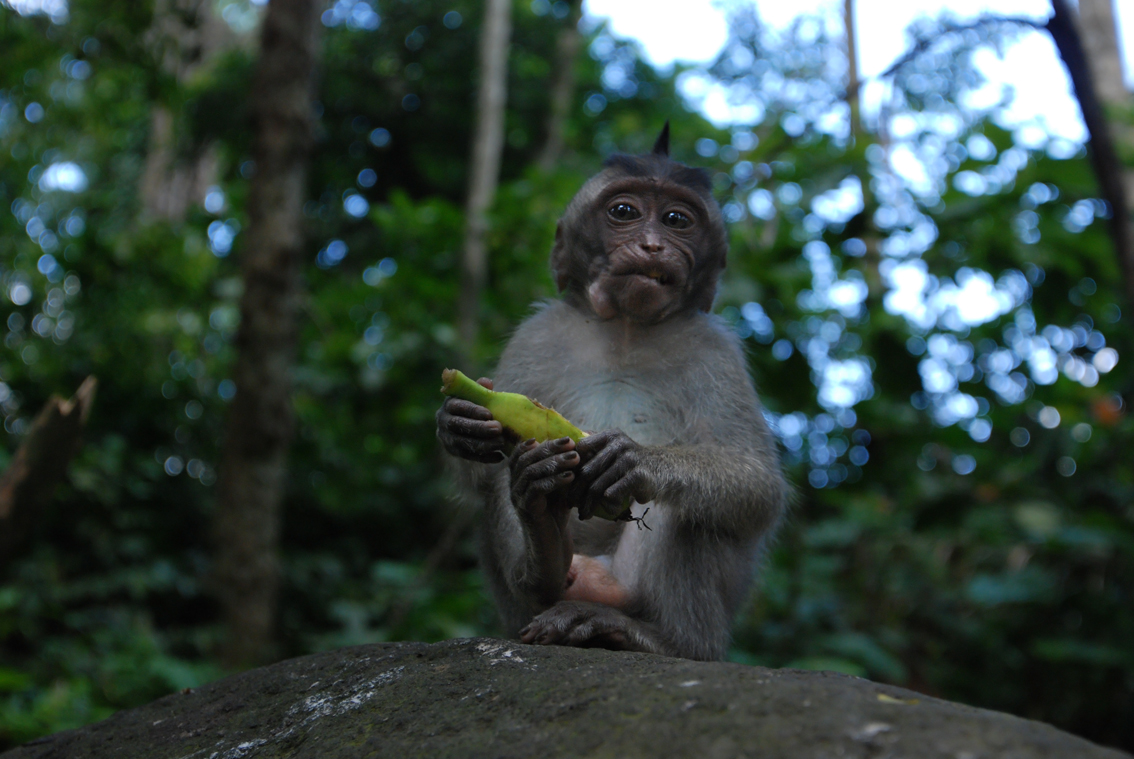
The Sacred Monkey Forest of Padangtegal is one of those rare places where nature, myth, and daily life merge so seamlessly that it’s hard to tell where one ends and the other begins. Tucked on the edge of Ubud, this patch of jungle is far more than a tourist attraction—it’s a living ecosystem where religious traditions, wildlife, and human history have coexisted for centuries. Though it spans just twelve hectares, its significance stretches far beyond its borders, shaping the way both locals and visitors experience Bali.
At the heart of the forest are its most famous residents: hundreds of long-tailed macaques that move freely through the trees, dart across paths, and occasionally peer into bags in search of food. Their antics can be amusing, but they’re also a reminder to stay alert. These monkeys are clever and unpredictable, especially if they feel threatened, though serious incidents are rare. Over time, the forest and its inhabitants have grown accustomed to human presence, and most interactions pass without conflict. Still, it’s wise to keep a respectful distance—this is their home, after all.
Yet the forest is about more than just monkeys. It’s a sacred space, home to three ancient temples hidden among the foliage. The most important of these is Pura Dalem Agung Padangtegal, dedicated to the Hindu god Shiva. Its moss-covered stone gates and weathered carvings seem frozen in time, a quiet testament to centuries of devotion. While the temples are reserved for worshippers performing rituals, even from a distance, their presence lends the forest an air of reverence. The other two temples, Pura Beji and Pura Prajapati, serve different spiritual purposes, but all three are integral to the religious life of the surrounding villages.
The history of Padangtegal runs deep. Local lore traces its origins to the 14th century, when it was part of the Ubud kingdom. The temples were built not just as places of worship but as guardians of the land, believed to protect the balance between humans and nature. Even today, villagers hold ceremonies here to honor the spirits of the forest, reinforcing the idea that this place is alive with more than just trees and animals. In recent decades, tourism has brought new attention to the forest, but its essence remains unchanged—a place where the sacred and the everyday coexist.
Walking through Padangtegal feels like stepping into another world. Narrow paths wind beneath towering banyan trees, their roots cascading like curtains from the branches. The air is thick with the scent of damp earth, leaves, and tropical blooms. Every so often, the rustle of foliage or the chatter of monkeys breaks the silence, a reminder that you’re never truly alone here. Some trails lead to small clearings where sunlight filters through the canopy, creating dappled patterns on the ground. It’s easy to lose track of time in these quiet corners, watching the forest breathe.
For the people of Ubud, the Monkey Forest is more than a landmark—it’s a vital part of their cultural and spiritual identity. Ceremonies are held here to honor the gods and the spirits of nature, and the monkeys themselves are seen as sacred, embodiments of divine energy. Visitors, on the other hand, often come seeking something different: a glimpse of Bali beyond the beaches and resorts, a place where nature and spirituality are inseparable. The forest offers both—an encounter with wildlife and a quiet moment of reflection.
The forest changes with the seasons. During the rainy months, it becomes lush and vibrant, with paths turning into small streams. The monkeys don’t seem to mind the downpours, and neither do the visitors who brave the weather. In the dry season, sunlight pierces the canopy in golden shafts, casting intricate shadows on the forest floor. The air is cooler here than in the open, a welcome respite from Bali’s tropical heat. No matter when you visit, the forest feels alive in its own rhythm.
There’s no right or wrong way to experience Padangtegal. Some come for the monkeys, snapping photos and laughing at their antics. Others seek solitude, wandering the trails until the sounds of the outside world fade away. A few simply want to feel the pulse of old Bali, a place where time moves differently. Whatever draws you here, the forest leaves an impression—one of quiet wonder, of a world where nature and spirituality are still deeply intertwined. It’s a place that lingers in memory long after you’ve left.