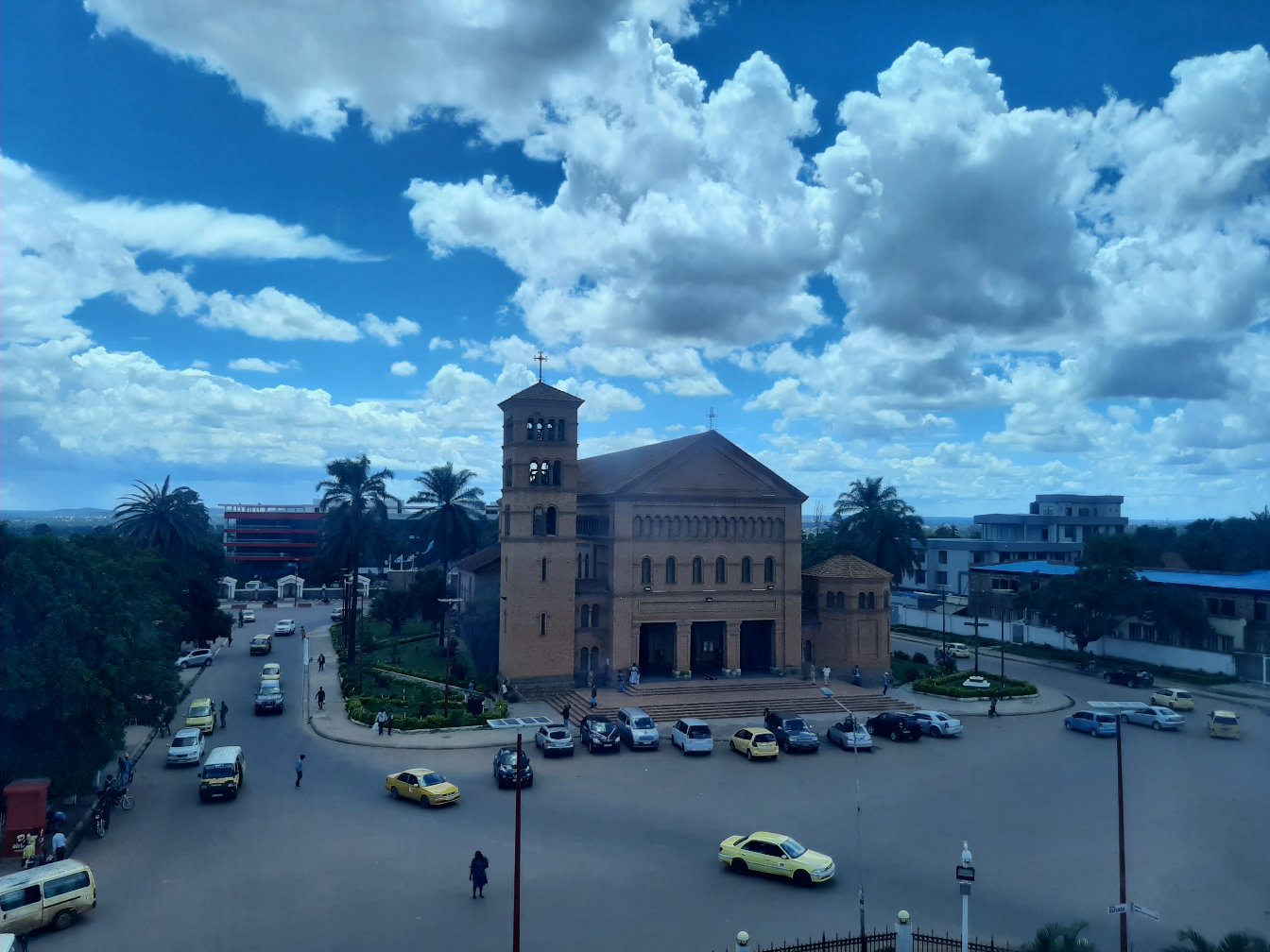
Sts. Peter and Paul Cathedral in Lubumbashi is one of those places that quietly anchors itself in a city’s identity, even if it doesn’t always demand attention. Built in the early 20th century, when the Congo was still under Belgian rule, the cathedral stands as a testament to both the religious life of the region and the architectural tastes of its colonial past. Constructed from brick and stone, the building reflects the neo-Gothic style that was popular in European church design at the time. Its tall, pointed windows, sturdy buttresses, and the spire of its bell tower make it a striking presence, though the surrounding urban growth has gradually softened its prominence in the cityscape.
Inside, the cathedral feels surprisingly airy and bright, despite the relative austerity of its forms. The vaulted ceilings are supported by columns, and while the stained glass isn’t as vivid as what you might find in European cathedrals, it casts a gentle, diffused light across the space. The altar follows traditional Catholic design, but there’s a subtle local influence in the wooden sculptures and paintings, blending African artistic traditions with the imported style. This wasn’t just a copy of a European church—it was an attempt to bridge two worlds, something that was rare during the colonial era.
The cathedral’s role in Lubumbashi’s history goes back to a time when the city was still finding its footing. In the mid-20th century, as the mining industry boomed and the population swelled with migrants from across the country and Europe, the church became a focal point for the Catholic community. For many newcomers, it offered a sense of familiarity in an unfamiliar land, a place where they could reconnect with traditions left behind. Even after Congo gained independence, the cathedral remained a constant, though the world around it shifted dramatically.
Today, Sts. Peter and Paul Cathedral is more than just an active place of worship—it’s a piece of Lubumbashi’s cultural heritage. The city has long outgrown its colonial origins, evolving into a bustling economic hub with over a million residents, where dozens of languages and cultures intersect. Yet the cathedral endures as one of the few reminders of the era when the city was known as Élisabethville, a Belgian stronghold in the heart of Central Africa. The area around it pulses with life—street markets, corporate offices, the hum of traffic—but the cathedral itself feels suspended in time, a quiet counterpoint to the city’s relentless energy.
What makes the cathedral’s architecture particularly interesting is how unapologetically European it is. Most colonial churches in Africa were built with simpler, more practical designs, adapted to local conditions. But here, the architects made a deliberate effort to replicate the neo-Gothic style with minimal concessions. It’s possible this was intentional, as Lubumbashi was originally conceived as a city for European settlers, and the cathedral may have been meant to reinforce their connection to home. Over time, though, the church became a place of worship for everyone—descendants of colonists and local residents alike—who now see it as their own.
Visiting the cathedral offers a chance to see how the city’s history is etched into its walls. There’s no grand opulence here, no gilded interiors, just a sense of authenticity. Unlike many modern churches built from standardized plans, this one carries the marks of a specific time and the people who shaped it. The craftsmanship is evident in the details, from the stonework to the wood carvings, all of it done with an eye toward permanence. Even if you’re not religious, the atmosphere invites a moment of reflection, a pause to consider the countless lives that have passed through its doors.
Lubumbashi is a city of contrasts, where gleaming high-rises stand beside sprawling informal settlements, and busy avenues give way to dusty outskirts. Sts. Peter and Paul Cathedral sits slightly off the beaten path, which only adds to its appeal. There are no crowds of tourists, no guides hawking their services—just the quiet, the light filtering through the stained glass, and the faint scent of candle wax in the air. For some, it might just be another stop on a journey, but for others, it’s an opportunity to engage with a history that rarely makes it into guidebooks.
Like many historic buildings in Congo, the cathedral faces challenges in preservation. The climate, air pollution, and limited funding for restoration take their toll, but the local community does what it can to maintain it. There may come a day when the facade is refreshed or new artwork is added, but even if that doesn’t happen, the cathedral will remain an important part of Lubumbashi. It’s not just an architectural landmark—it’s a living reminder of how the city was shaped by different people, different eras, and the quiet resilience of a place that has seen it all.