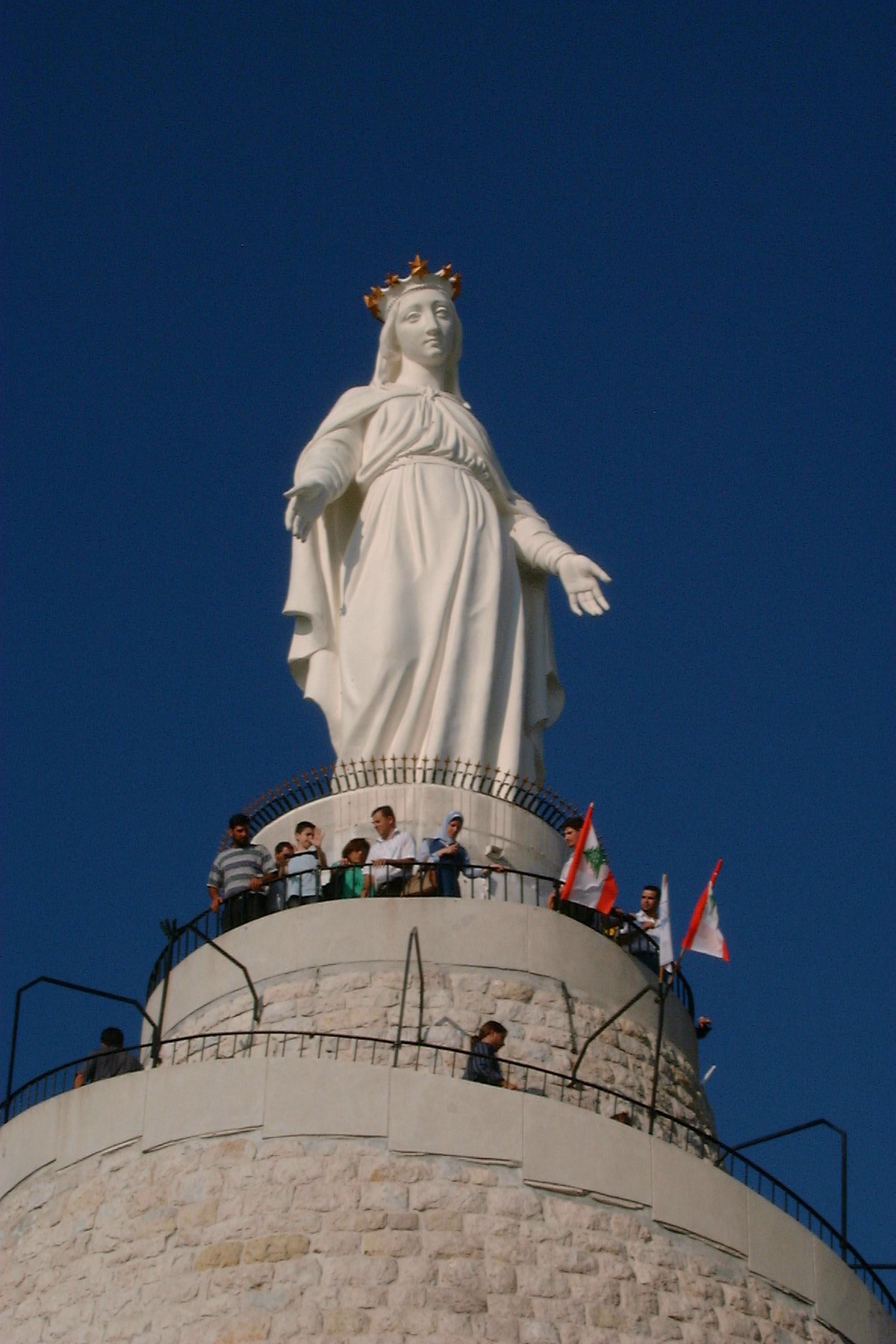
Perched on the slopes of Harissa Mountain, the statue of Our Lady of Lebanon watches over the coastal town of Jounieh like a quiet guardian. From this height, the Mediterranean stretches out endlessly, its surface shimmering under the sun, while the city below unfolds in a patchwork of white buildings and winding streets. The statue doesn’t demand attention—it simply stands there, a presence that lingers long after you’ve left. Pilgrims come here, of course, but so do those seeking a moment of stillness, a breath of mountain air, or the kind of view that makes you pause and look at the world differently.
The statue was erected in 1908, commissioned by French Marianist monks who had settled in Lebanon decades earlier. They chose Harissa for a reason. The mountain had long been considered sacred, its slopes dotted with small chapels and shrines, a place where the earth felt closer to the divine. Carved from white marble, the statue depicts the Virgin Mary with arms outstretched, as if embracing the land and sea below. It’s only about eight meters tall, but its position on the hillside makes it seem much larger, especially when you stand at the base and look up. The effect is deliberate—humble in scale, yet impossible to ignore.
There are a few ways to reach the statue, each with its own rhythm. The easiest is the cable car, a short ride that begins at the foot of the mountain and ascends in a slow, steady climb. The journey takes about ten minutes, just enough time to watch the landscape shift beneath you—the bay curving into the distance, the rooftops of Jounieh shrinking, the pine trees thickening as you rise. For those who prefer walking, a winding path cuts through the forest, passing small houses and the occasional stray goat. The hike isn’t strenuous, but it’s not quick either. The real reward isn’t the destination, but the quiet along the way: the scent of pine needles, the rustle of leaves, the rare sound of a voice carrying up from the valley.
The sanctuary itself is more than just the statue. A small complex surrounds it, including a chapel, a viewing platform, and carefully tended gardens. The chapel, built in a restrained neoclassical style, feels unassuming from the outside, but inside, the air is cool and still. Light filters through stained glass, casting soft colors onto the marble altar. Frescoes line the walls, their details worn smooth by time. Services are held here regularly, and in August, during the Feast of the Assumption, the place fills with worshippers and visitors. Most of the year, though, it’s quiet. You can sit on one of the benches, listen to the wind, and watch the sea stretch out below like a vast, unbroken sheet of blue.
The viewing platform next to the statue offers one of the best vantage points in the area. On clear days, the Mediterranean seems to dissolve into the horizon, while Jounieh sprawls below, a mix of old and new. Beirut is visible in the distance, its skyline faint but unmistakable. Closer in, fishing villages cling to the shore, their boats bobbing in the water. The best time to come is at sunset, when the light softens and the sky turns gold, then pink, then deep blue. It’s the kind of view that makes you forget, for a moment, how much noise and movement there is in the world.
For many Lebanese, the statue is more than a religious symbol. In a country where Christians, Muslims, Druze, and others have lived side by side for generations, it has become a shared landmark. People come here not just to pray, but to escape the heat of the city, to picnic with family, or to mark a milestone—a graduation, a wedding, a moment of personal reflection. It’s a place where traditions are passed down, where children learn to appreciate the quiet beauty of the mountains, where strangers can sit together on a bench and watch the same view without needing to speak.
The statue’s history is woven into Lebanon’s own. When it was installed in the early 20th century, the country was under French mandate, and European influence was strong. The Marianist monks who commissioned it weren’t just spreading their faith; they were building schools and cultural centers, places where ideas could take root. Over time, the sanctuary on Harissa became one of those places—a spot where religion, education, and history intersected. Today, you’ll still find pilgrims here, but also school groups on field trips, students sketching the architecture, and locals who treat the mountain like an old friend.
Beyond its spiritual significance, the statue is also part of a landscape that invites you to slow down. The gardens around the sanctuary are lush with flowers and trees, a cool retreat in the summer heat. In winter, the mountain occasionally dusts with snow, turning the scene into something out of a storybook. Families often come here on weekends, spreading out blankets under the pines, while tourists wander the paths, cameras in hand. It’s a place where you can be alone with your thoughts or share the space with others, where the only agenda is the one you bring with you.
Visiting the statue of Our Lady of Lebanon is a small but meaningful experience, especially if you’re curious about the layers of history that shape this country. Here, the past isn’t just preserved in museums or books—it’s alive in the land itself. The mountain, the sea, the statue, the chapel: they all tell a story of faith, of change, of resilience. It’s a reminder that even in a place as complex and fast-moving as Lebanon, there are still corners where time seems to stand still, where the view is as much about the heart as it is about the eyes.