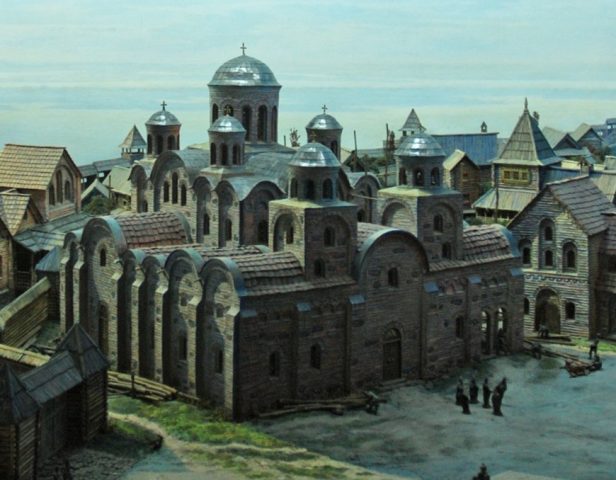
Sophia Cathedral in Kyiv is one of those rare places where history isn’t just preserved in stone—it breathes. Built in the first half of the 11th century under Prince Yaroslav the Wise, the cathedral wasn’t merely a religious center but a statement of power for the young state of Kyivan Rus. Its scale was meant to rival the great churches of Constantinople, and its name—Sophia—was a direct nod to the Hagia Sophia, the architectural marvel of the Byzantine Empire. Yet Kyiv’s version wasn’t a copy. It absorbed local traditions, blending Byzantine design with early Rus craftsmanship to create something entirely its own. For centuries, it stood as a symbol of the city’s ambition, faith, and cultural identity.
The architecture of Sophia Cathedral still commands attention, even after a thousand years. Originally designed as a cross-domed church with thirteen cupolas—representing Christ and the twelve apostles—its structure has evolved through fires, invasions, and reconstructions. The central dome, rising above the city, remains its most striking feature, a reminder of Kyiv’s former glory as one of medieval Europe’s wealthiest and most influential cities. Inside, the walls are adorned with 11th-century mosaics and frescoes, masterpieces of early Rus art. Among them, the Orans—a depiction of the Virgin Mary with outstretched arms—stands out, as does the Pantocrator in the central dome, both radiating a quiet, timeless majesty.
Beyond its religious role, Sophia Cathedral was a hub of intellectual and political life. It housed one of the first libraries in Rus, founded by Yaroslav the Wise, and served as a place where chronicles were written, treaties signed, and foreign envoys received. The cathedral’s walls witnessed pivotal moments: in the 12th century, Vladimir Monomakh was crowned here, and in the 17th century, it became the residence of Kyiv’s metropolitans. Even after Kyiv fell under Russian rule in the 18th century, the cathedral underwent Baroque renovations, adding the ornate elements visible today. Yet beneath the layers of history, the original mosaics and frescoes—crafted by Byzantine and Rus masters—retain their brilliance, as if untouched by time.
The cathedral’s bell tower, built in the 18th century, was once one of Kyiv’s tallest structures. More than just a functional addition, it symbolized the church’s authority, its bells calling the faithful to prayer. Today, climbing its narrow spiral staircase offers a glimpse of old Kyiv: the golden domes of the Lavra, the winding Dnipro River, and the green hills that cradle the city. The view from the top feels like stepping into the past, where every stone carries the weight of centuries.
Sophia Cathedral has endured more than its share of hardships. It was looted during invasions, damaged by fires, and repurposed as a museum during the Soviet era. During World War II, German forces planned to demolish it but were thwarted by the city’s liberation. Post-war restorations helped restore its original grandeur, and today it functions both as an active church and a museum. Services, tours, and concerts of sacred music fill its halls, allowing visitors to connect with the layers of history embedded in its walls.
The atmosphere inside the cathedral is unlike anywhere else. The high vaults, the soft light filtering through narrow windows, and the hushed footsteps create a sense of timelessness. The mosaics, despite their age, glow with vivid colors, their gold backgrounds shifting with the light, as if alive. The cool air inside offers respite even on the hottest days, inviting quiet reflection. It’s a place where the past feels immediate, where the weight of history isn’t just observed but experienced.
More than an architectural landmark, Sophia Cathedral is a living witness to Kyiv’s evolution. It has seen the rise of Kyivan Rus, survived Mongol invasions, endured Cossack revolts, and weathered imperial and Soviet rule. Each stone holds memories of those who prayed, built, and defended the city. Today, it remains a vital part of Kyiv’s life, hosting religious ceremonies, processions, and gatherings. Yet even for those who don’t share its faith, the cathedral offers something profound: a tangible link to the past and a reminder of beauty that transcends eras.
Visiting Sophia Cathedral is a chance to touch the roots of Rus culture. From the ancient frescoes to the graffiti left by pilgrims over the centuries, every detail tells a story. The cathedral isn’t just located in the heart of Kyiv—it *is* the heart, a place where past and present converge. Walking through its halls, you can almost hear the voices of chroniclers, the murmurs of princes making decisions, the echoes of congregations filling the space. It’s not a relic behind glass but a place where history continues to unfold.