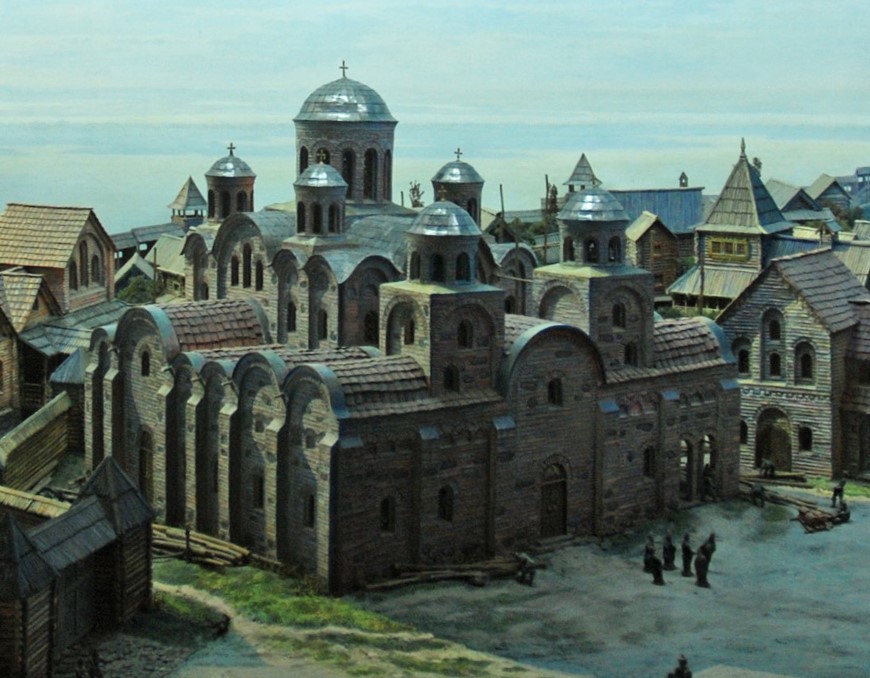
The Church of the Tithes isn’t just another historical site. It’s where you can almost feel the past. Commissioned by Prince Volodymyr the Great in the late 10th century, it became the first stone church in Kyivan Rus. This wasn’t merely a religious building—it was a declaration. Christianity’s adoption, the young state’s consolidation, and Byzantine cultural ties all took root here. The church’s name comes from the tithe: a tenth of the prince’s income set aside for its maintenance, proving its role as both a spiritual center and a symbol of state authority.
The architecture fused Byzantine traditions with local craftsmanship. The original structure was a three-naved basilica topped with domes, its walls covered in marble and decorated with mosaics and frescoes. Beneath the floors lay the tombs of the princely family, including Volodymyr and his wife Anna. But the church was more than a place of prayer. It housed state documents, welcomed foreign envoys, and safeguarded the treasury in its cellars. Here, politics, faith, and daily life intertwined.
History dealt the church a harsh blow. In 1240, the Mongols destroyed it. Legend says its vaults collapsed under the weight of people seeking refuge inside, burying hundreds. For centuries, the ruins remained hidden until 19th-century archaeologists uncovered the foundations, fragments of mosaics, and everyday objects now displayed in museums. A neoclassical church built in 1842 later stood on the site but was demolished during the Soviet era.
Today, the site is a quiet square. The remnants of the foundation sit behind a low fence—no grand domes, just weathered stones. The simplicity is striking. Informational panels explain the excavations, but the real draw is the atmosphere. You can almost hear the ancient bells, the processions, the life that once filled this space.
This place connects modern Kyiv to its earliest days. It wasn’t just a principality’s capital; it was a center of the Christian world. Its story mirrors the rise and fall of states, the cycles of war and peace, and the persistence of faith. Tourists come, but so do those searching for roots. There are no crowds, just stillness.
Should the church be rebuilt or left as ruins? The debate continues. For now, the site exists quietly. In summer, small exhibitions appear. In winter, snow covers the stones. In spring, trees bloom around them. It’s not a place for a quick stop—it’s a place to linger, to wonder how much changes and how little remains the same.
A short walk away, other landmarks appear—the Golden Gate, St. Sophia’s Cathedral, Andriyivsky Descent. But the Church of the Tithes is different. It’s not just about location; it’s about meaning. Kyiv isn’t just a modern city—it’s a place where history doesn’t fade. People come here for the silence, for the chance to pause. The stones don’t speak, but if you listen, they tell a story over a thousand years old.