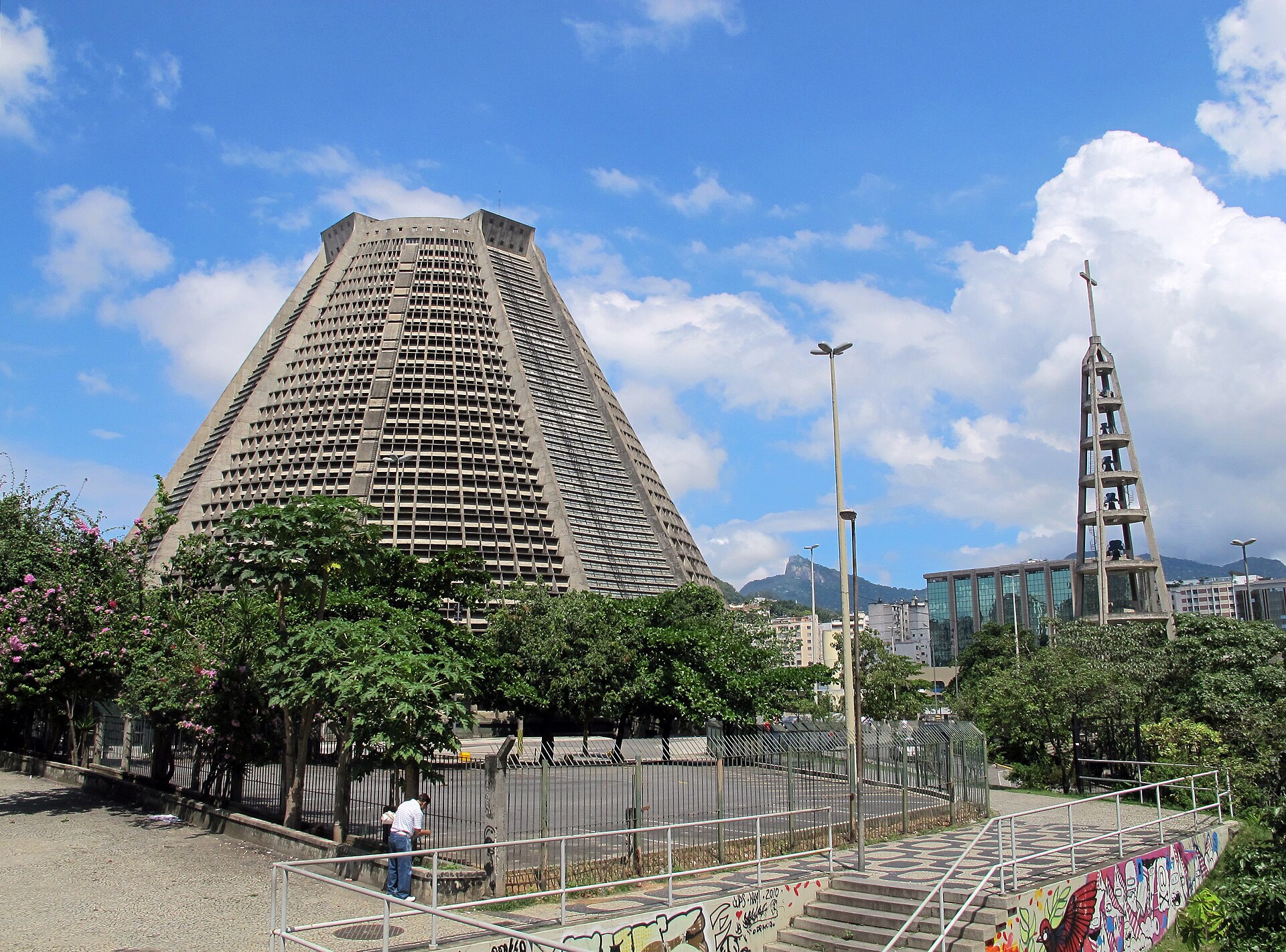
Standing apart from Rio de Janeiro’s most famous landmarks, the Cathedral of Saint Sebastian offers a different way to see the city. It doesn’t appear on postcards like Copacabana or Christ the Redeemer, yet it holds something the others don’t: a space where Rio’s past and present meet without fanfare.
Built in 1979, the cathedral breaks from tradition. Architect Edgar Fonseca designed it as a concrete pyramid, its four tall columns supporting a shape that recalls ancient temples rather than European churches. Inside, the hall is large enough for twenty thousand people—a response to mid-century Rio’s rapid growth, when the city needed a place that could serve both worship and community.
The interior is uncluttered. Light enters through narrow slits, casting shadows that shift with the sun. The walls carry simple geometric patterns, and the altar is a plain stone slab under a towering cross. This simplicity can feel unexpected, but it works: the cathedral becomes a quiet spot in a city that rarely slows down.
Rio’s patron saint gives the cathedral its name. Portuguese settlers founded the city on Saint Sebastian’s feast day, and his image has been part of Rio’s story ever since. Before this cathedral existed, Candelária Church was the main religious site, but by the 1950s, it couldn’t hold the city’s growing population. The new cathedral, with its bold design, marked a change—not just in architecture, but in how Rio saw itself.
The cathedral is more than a church. Concerts, exhibitions, and light shows turn its walls into a stage. During holidays, candlelight and music fill the space, drawing crowds. These moments show how the cathedral fits into Rio’s life, not just as a building, but as a place where people gather.
It sits in Cinelândia, a district where Rio’s layers are visible. Nearby stand the National Library, the Municipal Theater, and the old presidential palace. A short walk away, Lapa’s colonial houses hint at the city’s past. Together, they tell the story of Rio’s growth from a small settlement to a major city.
The cathedral’s thick walls keep the heat out. Inside, the quiet feels separate from the streets.
Visitors can sit on a bench, watch light move across the stone, or visit the small chapel with its statue of Saint Sebastian. There are no crowds here, no rush—just a place to stay as long as you like.
Guided tours sometimes pass through, but the cathedral doesn’t need explanation. Its design speaks clearly: no ornate details, just space and light. For locals, it’s a place to pray, think, or simply be still in the middle of the city.
Rio is full of contrasts, and this cathedral holds many of them. Here, modern architecture meets old traditions, and daily life mixes with faith. It’s a reminder that the city has more to show than what you see at first glance.