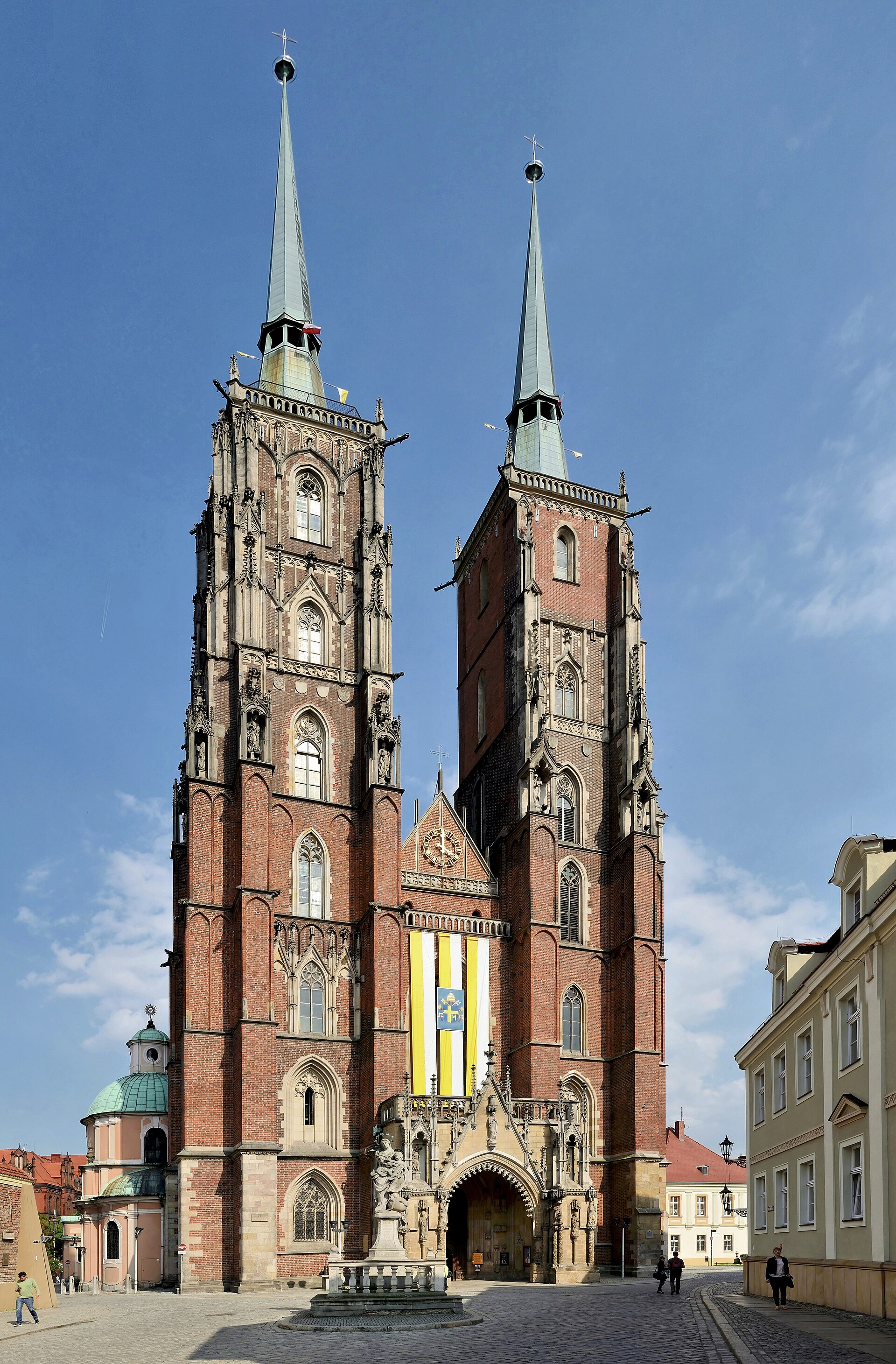
Wrocław’s Cathedral of St. John the Baptist is one of those rare places that feels suspended in time yet remains deeply woven into the life of the city. Standing on Tumski Island, the oldest part of Wrocław, it has witnessed the birth of the settlement that would grow into one of Poland’s most vibrant cities. The cathedral is more than just an architectural landmark—it’s a living chronicle of wars, fires, reconstructions, and shifting eras. Its twin spires rise above the skyline, impossible to ignore even if you hadn’t planned to step inside. They serve as a quiet reminder that Wrocław is not only a modern metropolis but a city with layers of history stretching back over a thousand years.
The first church on this site appeared in the 10th century, when Wrocław was still known as Vratislavia and just beginning to emerge as a key center of Silesia. That early wooden structure was commissioned by Duke Mieszko I, who brought Christianity to these lands. Nothing remains of it today—fires and invasions erased all traces. The stone cathedral we see now began taking shape in the 13th century, though it has been rebuilt and altered countless times since. Gothic, Baroque, and Neo-Gothic elements blend together, each era leaving its mark. The result is a building that feels like a patchwork of different centuries, each telling its own story.
The cathedral’s façade is striking, especially when approached from the square in front. The two towering spires, dark against the lighter stone, dominate the view. In medieval times, such towers weren’t just decorative—they served as lookout points and symbols of the Church’s power. Today, they remain one of Wrocław’s most recognizable landmarks. Climbing one of them is possible, though not for the faint of heart, and the effort is rewarded with sweeping views of Tumski Island, the Oder River, and the old town. On clear days, the horizon stretches far beyond the city, making it easy to understand why this cathedral has guided travelers and locals for centuries.
Inside, the cathedral is unexpectedly understated compared to its imposing exterior. High vaulted ceilings, narrow pointed windows, and sturdy columns create a distinctly Gothic atmosphere, though many of the interior details were added later. The Baroque high altar stands out with its gilded figures and intricate carvings, a stark contrast to the cathedral’s otherwise austere lines. The side chapels hold tombs of bishops and noble citizens, some dating back to the 16th and 18th centuries. These monuments are more than just art—they’re fragments of Wrocław’s history, bearing the names of those who once shaped the city’s fate.
One of the cathedral’s most remarkable features is its 19th-century organ. Visually impressive, it also produces a sound that fills the entire space, resonating off the stone walls. Occasionally, organ concerts are held here, transforming the cathedral into a different kind of experience. Even outside of performances, the faint echoes of practice sessions sometimes drift through the air, making the building feel alive. It’s as if the music itself is part of the cathedral’s breath.
Beyond its role as a tourist attraction, the Cathedral of St. John the Baptist remains an active place of worship. Services, weddings, and baptisms take place here regularly, adding another layer to its significance. Wrocław has always been a city of intersecting cultures and faiths, and the cathedral embodies that diversity. In the Middle Ages, it was the heart of the Catholic diocese, but after the Reformation, when Wrocław became part of Protestant Prussia, it briefly served Lutheran congregations. Today, it has returned to Catholic hands, though its history reflects the complex relationship between religion, politics, and identity in this region.
Tumski Island, where the cathedral stands, is worth exploring in its own right. As Wrocław’s oldest district, it was once home to the ducal court and later the bishop’s residence. Narrow streets, historic houses, and small bridges over the Oder create an atmosphere that feels like stepping back in time. The cathedral isn’t just a building here—it’s the focal point around which life on the island has revolved for centuries. Even now, surrounded by the hum of the modern city, Tumski retains its own rhythm, and the cathedral remains its beating heart.
The cathedral has endured its share of hardships. During World War II, it suffered severe damage from bombing—its roof, walls, and stained glass were destroyed. Restoration began in the 1950s, and today, the scars are nearly invisible. That recovery mirrored Wrocław’s own rebirth after the war, when the city found itself within Poland’s borders and began a new chapter. The Cathedral of St. John the Baptist is more than a monument to the past. It’s a place where history is still unfolding, a living space that evolves alongside the city while retaining its essence. It isn’t a museum—it’s a part of Wrocław’s daily life, as relevant now as it was centuries ago.