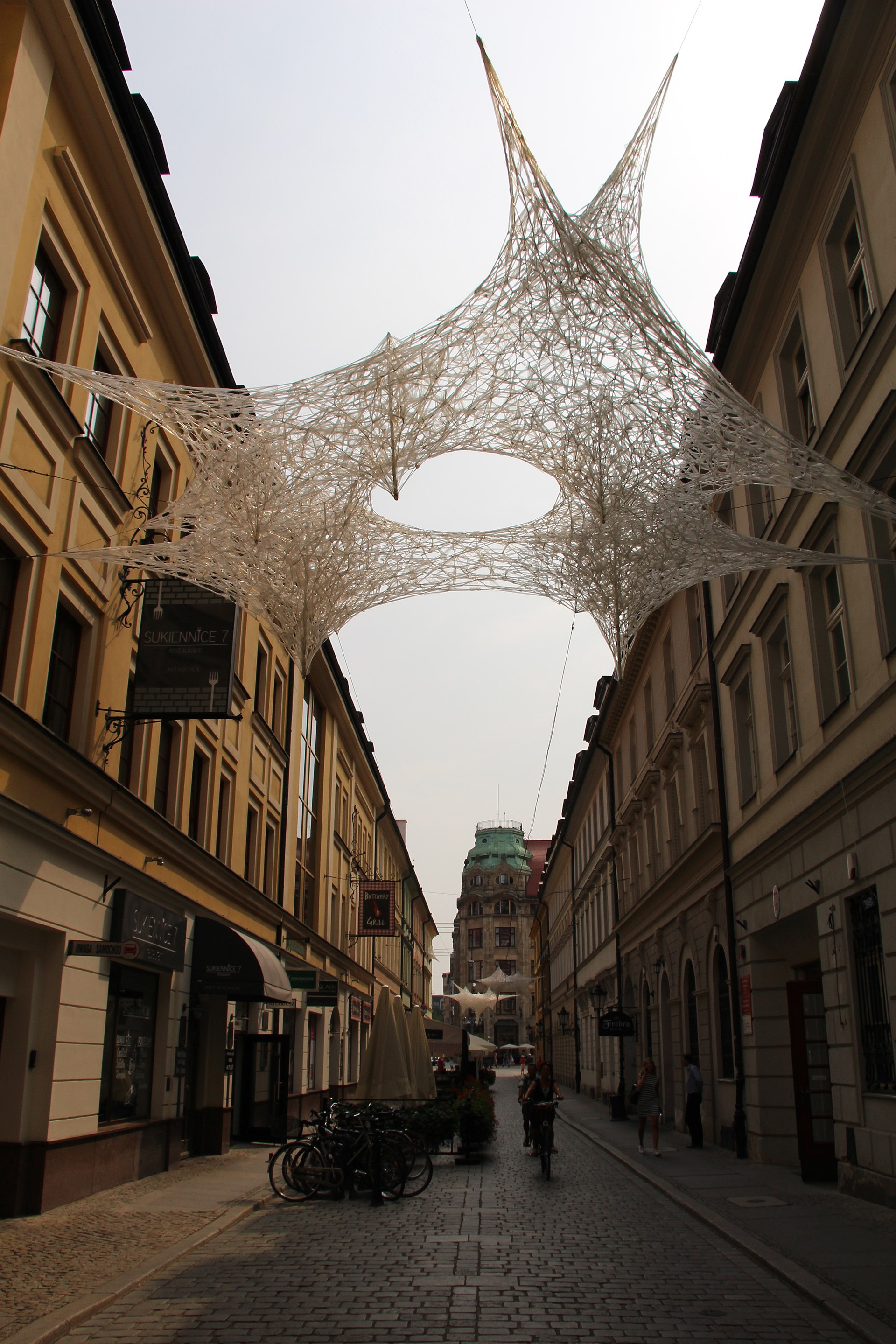
Wrocław’s Market Square is one of those rare places where history feels alive without trying too hard. Laid out in the mid-13th century, it remains one of the largest medieval town squares in Europe, sprawling across nearly four hectares. What makes it unusual is its layout—unlike most squares, which are open expanses, this one has a cluster of buildings at its heart, encircled by a ring of streets and then the perimeter of merchant houses. It’s as if the city planners of the Middle Ages designed it to keep life humming at its core rather than leaving it empty.
At the center stands the Old Town Hall, a masterpiece of Gothic architecture that took over three centuries to complete. Its intricate facade, adorned with decorative brickwork, tells the story of Wrocław’s prosperity through the ages. The astronomical clock, installed in 1580, still marks the hours, while the tower looms above, offering a view that stretches across the rooftops of the old city. Inside, the building houses a museum of municipal art, but the real draw for many is the cellar, home to one of Europe’s oldest continuously operating taverns. Records suggest it’s been pouring beer since the 13th century, a claim few places can match.
The square’s perimeter is lined with merchant houses, their ornate gables a testament to the wealth that once flowed through Wrocław. Most of these buildings are reconstructions—after the devastation of World War II, when three-quarters of the city lay in ruins, architects painstakingly rebuilt them using old photographs and measurements. The result is a square that looks much as it did centuries ago, even if some of the stones are newer than they appear.
On the western side, two narrow houses stand out, connected by an arch. Locals call them Jaś and Małgosia, named after characters from a Polish fairy tale. Their slender forms and playful design make them a favorite spot for photographs, a quiet nod to the city’s love of storytelling. Just steps away, Salt Square offers a different kind of charm with its 24-hour flower market, where blooms are sold at all hours, adding a splash of color to the cobblestones.
The square is entirely pedestrian, and while the cafes lining its edges can be pricey, the real magic happens in the evenings. As the sun sets, the facades are bathed in warm light, and the square fills with people—students, families, tourists, and locals all mingling under the glow. In December, the atmosphere shifts entirely when one of Poland’s largest Christmas markets takes over. Wooden stalls sell mulled wine, handmade crafts, and pierogi, while carols drift through the air, turning the square into a winter wonderland.
For those willing to climb the town hall tower, the reward is a panoramic view of the old city. The ascent is steep, but the sight of the square below, with its patchwork of rooftops and winding streets, makes it worthwhile. The cobblestones underfoot are uneven, a reminder that this place has been walked on for centuries, and the bronze dwarves scattered around the square add a touch of whimsy. The first of these small statues can be found near the town hall, and they’ve become something of a Wrocław trademark, popping up in unexpected corners.
The square is lit throughout the night, making it a safe and inviting place to wander at any hour. Whether it’s the quiet of early morning, the bustle of midday, or the soft glow of evening, there’s always something to notice—the way the light catches the gables, the sound of footsteps on stone, or the occasional street musician playing a folk tune. The town hall museum, with its collection of art and artifacts, is worth a visit, though it’s closed on Mondays.
Wrocław’s Market Square isn’t just a place to pass through; it’s a space that invites you to linger. The uneven cobblestones, the layers of history in the buildings, and the way the square adapts to each season all contribute to its enduring appeal. It’s a reminder that cities are more than just their landmarks—they’re the stories, the people, and the small details that make a place feel like home.