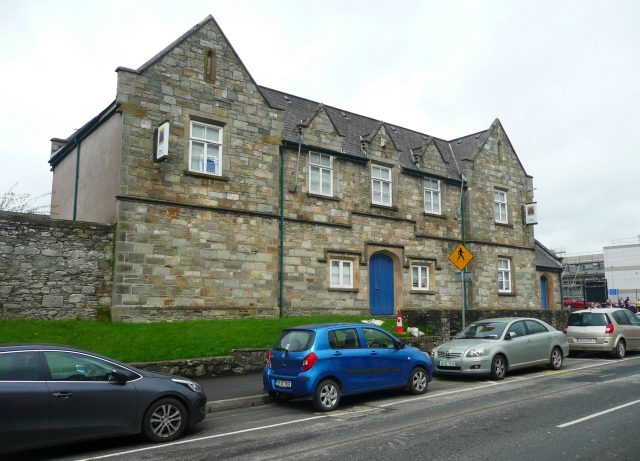
St. Eunan’s Cathedral in Letterkenny is the kind of place that doesn’t demand attention but lingers in the mind long after you’ve left. Perched on a hill overlooking the town, it stands as a quiet witness to the centuries that have passed by its walls. Unlike many of Ireland’s grand cathedrals, it doesn’t overwhelm with soaring Gothic arches or lavish ornamentation. Instead, its strength lies in its simplicity—a quiet dignity.
Built in the mid-19th century, the cathedral emerged when Ireland’s Catholic community began to rebuild after restrictive British laws. For generations, Catholics in the region had lived under laws that barred them from openly practicing their faith, constructing churches, or gathering for prayer. St. Eunan’s wasn’t just a place of worship; it was a symbol of change. As the first major Catholic cathedral in County Donegal after decades of suppression, its construction marked the easing of those laws. For the people of Letterkenny, its opening was a civic milestone.
The cathedral’s architecture reflects the neo-Gothic style of the Victorian era. Tall, pointed windows, sharp arches, and sturdy buttresses give the building a sense of solidity. Inside, the space is uncluttered: white walls, wooden pews, a modest altar. The most striking feature is the eastern window, depicting Christ surrounded by saints.
St. Eunan’s hasn’t always looked as it does today. The original plans were more modest, but over time, the building grew alongside the community. The clock tower, for instance, was added in the early 20th century. These changes mirror Letterkenny’s own transformation from a small provincial town into the administrative and commercial heart of Donegal.
The cathedral’s hilltop location makes it one of the best vantage points in Letterkenny. From here, the town unfolds below—low-slung houses, rolling green hills, and the winding Swilly River. On clear days, the distant peaks of the Derryveagh Mountains shimmer on the horizon. Locals often come here to sit on the bench by the entrance, breathe in the air, and take in the view.
The area around St. Eunan’s is a small neighborhood of narrow streets and old houses. Wander the nearby lanes, and you might stumble upon a traditional pub or a little shop selling fresh bread and hand-knit wool sweaters.
St. Eunan’s rarely makes it into guidebooks. There are no crowds jostling for photos, no guides reciting rehearsed facts. Step inside, and you can sit on a pew, listen to the organ during a service, or stand by the wall, reading the old gravestones in the churchyard. Each one tells a story.
In recent years, the cathedral has become a venue for cultural events: classical concerts, local art exhibitions, charity fairs. It’s an unexpected role, but churches have always been more than places of worship; they’re community hubs. St. Eunan’s continues that tradition.
If you ever find yourself in Letterkenny, climb up the hill to visit. Not to tick it off a list, but to experience the place for what it is. Maybe here, more than anywhere else, you’ll understand that the real Ireland isn’t in its castles or museums. It’s in the quiet corners where time slows down. St. Eunan’s is one of those corners.