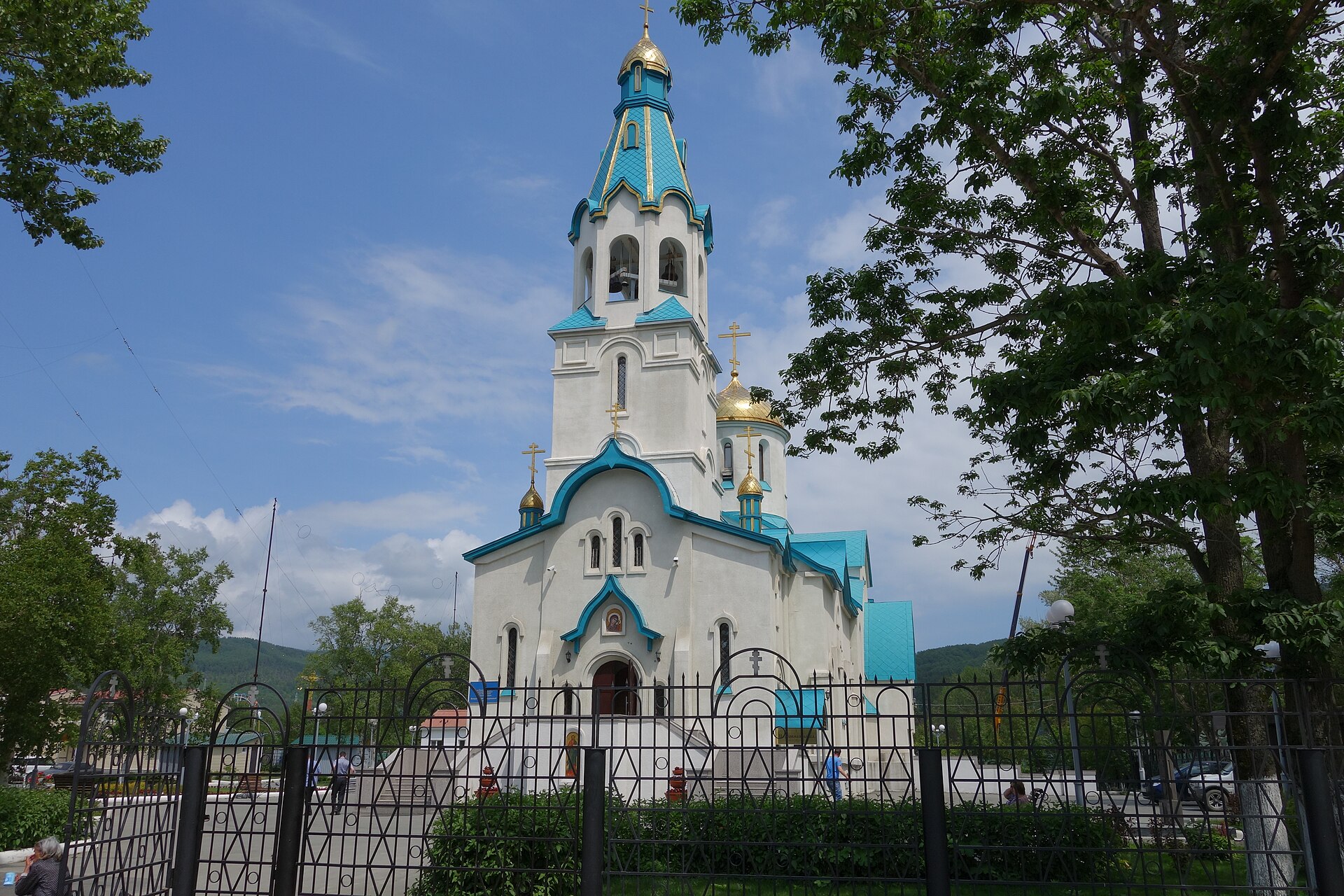
The Cathedral of the Nativity of Christ in Yuzhno-Sakhalinsk is one of those places that doesn’t immediately demand attention but slowly reveals its significance. Perched on a gentle hill in the city center, surrounded by a quiet park, its white walls and golden domes stand out against the skyline, especially on clear days. Unlike many of Russia’s ancient Orthodox cathedrals, this one is relatively new, yet its story is deeply intertwined with Sakhalin’s complex past—a place where faith, culture, and political upheavals have long been intertwined.
Construction began in the late 1990s, a time when religious life on the island was gradually reviving after the collapse of the Soviet Union. Before that, Sakhalin had few churches, especially during the Soviet era, when many were destroyed or repurposed. The Cathedral of the Nativity became one of the first major Orthodox churches built here after decades of neglect. It took several years to complete, and by the early 2000s, it had become not just a spiritual center but also an architectural landmark for the city.
The cathedral’s design blends traditional Russian Orthodox elements with subtle local adaptations. Its white stone walls, tall arched windows, and gilded domes echo the classic churches of central Russia. Yet there are practical touches unique to Sakhalin: the foundation had to be reinforced to withstand the island’s unstable soil, and the climate required special materials for the exterior. Inside, the high vaulted ceilings create a sense of spaciousness, while the iconostasis—crafted in a traditional style but with modern techniques—bridges the past and present.
For Yuzhno-Sakhalinsk, the cathedral is more than a place of worship. It serves as a cultural hub, hosting not only services but also concerts of sacred music, exhibitions, and gatherings with religious scholars. On major holidays like Christmas and Easter, the cathedral fills with people, its atmosphere warm and solemn. Yet it remains open to everyone—believers and curious visitors alike—offering a quiet space to reflect, admire the architecture, or simply take in the view of the golden domes.
The cathedral also carries a deeper historical resonance. During the Soviet era, Sakhalin’s religious past was largely erased from public memory. Today, the Cathedral of the Nativity stands as a reminder that faith persisted even in difficult times. Before the revolution, several churches existed on the island, some built during the period of Japanese rule, but most were lost. This cathedral, in a way, revives that tradition, restoring a sense of spiritual continuity to the city.
The surrounding park is another reason to visit. One of the few green spaces in central Yuzhno-Sakhalinsk, it offers a peaceful retreat from urban bustle. In summer, families stroll along the paths, while in winter, a small decorated tree becomes a gathering spot for locals. The cathedral itself is enclosed by a low fence, with trees—some transplanted from the mainland—adding to the scenery. In warmer months, the park blooms with flowers, and the air is filled with the scent of pine.
Over the years, the area around the cathedral has evolved. New cafes, shops, and pedestrian paths have sprung up, making the neighborhood more inviting. Yet the cathedral itself remains a tranquil oasis in the heart of the city. Unlike the crowded cathedrals of Moscow or St. Petersburg, this one has an intimate, almost provincial feel, as if it belongs to a smaller town rather than a regional capital.
For first-time visitors to Sakhalin, the cathedral can be a surprising discovery. The island is often associated with rugged landscapes, mining towns, and military outposts, but Yuzhno-Sakhalinsk is also a city where history and modernity coexist. The Cathedral of the Nativity is one of those landmarks that helps visitors understand this place better. It may not be as grand as some mainland churches, but its quiet beauty and understated dignity leave a lasting impression.
In winter, when snow blankets Sakhalin, the cathedral becomes even more picturesque. Its white walls blend with the drifts, while the golden domes gleam against the gray sky. The light inside and out feels especially bright during this season. In summer, the cathedral is framed by greenery, its domes reflecting in puddles after frequent rains. No matter the time of year, it remains a peaceful corner of the city—a place to pause, reflect, or simply enjoy the view. For many locals, the cathedral is part of daily life, a place they visit not just for holidays but to feel connected to something greater.