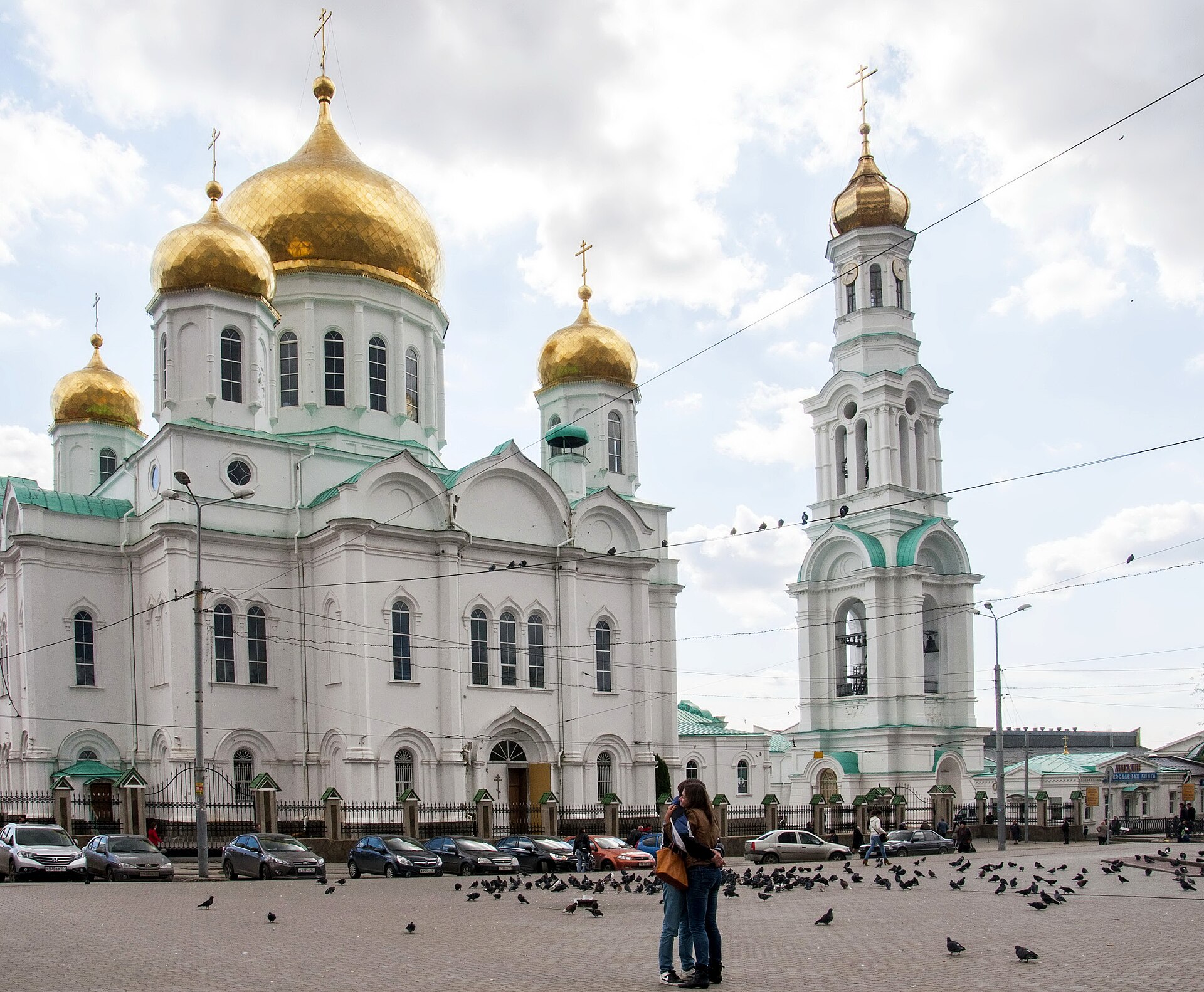
The Cathedral of the Nativity of the Blessed Virgin Mary stands as one of Rostov-on-Don’s most significant landmarks, a place where faith and history intertwine. Built in the mid-19th century, it emerged during a period of renewal for the region, marking the revival of Orthodox traditions after decades of upheaval. The cathedral has witnessed the city’s transformation from a modest trading outpost into a bustling hub of the Russian South, its walls holding stories of resilience and continuity. For locals and visitors alike, it remains a quiet witness to the passage of time, offering a glimpse into the spiritual and cultural heart of the Don region.
Designed by Konstantin Thon, the architect behind some of Russia’s most iconic religious buildings, the cathedral embodies the Russo-Byzantine style that defined 19th-century ecclesiastical architecture. Thon’s vision blended the grandeur of Byzantine domes with the simplicity of traditional Russian church design, creating a structure that feels both imposing and harmonious. The cathedral’s massive central dome, supported by sturdy columns and arched windows, dominates the skyline, while its intricate brickwork and decorative details add a sense of elegance. Inside, the space unfolds with soaring vaults, ornate frescoes, and a richly carved iconostasis, all executed in the timeless traditions of Orthodox art. The interplay of light and shadow across the gilded surfaces gives the interior a serene, almost ethereal quality.
The cathedral’s history is deeply entwined with that of Rostov itself. By the mid-1800s, the city was flourishing as a commercial and industrial center, and the construction of such a prominent church reflected its growing importance. Funded by donations from merchants and ordinary citizens, the cathedral was more than a place of worship—it was a symbol of collective pride and identity. Yet its fate mirrored the turbulent 20th century: during the Soviet era, the building was repurposed, first as a warehouse, then as a planetarium, its religious function erased. It wasn’t until the 1990s that the cathedral was returned to the Orthodox Church, undergoing extensive restoration to reclaim its original splendor.
Today, the Cathedral of the Nativity of the Blessed Virgin Mary is once again a living place of worship, where services, baptisms, and weddings draw crowds of the faithful. On ordinary days, the atmosphere is one of quiet devotion, with visitors lighting candles or pausing in silent reflection. But during major religious holidays, the cathedral comes alive with the sound of choirs, the scent of incense, and the flicker of countless candles, creating an immersive experience that lingers long after one leaves. For many in Rostov, the cathedral is more than a historic monument—it’s a place of solace, a thread connecting past and present.
Beyond the main structure, the cathedral’s bell tower rises gracefully above the surrounding streets, its slender silhouette visible from afar. The tower houses a set of historic bells, their deep tones ringing out across the city during services, a sound that has become part of Rostov’s auditory landscape. Nearby, smaller chapels and memorials dot the grounds, each with its own story tied to the region’s history. The cathedral’s location in the city center makes it easily accessible, surrounded by other landmarks like the bustling Nakichevan Market and the lively Bolshaya Sadovaya pedestrian street, where the rhythms of daily life contrast with the cathedral’s timeless tranquility.
The cathedral also serves as a keeper of regional heritage, preserving relics that speak to the unique history of the Don Cossacks and the Orthodox Church in southern Russia. Among its treasures are ancient icons, ecclesiastical artifacts, and documents that trace the evolution of faith in the area. For those interested in history, the cathedral offers a tangible connection to the past, a chance to see how religious and cultural traditions have shaped the identity of the Don region over centuries.
What makes the cathedral truly special, however, is the atmosphere it cultivates. Stepping inside, one is struck by the sense of continuity—these same walls have sheltered generations of worshippers, their prayers echoing through the ages. Even as the city hums with activity just beyond its doors, the cathedral remains a sanctuary of stillness, a place where the noise of the modern world fades into the background. Whether drawn by faith, curiosity, or a love of architecture, visitors often find themselves lingering, soaking in the quiet beauty of the space.
More than just a building, the Cathedral of the Nativity of the Blessed Virgin Mary is a living testament to Rostov’s endurance. It has weathered wars, revolutions, and decades of neglect, yet it endures as a place of worship and reflection. For many, it is one of the city’s most recognizable symbols, a landmark that invites exploration and contemplation. To walk through its doors is to step into a story that spans centuries, a reminder of the enduring power of faith and tradition in an ever-changing world.