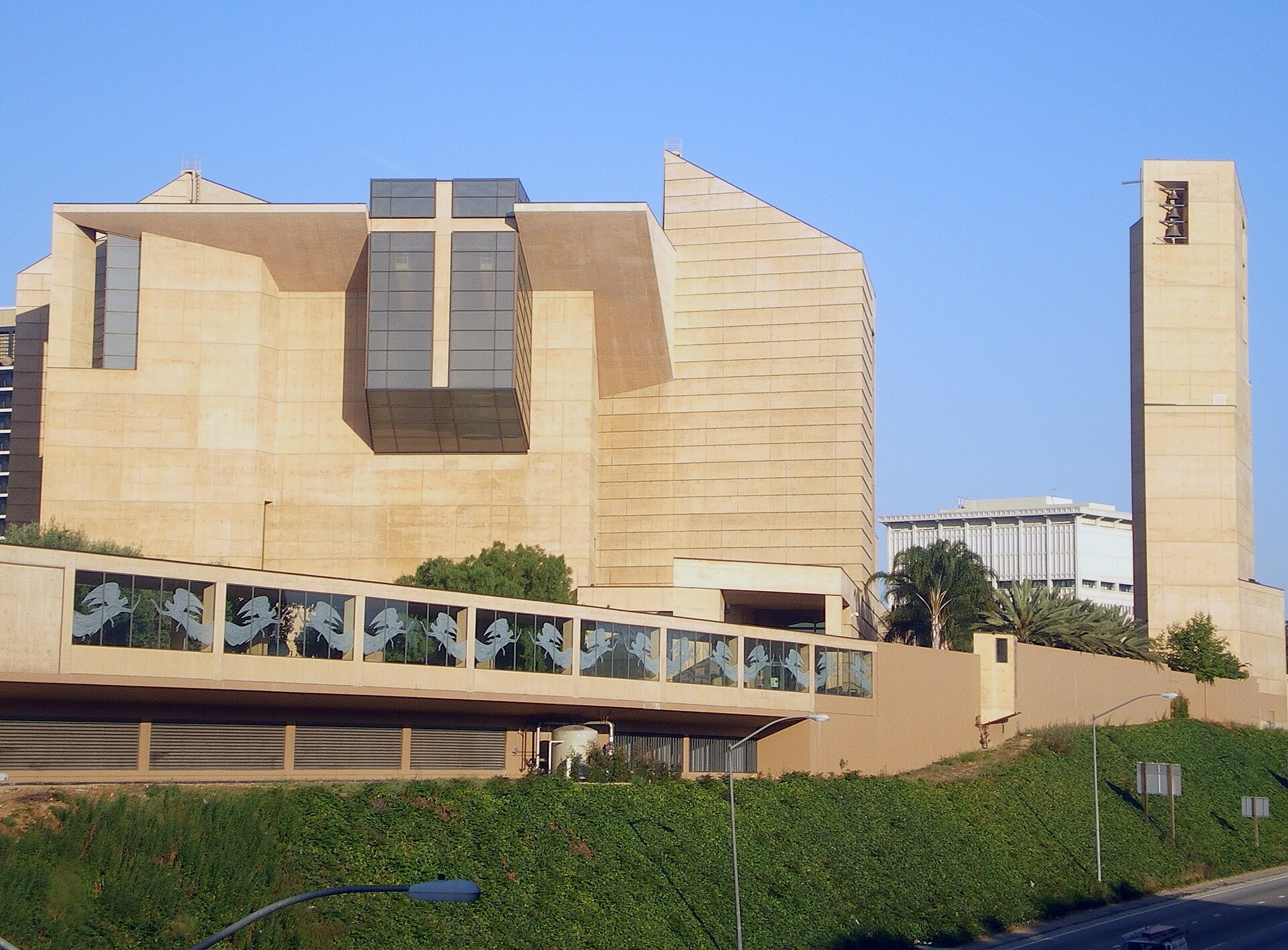
Los Angeles is a city of contrasts, where the relentless energy of urban life collides with moments of unexpected stillness. The Cathedral of Our Lady of the Angels is one of those quiet surprises—a place that doesn’t demand attention but rewards those who pause to notice it. Completed in the early 2000s, it was the first major Catholic cathedral built in the United States in decades, a response to both the growing needs of the archdiocese and a desire to create something that felt both timeless and distinctly modern. Unlike the towering Gothic spires or ornate Baroque facades of Europe’s grand cathedrals, this one steps back, offering space, light, and a kind of understated grace.
Designed by Spanish architect Rafael Moneo, a Pritzker Prize laureate, the cathedral carries his signature approach: architecture that doesn’t overpower but invites. From the outside, it doesn’t look like a traditional church at all. The massive walls of pale stone give it the appearance of a fortress or a monastery, with minimal decoration and only narrow vertical slits to let in the daylight. Inside, though, the space unfolds in a way that feels almost weightless. High ceilings, vast windows flooding the interior with sunlight, and an altar positioned so that every visitor can see it without strain—all of it designed to draw people in rather than intimidate them.
The main nave is where the building’s ingenuity becomes most apparent. Instead of the usual rows of columns, the ceiling seems to float, supported by angled buttresses that create a sense of movement. The walls are adorned not with frescoes but with modern mosaics, depicting scenes from the lives of Christ and the Virgin Mary in a way that feels more like quiet meditation than grand spectacle. The marble floor, with its veined patterns, adds a subtle dynamism, as if water were flowing beneath your feet. It’s a space that encourages reflection without dictating how to feel.
The cathedral’s construction was driven by necessity as much as faith. It replaced the previous cathedral, which had been severely damaged in the 1994 Northridge earthquake. Given California’s seismic activity, the new building had to be engineered to withstand powerful tremors—a challenge that was met without sacrificing beauty. The result is one of the first major structures in Los Angeles where safety and aesthetics were given equal priority. The cathedral stands as a testament to how modern engineering can serve both form and function, even in a city where the ground beneath your feet is never entirely still.
Beyond the cathedral’s walls, a small garden offers a buffer between the noise of downtown and the quiet within. Olive trees, fountains, and benches create a sense of seclusion, though the skyscrapers of Bunker Hill are just a few blocks away. It’s a place where people—whether parishioners, office workers, or passersby—can sit for a moment, away from the city’s relentless pace. The garden feels like an extension of the cathedral itself, a reminder that even in the heart of a metropolis, nature and architecture can coexist without competing.
While the cathedral is first and foremost a place of worship, it also serves as a cultural hub. The acoustics of the vast interior make it ideal for concerts, and the organ, considered one of the finest in California, fills the space with a sound that feels almost otherworldly. Regular events—organ recitals, choral performances, art exhibitions, and lectures—draw visitors who may not come for religious reasons but stay for the experience. The cathedral’s doors are open to everyone, whether they seek solace, inspiration, or simply a moment of quiet in a city that rarely slows down.
Los Angeles is a city of many languages, cultures, and traditions, and the cathedral reflects that diversity. On any given Sunday, you might hear Mass celebrated in Spanish, Tagalog, or Vietnamese, a nod to the city’s multicultural Catholic community. For many, the cathedral is more than just a place to pray—it’s a gathering point, a connection to heritage. During major holidays like Christmas or Easter, the cathedral comes alive with worshippers from all backgrounds, a microcosm of the city itself.
In a place where landmarks often vie for attention with neon signs and billboards, the Cathedral of Our Lady of the Angels doesn’t shout. It doesn’t need to. It sits quietly in the heart of downtown, a place where the past and present coexist without fanfare. There are no crowds of tourists snapping photos, no lines of people waiting to get in. Instead, there’s a sense of discovery, the kind that comes when you stumble upon something unassuming and realize it has more to offer than you expected. In a city that moves at breakneck speed, the cathedral is a reminder that stillness can be found—if you know where to look.