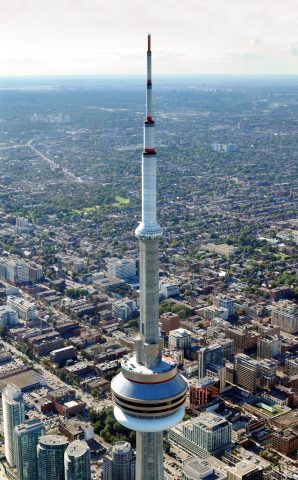
Standing tall over Toronto’s skyline, the CN Tower isn’t just a landmark—it’s a piece of the city’s identity. Built in the early 1970s, when Toronto was rapidly expanding into a major metropolis, the tower was originally conceived as a telecommunications hub. But its purpose quickly evolved beyond practicality. What started as an engineering solution became a symbol, a beacon that defined the city’s ambition and gave it a recognizable face against the vast Canadian sky.
At 553 meters, the CN Tower held the title of the world’s tallest freestanding structure for over three decades. Even now, it remains one of the tallest in the Western Hemisphere, though newer skyscrapers have since surpassed it. The design is a study in contrasts: a massive concrete and steel shaft that narrows as it rises, giving the illusion of weightlessness. The foundation alone is a marvel, sunk deep into the earth to anchor the tower against the winds that sweep across Lake Ontario. The main observation deck sits at 346 meters, but the real magic happens higher up, at the SkyPod, 447 meters above the ground.
Reaching the SkyPod is an experience in itself. The elevators ascend at nearly six meters per second, whisking visitors upward in less than a minute. Through the glass walls, the city shrinks below—buildings become matchboxes, streets turn into threads, and the lake stretches out like a sheet of steel. When the doors open, the view hits you all at once: Toronto sprawls in every direction, a patchwork of neighborhoods, parks, and waterways. On clear days, the horizon seems endless, with the faint outline of the U.S. shore visible in the distance. In winter, the contrast between the snow-dusted rooftops and the dark expanse of the lake creates a quiet, almost surreal beauty.
The tower’s architecture blends futurism with function. Its concrete core and steel reinforcements were built to withstand the elements, while the sleek, tapering design ensures it looks striking from any angle—whether reflected in the water along the harborfront or looming over the narrow streets of the financial district. Inside, the space is just as thoughtfully designed. Glass floors let you peer straight down to the streets below, and the revolving restaurant offers a slow, 360-degree panorama of the city lights after dark. It’s a place where engineering meets artistry, where every detail serves a purpose without sacrificing aesthetics.
Beyond its role as a tourist attraction, the CN Tower has woven itself into the fabric of Toronto’s culture. It’s where the city gathers for New Year’s fireworks, where charity stair-climbing events push hundreds of participants to the top, and where generations of locals have brought their families to mark special occasions. The tower’s image appears on everything from postcards to movie screens, a shorthand for the city itself. For many Torontonians, it’s a childhood memory—a place of wonder, where the world below suddenly made sense from a dizzying height.
The SkyPod, perched even higher than the main observation deck, offers a different kind of experience. Fewer visitors make the trip up here, so the atmosphere is quieter, more intimate. On a clear day, the air feels thinner, the horizon farther away. You can stand at the windows for ages, watching clouds drift over the lake or shadows creep across the streets. At night, the city transforms into a glittering grid, each light a tiny story in itself. It’s a place to pause, to take in the scale of the city and the vastness of the landscape beyond.
The tower doesn’t just stand still—it changes with the city. Its lights shift to mark holidays, victories, and celebrations: red for sports triumphs, rainbow hues during Pride, or a soft glow to honor a moment of silence. Sometimes it feels almost alive, pulsing in time with the rhythm of Toronto. For visitors, it’s a chance to see the city from a new perspective. For locals, it’s a familiar presence, a constant reminder of home, even when viewed from hundreds of meters in the air.
A visit to the CN Tower isn’t just about the view—it’s about understanding how a city works. From this height, the layers of Toronto become visible: the old neighborhoods nestled beside modern skyscrapers, the parks breaking up the concrete, the lake pressing against the urban edge. The tower invites you to think about how cities grow, how they shape the land and are shaped by it in return. It may no longer be the tallest structure in the world, but for Toronto, it remains the place where the city reveals itself in full.