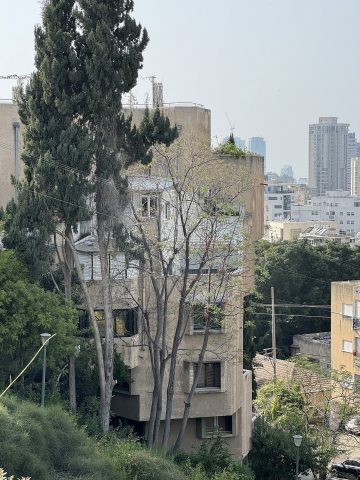
Fureidis is a quiet Arab town along Israel’s Mediterranean coast, known mostly for its banana groves and unhurried pace of life. The streets are lined with low, flat-roofed houses, and the atmosphere feels far removed from the bustle of nearby cities. Yet tucked among these familiar surroundings is a place that stands out—a small synagogue, one of the few remaining Jewish landmarks in a predominantly Arab community. Its presence tells a story of coexistence, displacement, and the slow passage of time in a region shaped by shifting borders and histories.
The synagogue was built in the early 1900s, when Fureidis was still part of the Ottoman Empire. At the time, a modest Jewish community lived here, mostly Sephardic families who had migrated from North Africa and other parts of the Middle East. They worked as farmers, traders, and artisans, living alongside their Arab neighbors in what appears to have been a peaceful coexistence. The synagogue was funded by local residents, serving not just as a house of prayer but as a gathering place for the community. The building itself is unassuming—a single-story structure made of local limestone, with arched windows and a simple interior that reflects the modest means of those who built it.
Architecturally, the synagogue follows the style common to religious buildings of that era in Palestine. The facade features traditional elements like carved stone lintels and narrow, semicircular windows, while the flat roof is topped with a small dome over the central hall. Inside, the walls were once adorned with geometric patterns and verses from the Torah, though time has faded much of the decoration. Some traces remain, like the intricately carved wooden cabinet that still holds the Torah scrolls, a quiet reminder of the building’s original purpose.
The synagogue’s fate mirrors the broader upheavals of the 20th century. After the establishment of Israel in 1948, most of Fureidis’s Jewish residents left, as did many others in Arab-majority towns across the region. The synagogue fell into disuse, though it was never destroyed. Local Arab residents, some of whom had known their Jewish neighbors for years, took care to preserve the building, occasionally making small repairs to prevent its collapse. Yet it was no longer a place of worship—just a relic of a time when different communities shared the same streets.
Today, the synagogue feels like a place suspended in time. It’s open to visitors, though it no longer functions as an active house of prayer. Inside, a few religious artifacts remain—old prayer books, yellowed photographs of people who once gathered here, and the faint outlines of faded murals. The atmosphere is one of quiet decay, but there’s also a certain beauty in its stillness. It’s as if the building has absorbed the memories of those who passed through its doors, holding onto them long after they’ve gone.
Fureidis itself isn’t a tourist destination, and the synagogue rarely appears in guidebooks. Those who visit are usually drawn by an interest in local history or a desire to see places untouched by mass tourism. There are no crowds, no souvenir stalls, no guided tours—just the sound of footsteps on stone and the sense that this small building carries more stories than any plaque could tell. It’s the kind of place where history feels tangible, not just something read in books.
The synagogue isn’t unique in Israel—similar sites exist in Haifa, Jaffa, Acre, and other towns where Jewish communities once thrived alongside Arab neighbors. But in Fureidis, the past feels particularly close, perhaps because the town has remained off the beaten path. There’s no rush here, no sense of performance for visitors. Even locals walk by without a second glance, as if the building is just another part of the landscape, something so familiar it barely registers.
If you ever find yourself in this part of Israel, it’s worth stopping by the synagogue, if only for a few minutes. You won’t find grand architecture or dramatic exhibits, but you might feel something rarer—the weight of history in a place where time seems to move more slowly. It’s a reminder that the lines between communities were once less rigid than they are today, and that every stone here has a story to tell.