The Gardens of El Pedregal are one of those rare places where nature and architecture don’t just coexist but seem to have finally understood each other. Tucked away in Tacubaya, one of Mexico City’s oldest neighborhoods, these gardens emerged in the mid-20th century from an idea by architect Luis Barragán. Where others saw only a barren lava field left by an ancient volcanic eruption, Barragán saw potential—a raw canvas waiting to be shaped into something extraordinary. Known for his mastery of space and light, he transformed the uneven, rocky terrain into a series of terraces, pools, and green nooks where every element feels like a natural extension of the landscape rather than an imposition upon it.
El Pedregal isn’t a garden in the traditional sense. There are no manicured flowerbeds or symmetrical pathways. Instead, the space unfolds as a seemingly chaotic arrangement of stones, water, and plants, all governed by an underlying logic that reveals itself slowly. Barragán worked with the land’s existing materials—dark basalt boulders from the volcanic eruption became walls and boundaries, while drought-resistant tropical plants lend the place a wild yet cultivated feel. Water, a recurring element in his designs, flows through narrow channels and collects in small pools, mirroring the sky and the surrounding greenery. The effect is meditative, as if the landscape itself is breathing.
Walking through El Pedregal feels like stepping into a different rhythm of time. Narrow paths wind between rocks, climbing gentle slopes and descending toward hidden pools. At times, it’s easy to feel lost in the maze of stone and foliage, but then a new vista opens—a glimpse of the city’s distant skyline or one of the many secluded courtyards where a bench invites you to sit and watch the play of light and shadow. Barragán used the natural contours of the land to create pockets of solitude, a quiet contrast to the bustle of the metropolis just beyond the gardens’ edges.
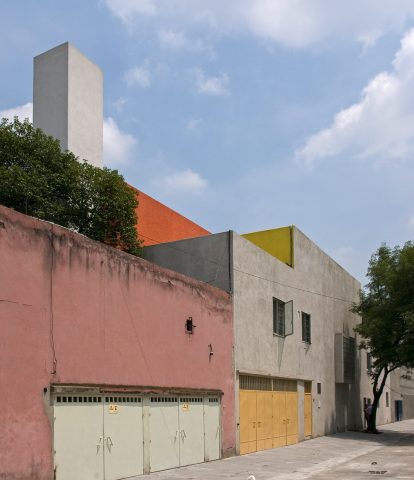
Architecture here isn’t separate from the landscape; it’s woven into it. Low walls of dark stone, reminiscent of ancient ruins, divide the space without closing it off. They guide movement and direct the gaze, encouraging exploration. In some corners, small pavilions or alcoves appear, where Barragán played with color and form. Pops of red, yellow, or blue emerge unexpectedly against the neutral tones of stone and greenery, adding a sense of dynamism to the otherwise serene setting.
El Pedregal wasn’t just a personal project for Barragán; it became a symbol of a new approach to urban development. In the mid-20th century, Mexico City was expanding rapidly, swallowing up surrounding villages, and architects were searching for ways to maintain a connection between the city and nature. The gardens demonstrated how natural landscapes could be integrated into urban environments without erasing their essence. Today, El Pedregal remains a living example of this philosophy, drawing architects and landscape designers from around the world who come to study how Barragán achieved such harmony between built and natural forms.
Despite its fame, the gardens retain an air of quiet intimacy. Unlike the crowded plazas and museums of downtown Mexico City, El Pedregal offers space to breathe. Even on weekends, it’s possible to find a secluded spot to sit and reflect. Perhaps this is because Barragán’s goal wasn’t just to create a garden but to preserve the spirit of the place. The lava field that became El Pedregal was once part of a vast volcanic plateau, and the architect ensured that his design didn’t erase its history but instead made it visible. The rough texture of the stone, the way the light catches the water—it all feels like a conversation with the land’s past.
El Pedregal is now part of Mexico City’s cultural heritage, but it hasn’t become a static museum piece. People still live and move through it—joggers pass by in the mornings, families spread out picnic blankets on the grass, and children play among the rocks. This is the garden’s greatest strength: it hasn’t frozen in time but continues to evolve, adapting to the rhythms of daily life. Barragán wanted his work to be lived in, not just admired, and in El Pedregal, that vision endures.
If you find yourself in Mexico City, it’s worth stepping away from the usual tourist paths to visit Tacubaya and wander through El Pedregal. The gardens won’t tell you grand stories of battles or famous figures, but they might teach you something quieter—how to notice beauty in simplicity, how to find stillness amid the chaos of a city. Here, the stones and the water, the light and the shadows, all come together in a way that feels both deliberate and effortless. It’s a place where the noise of the world fades, if only for a little while.