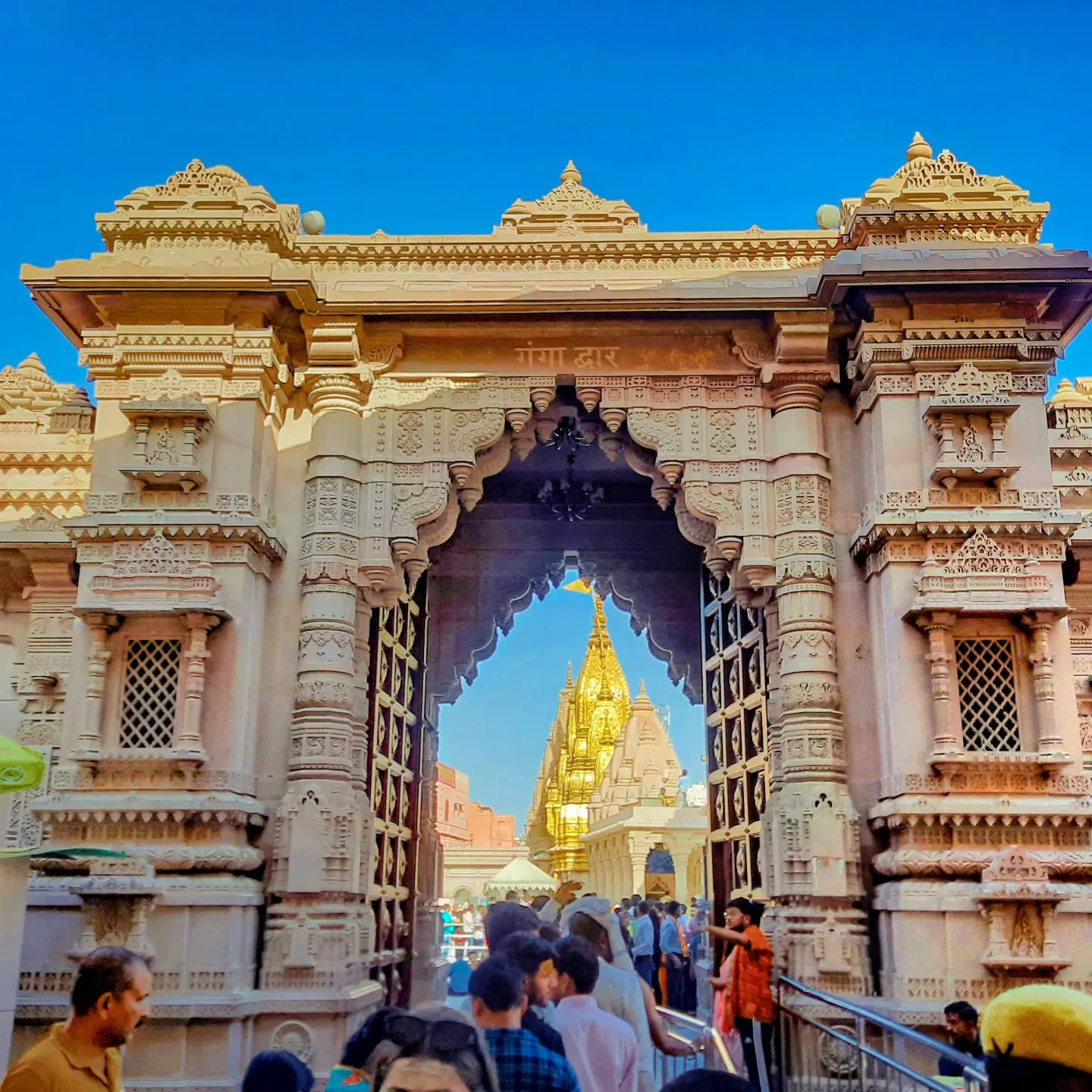
Varanasi moves to a rhythm all its own, where the past isn’t just remembered—it’s lived. The city’s narrow lanes hum with centuries of devotion, commerce, and quiet daily routines, woven into the fabric of its streets. Among them, Vishwanath Gali stands apart: a slender lane leading to the Kashi Vishwanath Temple. Here, pilgrims and locals gather to buy marigolds, brass lamps, or spices before worship, or simply to move through the pulse of a city that has seen empires rise and fall.
The entrance to Vishwanath Gali is easy to miss. One moment you’re navigating the wider streets of old Varanasi, and the next you’re inside a corridor of leaning buildings, their facades layered with peeling paint. The transition is abrupt. Almost immediately, the lane unfolds into color and sound. Strings of orange and yellow flowers drape across stalls, their petals damp with morning dew. Brass vessels gleam under the dim light filtering through overhead wires, while mounds of turmeric, cardamom, and cloves spill across wooden tables. The air carries the scent of incense, frying pakoras, and freshly brewed chai.
The buildings, most from the 18th and 19th centuries, show the city’s history under Maratha patronage. Their facades have carvings—geometric patterns, floral motifs, and faces of deities. Balconies jut over the street, their wooden railings worn smooth by time, while lattice windows cast shifting patterns on the cobblestones. Many structures hide inner courtyards behind heavy wooden doors, where families have lived for generations.
Dawn is the busiest hour. Pilgrims stream toward the temple, their arms laden with coconuts, sweets, and garlands. Vendors arrange their wares: the clatter of metal, the murmur of prayers, the shouts of shopkeepers. By midday, the pace slows. Customers linger over chai at tiny stalls or watch a street cook flip pakoras in hot oil. The heat drives many indoors, but the lane never empties. Even as evening falls, lanterns keep the shadows at bay, their light dancing across the walls.
Here, the sacred and the mundane intertwine. A priest might bless a pilgrim with vermilion, or a woman in a vivid sari balance a basket of roses on her head. For locals, the lane is an everyday path. For visitors, it’s a glimpse into the rituals of Varanasi—less a spectacle than a lived experience.
You might stop to watch a craftsman etch designs into a brass lamp or listen to bargaining over rudraksha beads. Children dart between stalls, their laughter mixing with the clink of bangles and the bleat of a goat. The longer you stay, the more the lane reveals itself—not as a place to observe, but as a world to absorb.
Vishwanath Gali isn’t idealized. It’s crowded, noisy, and at times overwhelming. The air can be thick with dust and the scent of drains, and the uneven cobblestones make every step a negotiation. But this is its authenticity. The lane doesn’t exist for tourists; it exists because it has to, because it always has.
If you ever find yourself in Varanasi, don’t just walk through Vishwanath Gali—let it walk through you. Whether you’re heading to the temple or wandering, the lane offers a chance to experience the city as it is: a place that breathes, endures, and refuses to be anything other than itself. You might leave with a trinket or a memory, but more likely, you’ll leave with the quiet understanding that some places aren’t meant to be understood—they’re meant to be felt.