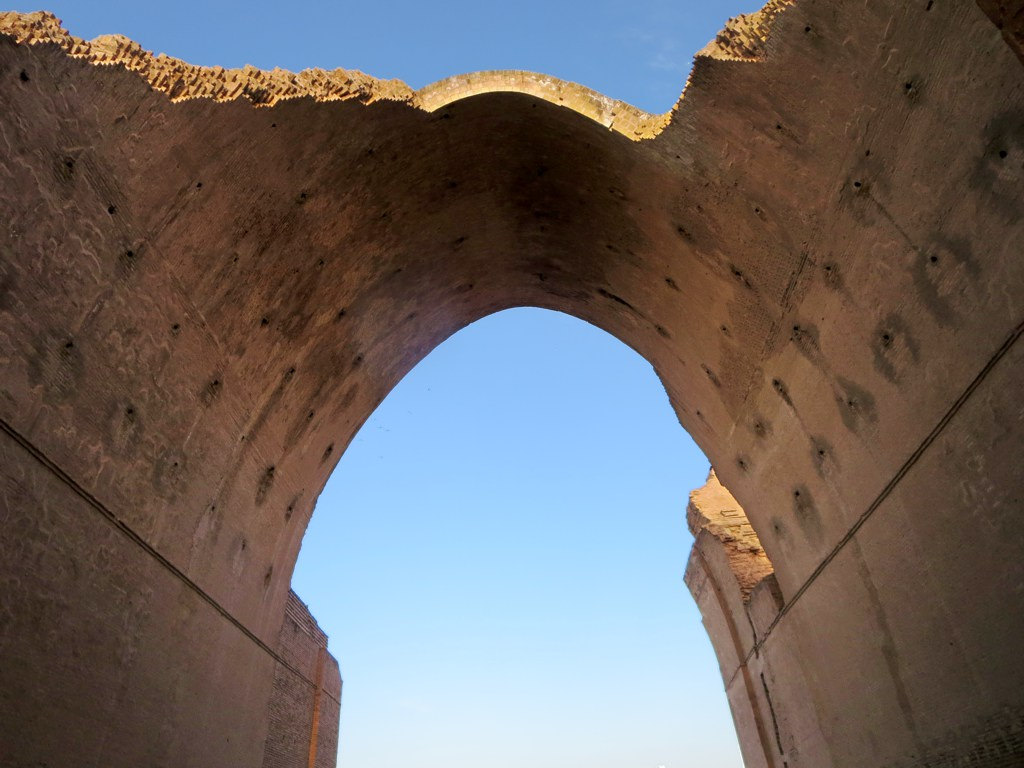
The ruins of Khosrow I Anushirvan’s palace near Ctesiphon stand as one of the most enduring symbols of Sasanian Persia’s grandeur. This was not just a royal residence but the heart of an empire that stretched from the Euphrates to the Indus, a place where kings received ambassadors, held court, and shaped the fate of the ancient world. Today, little remains above ground beyond the skeletal outline of what was once the largest single-span vault in the pre-modern world, the Taq Kasra. Yet even in its decay, the site carries the weight of history—whispers of power, ambition, and the slow unraveling of a civilization that once rivaled Rome.
Ctesiphon itself was a city of contradictions. Founded as a military outpost by the Parthians in the 2nd century BCE, it grew into a sprawling metropolis under the Sasanians, who made it their winter capital. The choice of location was strategic: nestled on the eastern bank of the Tigris, it sat at the crossroads of trade routes linking the Mediterranean to Central Asia. The river was both a lifeline and a barrier, its waters reflecting the shifting fortunes of empires. By the time Khosrow I ascended the throne in the 6th century CE, Ctesiphon was a city of palaces, gardens, and bustling markets, its skyline dominated by the towering arch of Taq Kasra. The palace complex was more than an architectural marvel; it was a statement of Sasanian might, designed to awe visitors with its scale and opulence.
The most striking feature of the ruins is the Taq Kasra itself, a colossal brick arch that once formed the entrance to the palace’s grand audience hall. At nearly 37 meters high and 26 meters wide, it was an engineering feat that would not be surpassed for centuries. The arch’s construction relied on a technique perfected by Sasanian builders: layers of baked bricks laid in mortar, with the curvature carefully calculated to distribute weight. The interior was once adorned with stucco reliefs, intricate geometric patterns, and scenes of royal hunts and banquets, though most of these decorations have long since vanished. What remains is the raw, almost brutal simplicity of the structure, its sheer size a reminder of the ambition that drove its creation.
Khosrow I, known as Anushirvan or "the Immortal Soul," was one of the most celebrated rulers of the Sasanian dynasty. His reign marked a golden age for Persia, a period of military expansion, administrative reform, and cultural flourishing. The palace at Ctesiphon was both a personal residence and a political stage, where he received envoys from Byzantium, India, and China. Diplomacy in this era was a delicate dance, and the palace’s grandeur was a tool of statecraft. The audience hall, with its soaring vault, was designed to intimidate as much as impress. Visitors would have entered through a series of courtyards, each more lavish than the last, before reaching the throne room, where the king sat in splendor, flanked by nobles and guards.
The decline of Ctesiphon and its palace was as dramatic as its rise. The city’s fortunes waned with the Sasanian Empire, which crumbled under the onslaught of the Arab conquests in the 7th century. The palace was looted, its treasures carried off, and its walls left to the mercy of time and the elements. The Tigris, once a source of life, became a force of destruction, its floods eroding the foundations of the city. By the medieval period, Ctesiphon was little more than a ruin, its glory fading into legend. Yet the Taq Kasra endured, a silent witness to the passage of empires. Even in its ruined state, it became a symbol—first for the Persians, who saw it as a relic of their lost greatness, and later for travelers and scholars, who marveled at its scale.
Visiting the site today is a study in contrasts. The arch stands alone in a landscape that has otherwise reverted to dust and scrub, a solitary monument to a vanished world. The surrounding area is quiet, the silence broken only by the occasional call of a bird or the distant hum of a car on the road to Baghdad. There are no crowds, no souvenir stalls, no grand interpretive centers—just the ruins and the weight of history. The Iraqi government has made efforts to stabilize the structure, but the challenges are immense. The bricks, though durable, are not immune to the ravages of time, and the site remains vulnerable to erosion, vandalism, and the slow creep of neglect.
For those who make the journey, the ruins offer more than just a glimpse into the past. They are a reminder of the fragility of empires and the impermanence of human achievement. The palace of Khosrow I was built to last forever, yet it has survived only in fragments. The audience hall, where kings once held court, is now open to the sky, its walls crumbling, its purpose forgotten. And yet, there is something hauntingly beautiful in its decay. The Taq Kasra, with its soaring arch, still commands attention, a testament to the skill of its builders and the vision of its patron.
The site is also a window into the broader history of Mesopotamia, a region that has been the cradle of civilization and the battleground of empires. Ctesiphon’s rise and fall mirror those of Babylon, Nineveh, and Ur—cities that flourished and faded, leaving behind only ruins to mark their passing. The palace of Khosrow I is part of this legacy, a link in a chain that stretches back thousands of years. It speaks to the enduring human desire to build, to create, and to leave a mark on the world. Even in its ruined state, it does just that. For those who stand beneath the arch of Taq Kasra, the past feels very close, as if the echoes of ancient voices might still be heard on the wind.