- Home
- Mesopotamia
- Ctesiphon

Ctesiphon
Mesopotamia · 8 places
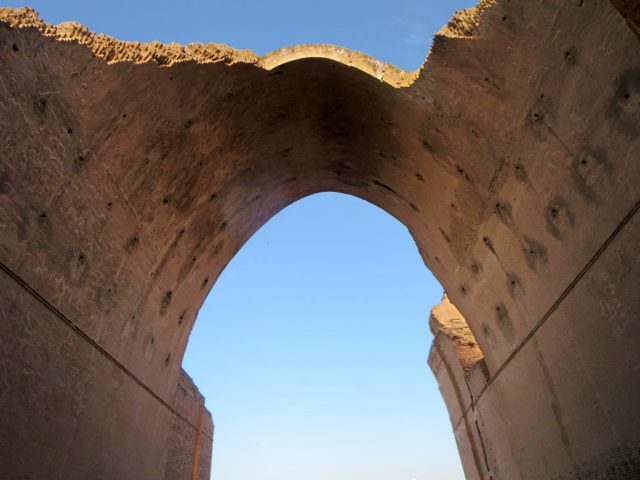
Photo: Unknown authorUnknown author, Public domain
Ctesiphon lingers in history like a half-remembered dream, a city that once commanded empires but now exists only in fragments. Nestled on the banks of the Tigris, just a short distance from modern Baghdad, it was the beating heart of the Parthian and later Sasanian worlds—a place where trade routes from the East and West converged, where kings held court, and where the fate of nations was decided. Today, little remains beyond scattered ruins, yet even those speak of an era when Ctesiphon stood as one of the great capitals of antiquity.
The most striking remnant of that past is the Taq Kasra, or Arch of Khosrow, a towering structure that still defies time. Built in the sixth century under the Sasanian ruler Khosrow I, it was once part of a vast palace complex, its grand iwan—a vaulted hall of staggering proportions—serving as the centerpiece of royal ceremonies. Though now weathered and incomplete, the arch rises nearly forty meters, its brickwork bearing the scars of centuries. In its prime, the palace was a marvel of opulence, adorned with intricate mosaics, gilded textiles, and frescoes that reflected the wealth and ambition of its rulers. Even in decay, it commands attention, a silent testament to the grandeur that once defined this city.
Ctesiphon’s rise was as much about geography as it was about power. Its location along the Tigris made it a prize for conquerors, and by the first century BCE, the Parthians had claimed it as their capital. Under the Sasanians, it flourished, becoming a hub of diplomacy, commerce, and culture. Envoys from Rome and Byzantium arrived to negotiate, while merchants from India, China, and the Mediterranean traded in silks, spices, and precious metals. The city’s libraries held ancient manuscripts, and its workshops produced glassware, metalwork, and ceramics that were coveted across the known world. For centuries, Ctesiphon was not just a political center but a crossroads of civilizations.
Yet empires, no matter how mighty, are not eternal. In the seventh century, Arab forces seized the city, and its significance waned as power shifted to the newly founded Baghdad. Ctesiphon’s palaces crumbled, its people dispersed, and the once-great capital faded into obscurity. Today, the landscape is dominated by empty hills, with only the Taq Kasra standing as a solitary reminder of what was lost. The ruins, scattered with broken bricks and stones, tell a story of decline, but they also invite reflection on the fleeting nature of power.
Visiting Ctesiphon is an exercise in imagination. The wind sweeps across the site, carrying whispers of the past—of royal processions, bustling markets, and the murmur of scholars in its libraries. Locals share tales of hidden treasures buried beneath the ruins and of the spirits of ancient kings who still wander the night. Whether those stories hold any truth hardly matters; they add a layer of mystery to the place. For anyone drawn to the history of the Middle East, Ctesiphon is a must-see. It doesn’t offer the polished grandeur of a restored monument, but that’s part of its allure. Here, history feels raw, tangible, and alive in a way that few places can match.
See & Do
8 places
Places on the map
Marker colour follows the categoryClimate and weather
Detailed weather: Ctesiphon- Average temperature
- 24 °C
- Precipitation per year
- 189 mm
Average air temperature
°C
11
13
17
23
29
35
37
36
33
26
18
12
Jan
Feb
Mar
Apr
May
Jun
Jul
Aug
Sep
Oct
Nov
Dec