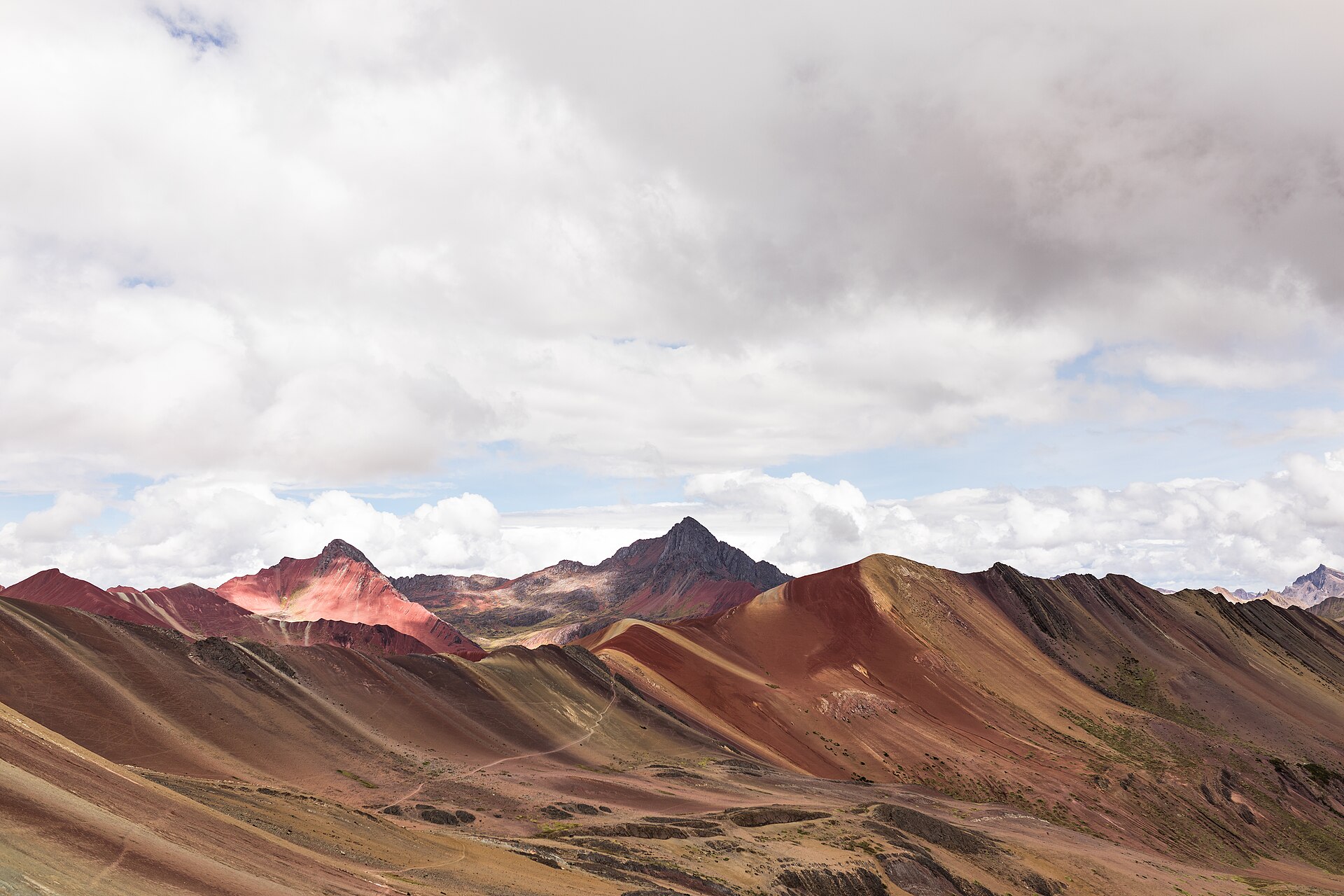
Vinicunca, known to many as Rainbow Mountain, feels like a place that shouldn’t exist—at least not in the way we usually imagine the world. Rising over five thousand meters above sea level in the Peruvian Andes, its slopes are striped with colors that seem almost painted: deep rust-reds, ochres, soft pinks, purples, and even streaks of turquoise. These layers weren’t shaped by human hands but by millions of years of geological forces—minerals compressed under shifting earth, sediments worn away by wind and water, until the mountain became a living palette. For most of history, it lay hidden beneath snow and ice, only revealing itself in recent decades as glaciers retreated, exposing its vivid hues to the sky.
Reaching Vinicunca is part of the experience, and it’s not an easy one. The journey begins in Cusco, the former heart of the Inca Empire, where the road winds upward through valleys and passes, climbing higher with every turn. After a few hours, the pavement ends, and the real ascent begins—either on foot or on horseback, following a narrow trail that cuts across the high-altitude plain. The air grows thinner with each step, and even those accustomed to altitude may find themselves pausing to catch their breath. But the effort fades as the mountain comes into view, its colors sharpening with every meter gained, while the surrounding peaks stretch endlessly in every direction.
For the Quechua people who live in these mountains, Vinicunca is more than a natural wonder—it’s a sacred place. They call it Apu Vinicunca, where *apu* refers to the mountain’s spirit, a guardian and presence that has watched over the land for generations. Long before tourists arrived, the Inca and their ancestors revered the peaks as living beings, offering them gifts and seeking their protection. Today, herders still bring their flocks of sheep and llamas to graze on the slopes, and in certain seasons, they perform rituals to honor the earth and its spirits. Visitors often spot small piles of stones—*apuchatas*—left by travelers as a sign of respect, a quiet acknowledgment of the mountain’s power.
The landscape around Vinicunca is just as striking as the mountain itself. This is a place of extremes: vast, windswept valleys, jagged ridges, and glaciers clinging to distant summits. The high-altitude environment is harsh, yet life persists in unexpected forms. Vicuñas, wild relatives of the llama, roam the plains, their fine wool prized for its warmth. Condors glide on thermal currents above the canyons, while Andean geese dart between slopes. The plants here are just as resilient—hardy grasses, cushion plants, and rare flowers that bloom briefly in the short growing season. The land feels untouched, though the growing number of visitors is a reminder of how fragile this balance can be.
Unlike Machu Picchu, where crowds gather at dawn to claim the best views, Vinicunca offers a different kind of solitude. Even in peak season, there are moments when the only sounds are the wind and the distant call of a bird. The best time to visit is early morning, when the first light hits the slopes, turning the colors into something almost unreal—gold, rose, and deep violet. By afternoon, clouds often roll in, softening the edges of the mountain, and by evening, the entire scene fades into shadow. Some travelers arrive before sunrise, wrapped in layers against the cold, waiting for that first burst of light to reveal the mountain in all its glory.
The journey here is also a chance to glimpse a way of life that has changed little over centuries. The villages along the route are small, their adobe houses clustered together against the wind. Families tend to their fields of potatoes and quinoa, while women weave brightly colored textiles on backstrap looms, the same techniques passed down through generations. In the mornings, the scent of woodsmoke mixes with the sharp, clean air, and the sound of children laughing carries across the valley. Many guides are locals who grew up in these mountains, and they’ll point out old Inca trails, explain how to read the weather from the clouds, or share stories of the spirits that dwell in the rocks and rivers.
But Vinicunca isn’t just a postcard-perfect destination—it demands respect. The altitude is no joke, and even the fittest travelers can feel its effects: dizziness, shortness of breath, or a headache that lingers like a dull ache. The key is to take it slow, to let the body adjust, and to drink plenty of water. The weather, too, is unpredictable. A clear morning can turn into a snowstorm within hours, and the wind at the summit can bite through even the warmest layers. That’s why most people hire a guide—not just for the route, but for the reassurance of someone who knows the land and can help if conditions worsen.
What makes Vinicunca special isn’t just its colors, but the way it makes you feel. There are no luxury hotels here, no souvenir shops or tour buses. Instead, there’s the vastness of the Andes, the silence of the high plains, and the sense that you’ve stepped into a place where time moves differently. The mountain has seen empires rise and fall, glaciers advance and retreat, and yet it remains, unchanged in its essential beauty. For some, it’s just another stop on a travel itinerary. For others, it’s a place that stays with them long after they’ve left—a reminder of how strange and wonderful the world can be.