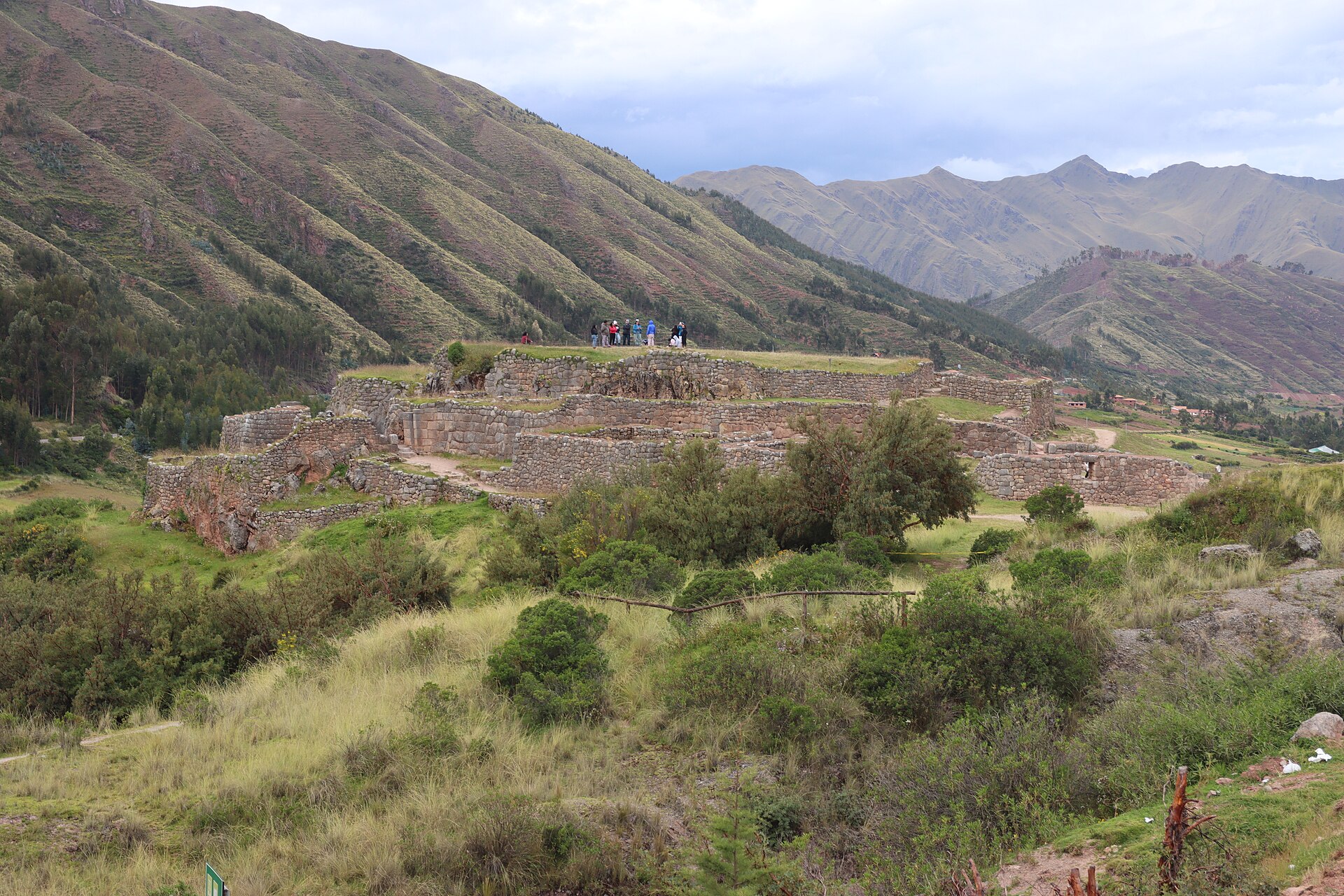
Puca Pucara sits quietly in the hills outside Cusco, often overlooked in favor of its more famous neighbors like Sacsayhuamán or Machu Picchu. Yet this understated site carries its own quiet allure, a place where the past lingers in the rough-hewn stones and the wide-open views of the Andean landscape. The name translates to Red Fortress, though the ruins here are modest compared to other Inca sites. The walls, built from roughly shaped stones, rise in uneven layers, blending into the terrain as if they grew from the earth itself rather than being placed there by human hands. There’s a sense of permanence in their simplicity, as if the mountains themselves decided to shape these structures over centuries.
The true purpose of Puca Pucara remains a subject of debate, which only adds to its mystique. Most scholars agree it served as a military outpost, guarding the approaches to Cusco, the heart of the Inca Empire. But some details don’t quite fit the usual narrative. There’s little evidence of a permanent garrison, and the intricate drainage systems suggest a function beyond mere defense. Perhaps it was a resting place for Inca rulers traveling through their domains, or a checkpoint for traders moving goods between the jungle and the highlands. The ambiguity leaves room for imagination, allowing visitors to piece together their own theories as they wander the terraces.
The architecture of Puca Pucara is unpretentious but effective. The stones, though not cut with the precision of Cusco’s temples, have endured for centuries, withstanding earthquakes and heavy rains. Three levels of terraces, connected by narrow staircases, create a sense of discovery as each turn reveals a new perspective on the valley below. At the highest point, the remains of watchtowers offer sweeping views of the surrounding mountains, their slopes dotted with sparse vegetation. From here, the road to the Sacred Valley winds into the distance, a reminder of the vast network of routes that once connected the empire.
The landscape around Puca Pucara is as compelling as the ruins themselves. This was once part of a major trade route leading toward Lake Titicaca, and the air carries the scent of dry grass and earth. The silence is broken only by the wind and the occasional cry of a bird. On clear days, the setting sun casts a warm glow over the stones, turning them a soft reddish hue—perhaps the reason behind the fortress’s name. As evening falls, the light lingers on the hills, and the ruins seem to absorb the colors of the sky.
Many visitors combine a trip to Puca Pucara with other nearby sites, often stopping here after Sacsayhuamán to end the day in a quieter setting. Unlike the more crowded attractions, this place offers solitude. There are no tour groups rushing through, no guides competing for attention. It’s possible to wander the ruins at leisure, imagining the footsteps of Inca warriors, traders, or even the emperor himself. Time moves differently here, as if the place itself encourages reflection rather than haste.
Though small, Puca Pucara played a significant role in the Inca Empire’s defense and communication networks. It was part of a chain of forts protecting Cusco from the north while also serving as a link between the capital and distant provinces. This speaks to the sophistication of Inca governance, where even minor outposts were integral to managing a vast territory. The ruins, though unassuming, stand as a testament to an era when discipline and strategy held an empire together.
Today, Puca Pucara offers a rare opportunity to connect with history without distractions. There are no vendors hawking souvenirs, no crowds jostling for the best photo spot. Visitors can sit on one of the ancient stones, close their eyes, and listen to the wind rustling through the grass. The mountains stand silent, keeping their secrets, while the past feels almost tangible in the stillness. It’s a place that doesn’t demand much—just an open mind and a willingness to step away from the noise of the modern world.