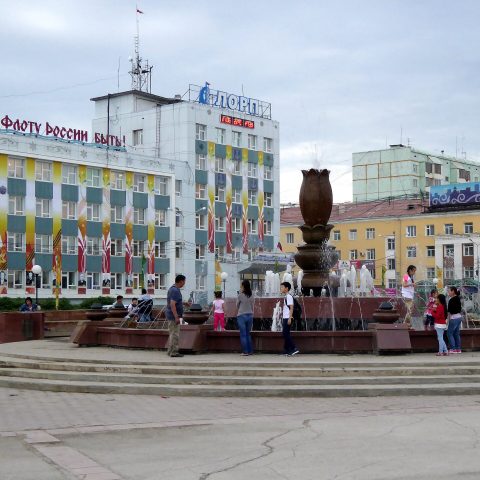
Lenin Prospekt cuts through Yakutsk like a vein. It starts at the Lena River and ends where the city blurs into the taiga. Along the way, it carries the weight of a century—wooden houses sagging under snow, Soviet facades still standing after decades of frost, and glass towers rising where there was once only permafrost.
The embankment marks the beginning. Here, the Lena moves slow and wide, its waters dark against the ice in winter, silver under the midnight sun in summer. A handful of old wooden houses still cling to the shore, their carved shutters and crooked walls the last traces of a town that was once just a trading post on the edge of nowhere.
The street changes as you walk. The 1950s and 60s left their mark in concrete and stone: the Government House, the National Library, the Opera and Ballet Theater. The theater’s facade is etched with Yakut patterns—reindeer, solar symbols, the curves of traditional khomus music. These buildings weren’t just built; they were statements. They said: this place matters.
Ordzhonikidze Square is where the city breathes. In December, the New Year tree here is the tallest in Yakutia. In July, the square fills with stalls selling frozen fish, reindeer pelts, and kumys in plastic bottles. The old Party headquarters is now a government office, its red star long gone but its bulk still dominating the skyline.
Lenin Prospekt is where Yakutsk works, shops, and argues. In summer, people sit on benches under the trees, eating ice cream that melts too fast in the 30-degree heat. In winter, the same benches vanish under snowdrifts, and the street becomes a path for skiers, their breath fogging in the -40 air. The cafes stay open. The shops keep their lights on. The city doesn’t stop; it just slows down.
Alekseyev Park is a pocket of quiet. A statue of Pyotr Alekseyev stands in the center, his bronze coat dusted with snow in winter, his gaze fixed on the future he never saw. In summer, the fountains run. In winter, the trees are wrapped in lights, and ice sculptures melt slowly in the weak Arctic sun. Locals bring their children here, their dogs, their thermoses of tea. It’s a place to stand still for a moment.
Walk the length of the prospekt and you’ll see it all: the ambition of the Soviet era, the stubbornness of Yakut traditions, the way a city learns to live where the ground never thaws. The wooden houses will eventually rot. The concrete will crack. The glass towers will rise higher. But the street will remain, because it’s more than pavement and buildings. It’s the path Yakutsk has always taken.
In summer, the air smells of pine and diesel. In winter, it’s so cold your nose hairs freeze. But the street is never empty. People walk it in the morning on their way to work, in the evening on their way home. They walk it in the middle of the night, when the sun never sets. They walk it because it’s theirs—because it’s Yakutsk, and there’s nowhere else like it.