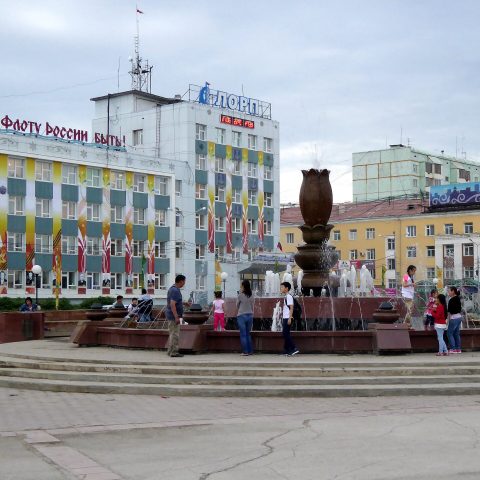
Ordzhonikidze Square in Yakutsk is where the city’s daily rhythm intersects with its layered past. Tucked in the heart of the Republic of Sakha’s capital, it serves as a quiet anchor for the streets that radiate outward, as if the city itself begins here—not just in geography, but in spirit. The square is compact, yet its role in Yakutsk’s life is anything but small. It’s a place where people gather for festivals, chance encounters, or simply to pass the time, a space that has absorbed the city’s changes while remaining a constant presence in its identity.
The square’s architecture tells a story of gradual evolution, with different eras coexisting side by side. At its center stands the imposing Government House of the Republic of Sakha, a Soviet-era structure with the unmistakable lines of its time—solid, functional, and slightly austere. Yet in Yakutsk, even such buildings take on a distinct character, shaped by the vastness of the North and the quiet resilience of its people. Nearby, other key institutions, including the Supreme Court building, contribute to the square’s official atmosphere, though the space never feels overly formal. Instead, it balances the weight of governance with the everyday life that flows around it.
One of the square’s most enduring features is the statue of Sergei Kirov, erected in 1936. It’s one of Yakutsk’s oldest monuments, and its placement here wasn’t arbitrary. Kirov, a prominent Soviet leader, played a significant role in the region’s development, particularly during the push for industrialization and the settlement of the North. The statue itself is classic in style—a bronze figure on a tall pedestal, one arm outstretched as if gesturing toward the future. For many locals, it’s more than a historical relic; it’s a familiar landmark, a silent witness to the city’s transformations.
The square hasn’t always been known by its current name. Over the decades, it has been called Bazaar Square and Lenin Square, each renaming reflecting the shifts in the country’s political and social life. Yet through these changes, the square has remained a focal point for public life. It has hosted rallies, parades, and markets, serving as a stage for both extraordinary events and the quiet routines of daily existence. Even now, as Yakutsk has grown into a modern city with all the trappings of urban life, Ordzhonikidze Square hasn’t lost its relevance. It’s still a place where the city’s pulse is most tangible.
Winter transforms the square entirely. Yakutsk’s winters are famously harsh, but the cold doesn’t deter people from gathering here. Instead, the season becomes part of the square’s character—ice sculptures appear, winter fairs set up stalls, and children skate on makeshift rinks. Summer brings a different kind of energy. The brief northern warmth turns the square into a green oasis, with flowers blooming and trees offering shade. No matter the season, the square remains a place of movement and stillness, where people hurry past or linger, depending on the day.
Just a short walk away stands the Yakutsk State United Museum of History and Culture of the Peoples of the North. Housed in a historic wooden building, it’s one of the few remaining examples of early 20th-century architecture in the city. The museum’s exhibits delve into the region’s past, from the traditions of Indigenous peoples to the challenges of Arctic exploration. Visiting it adds depth to the experience of the square, tying its present to the broader narrative of Yakutsk’s development. The two places—museum and square—exist in dialogue, each reinforcing the other’s significance.
What makes Ordzhonikidze Square special isn’t just its buildings or monuments, but the atmosphere that lingers here. It’s always alive with activity: office workers rushing to meetings, friends catching up on benches, or musicians playing on warm summer evenings. During festivals, the square becomes the heart of celebrations, filled with music, dancing, and the hum of conversation. Even on ordinary days, there’s a sense of quiet vitality, a feeling that this space belongs to the people who pass through it.
Yakutsk is a city of contrasts—where modernity brushes against tradition, and where the harsh climate doesn’t dim the vibrancy of life. Ordzhonikidze Square embodies these contrasts. It’s a place where the city’s past and present coexist, where history isn’t just preserved in stone but lives on in the footsteps of those who walk here. The square isn’t just a landmark; it’s a living part of Yakutsk, a space that has grown and adapted alongside the city itself. In its own understated way, it remains the soul of the capital.