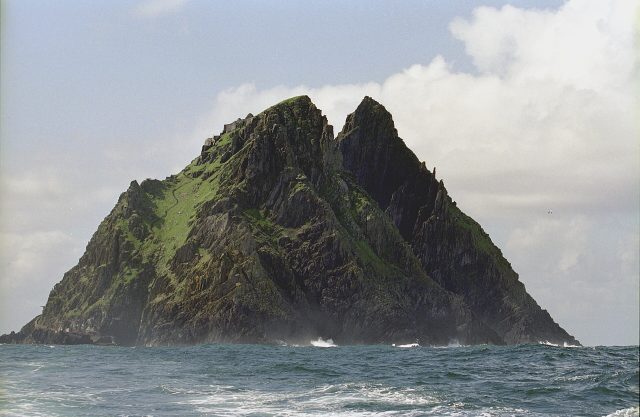
Portmagee Castle
Portmagee Castle stands where the land of Ireland meets the Atlantic. Its weathered stones are softened by moss and ivy. There are no crowds here, no guided tours, just the wind and the salt-tanged air rolling in from the bay. It’s the kind of place where history lingers in the damp corners of its walls.
The castle’s origins stretch back to the 16th century, when the O’Dowd clan ruled these shores. A fortress then was both stronghold and statement—proof of power in a land where loyalty and territory were contested. The square tower has narrow slit windows and walls over two meters thick. It was built to withstand enemies, human and storm alike. The Atlantic has battered it for centuries, yet it still stands. Some say the foundations rest on older ruins, perhaps Norman or pre-Norman, though little remains beyond scattered stones.
By the 17th century, the castle had passed to the Bingham family after Cromwell’s conquest. For the local Irish, this marked a turning point—land lost, names erased from deeds. The castle became an outpost of English rule, but its military importance faded quickly. By the century’s end, it was a country retreat, its interiors softened with fireplaces and larger windows. The Binghams may have tried to tame it, but the castle remained a fortress first, a home second.
Today, the castle is open to visitors. There are no glass cases or audio guides—just stone staircases worn smooth by footsteps, fireplaces bearing the crests of long-dead owners, and faint remnants of frescoes in the great hall. Climb to the top of the tower. The view stretches across Killala Bay, where the water shifts from slate gray to deep blue. On clear days, the mountains of Connemara shimmer in the distance.
This corner of Ireland has always moved to its own rhythm. In medieval times, the bay was a trade route, with ships carrying wool, fish, and flax to and from the continent. The castle watched over it all, though the sea ruled here. Even now, the bay sustains the village—salmon and oysters pulled from its depths, fishermen setting out at dawn in small boats.
The land around the castle is classic northwest Ireland: rolling hills, low stone walls dividing fields grazed for generations. Sheep wander these slopes. The air carries the scent of damp earth and wild herbs.
Scattered across the landscape are traces of the past—ringforts, crumbling graveyards with Celtic crosses, and faint paths of old roads that once led to the coast. You stumble upon them while walking the hills or notice them from the corner of your eye as you drive past.
Visiting Portmagee Castle isn’t about ticking off a tourist attraction. There are no gift shops or cafes, just the quiet company of the stones and the sea. On rainy days, when mist clings to the hills, the castle feels like something out of a folktale. In sunlight, its walls glow golden. It’s easy to picture the people who once lived here—feasting in the great hall, watching for ships, or huddling by the fire during a storm.
The village of Portmagee is little more than a handful of houses, a pub, and a small church. The locals are used to visitors. They’ll nod in greeting, point you toward the shore, or tell you a story about the castle if you ask. In the pub, you can order a pint of stout and listen to musicians playing traditional tunes on weekend nights. Someone might share an old tale—stories of hidden treasures or the ghost of a long-dead chieftain.
What makes Portmagee Castle special? It refuses to perform for visitors. It simply *is*—a quiet witness to centuries of life on this edge of the world. There’s no fanfare, no grand narrative, just the slow accumulation of time in the stones and the sea. Leave here, and you’ll carry something with you—a sense of Ireland that isn’t just about green hills and ancient legends, but about the quiet places where the past and present blur.