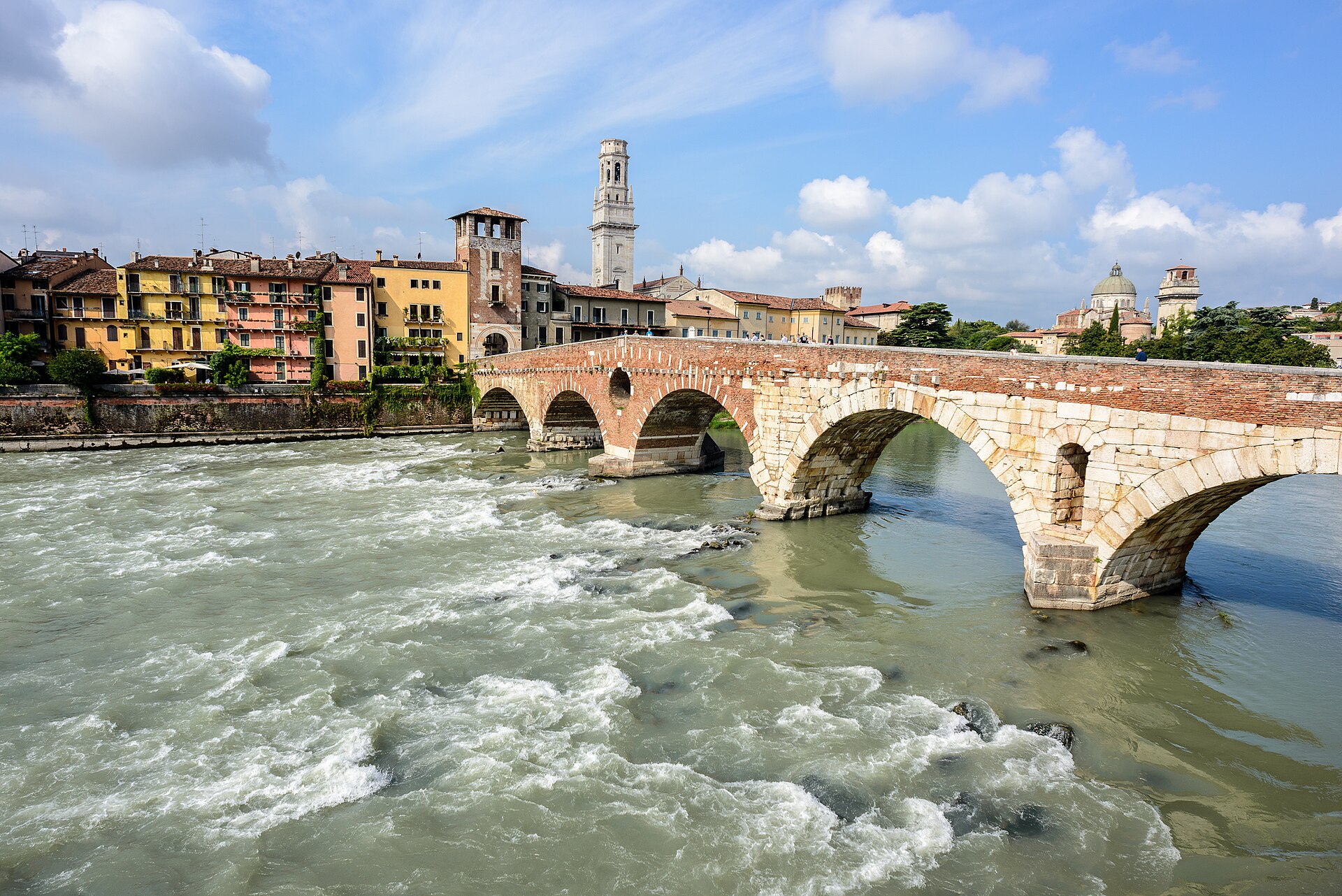
Ponte Pietra feels like a bridge that has always belonged to Verona, as if the city and the river could never have existed without it. Stretching across the Adige in the heart of the city, it connects two banks in a way that seems effortless, yet its presence is so deeply woven into the fabric of Verona that it’s hard to imagine the place without it. More than just a crossing, it’s a piece of living history—one that has witnessed over two thousand years of change, conflict, and quiet resilience.
The first version of this bridge dates back to the Roman era, around 100 BC, when it was little more than a wooden structure. Even then, it was far from ordinary. The bridge carried the Via Postumia, one of the empire’s most important roads, linking the port of Genoa to the northern outpost of Aquileia. The Romans soon replaced the timber with stone, and though the bridge has been rebuilt countless times since, traces of those ancient foundations can still be glimpsed beneath the water when the river runs low. It’s a rare and fleeting reminder of how long this spot has mattered.
The Middle Ages were unkind to Ponte Pietra. Floods, wars, and simple decay took their toll, and the bridge was destroyed and rebuilt more times than anyone bothered to count. Yet each time, the people of Verona restored it, because without this crossing, the city would have been cut off from the left bank of the Adige, where vital neighborhoods and trade routes lay. By the 12th century, the bridge took on the form we recognize today—five graceful arches of red brick and white stone, sturdy yet light, with battlements lining the parapets. These weren’t just for show; Verona was a city of warriors, and its bridges were strategic assets, not just pathways.
The most violent chapter in Ponte Pietra’s history came during World War II. In 1945, retreating German forces dynamited every bridge in Verona, including this one. The destruction was more than physical—it felt like an erasure of the city’s identity. But Verona refused to let the bridge disappear. Within a few years, reconstruction began, and by 1957, Ponte Pietra stood again. The restorers worked carefully, using original materials and techniques to preserve its historic character. Today, it’s easy to forget that the bridge is less than a century old in its current form. It carries the weight of history so convincingly that it feels as ancient as the city itself.
Standing on Ponte Pietra, you get one of the best views Verona has to offer. To the east, the hill of San Pietro rises, crowned by the ruins of a Roman theater and an old church. To the west, the dense tangle of the historic center unfolds—towers, rooftops, and domes pressing close together. The bridge is especially magical at sunset, when the stones glow gold and the river mirrors the sky. That’s when it’s busiest: tourists framing photos, locals strolling, couples leaning against the parapet, and the occasional musician playing a guitar or singing, their voices mingling with the sound of rushing water.
Like any place with deep roots, Ponte Pietra has its share of legends. One claims that this is where Romeo and Juliet first met, though Shakespeare’s play places their story elsewhere. The myth persists, as myths do, and it’s easy to see why—there’s something romantic about the bridge, something that makes the idea feel plausible. Another tale speaks of a hidden treasure buried beneath one of the arches, left behind by medieval merchants. No one knows if it’s true, but children still come here with metal detectors, hoping for a lucky find.
For all its fame, Ponte Pietra isn’t just a tourist attraction. It’s a part of daily life in Verona. Pedestrians cross it, cyclists weave through the crowds, and the occasional small car makes its way across, though traffic is limited. It’s a place for morning runs, evening walks, first dates, and chance encounters. The people of Verona treat it with a kind of quiet reverence, as if it were a living thing that has watched over their city through good times and bad.
Walking across Ponte Pietra isn’t just about getting from one side of the river to the other. It’s a step back in time, a chance to touch history in a way that feels tangible. The stones beneath your feet have seen Roman legions, medieval battles, and the quiet routines of countless generations. While most visitors rush toward the Arena or Juliet’s balcony, those who pause here leave with something deeper—a sense of authenticity, of a place that has endured and adapted, yet never lost its soul. In a world where so much feels temporary, Ponte Pietra stands as a reminder of what it means to last.