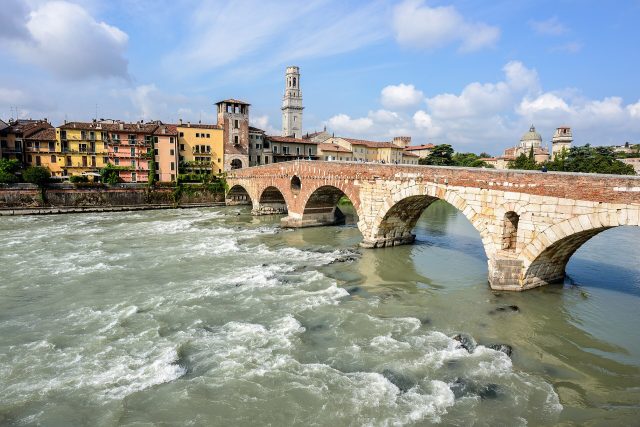
Verona
Italy · 10 places
Photo: collection by DanieleDF1995 (talk), CC BY-SA 3.0
Verona feels like a place where time has settled into the stones, where every alleyway and piazza carries the quiet weight of centuries. Nestled along the Adige River, the city wears its history lightly—Roman ruins stand beside medieval palaces, and Renaissance facades hide courtyards where laundry still sways between buildings. There’s no grand spectacle here, no clamor for attention. Instead, Verona offers something rarer: the unhurried rhythm of a city that has always been lived in, not just visited. Evenings drift by with the scent of fresh pasta from family-run trattorias, the strum of a guitar from a hidden square, and the murmur of locals sharing a bottle of wine on a doorstep.
Of course, Verona is best known as the stage for Shakespeare’s *Romeo and Juliet*, and the city plays its part with a mix of charm and irony. The famous balcony, attached to a 13th-century house later repurposed as a tourist attraction, draws crowds who leave love notes on the walls and rub the bronze statue of Juliet for luck. The gesture has worn her right breast smooth over the years. But the real magic isn’t in the staged romance—it’s in the way the story lingers in the air, even for those who’ve never read the play. The courtyard, with its graffiti of promises and initials, feels like a place where love, in all its messy, fleeting forms, still matters.
At the heart of Verona lies Piazza delle Erbe, a square that has been a marketplace since Roman times. Today, it’s a riot of color and noise—stalls piled with truffles, spices, and local cheeses, while overhead, faded frescoes on the surrounding buildings watch over the chaos. Nearby, Piazza dei Signori offers a quieter contrast, its elegant arches and the statue of Dante (who found refuge here after his exile from Florence) lending it a more solemn air. Just steps away, the Arena di Verona stands as one of the best-preserved Roman amphitheaters in the world. When summer opera festivals fill the ancient stones with music, the past and present blur under the glow of floodlights.
Beyond the tourist trail, Verona reveals itself slowly. The Adige Riverbank comes alive in the evenings as locals stroll or linger on benches, while children play in the parks and old men argue over espresso at corner cafés. The city doesn’t try to impress—it simply endures, much as it has for two thousand years. That’s its greatest trick: making visitors feel like temporary residents, not just passersby. Wander off the main streets, and you’ll find a hidden cloister, a crumbling church with forgotten frescoes, or a tiny shop selling olive oil pressed from trees in the surrounding hills. There’s no rush here. Verona has been waiting for centuries; it can wait a little longer for you to notice the details.
And then there’s the wine. Verona sits at the gateway to the Veneto region, where vineyards stretch across rolling hills and winemaking is as much a part of life as the changing seasons. The local wines—bold Amarone, velvety Valpolicella, crisp Soave—are best enjoyed where they’re made. Many wineries welcome visitors for tastings, pouring glasses straight from the barrel while explaining the alchemy of fermentation. Afterward, it’s easy to slip back into the city and settle into an osteria, where a plate of risotto with wild mushrooms or handmade bigoli pasta arrives alongside a glass of something local. The food, like the city itself, is unpretentious but unforgettable.
What makes Verona special isn’t any single monument or legend, but the way it all fits together—the way the past seeps into the present without fanfare. You might come for the romance of Juliet’s balcony, but you’ll stay for the way the light hits the river at dusk, or the sound of a vespa puttering down a cobblestone street, or the way an old woman in a market stall insists you try her grandmother’s recipe for pear and cheese pie. Verona doesn’t demand your attention. It just offers itself, quietly, to those willing to slow down and listen.
See & Do
10 places


Places on the map
Marker colour follows the categoryClimate and weather
Detailed weather: Verona- Average temperature
- 14 °C
- Precipitation per year
- 903 mm
Average air temperature
°C
3
6
9
14
18
23
26
25
20
15
9
4
Jan
Feb
Mar
Apr
May
Jun
Jul
Aug
Sep
Oct
Nov
Dec