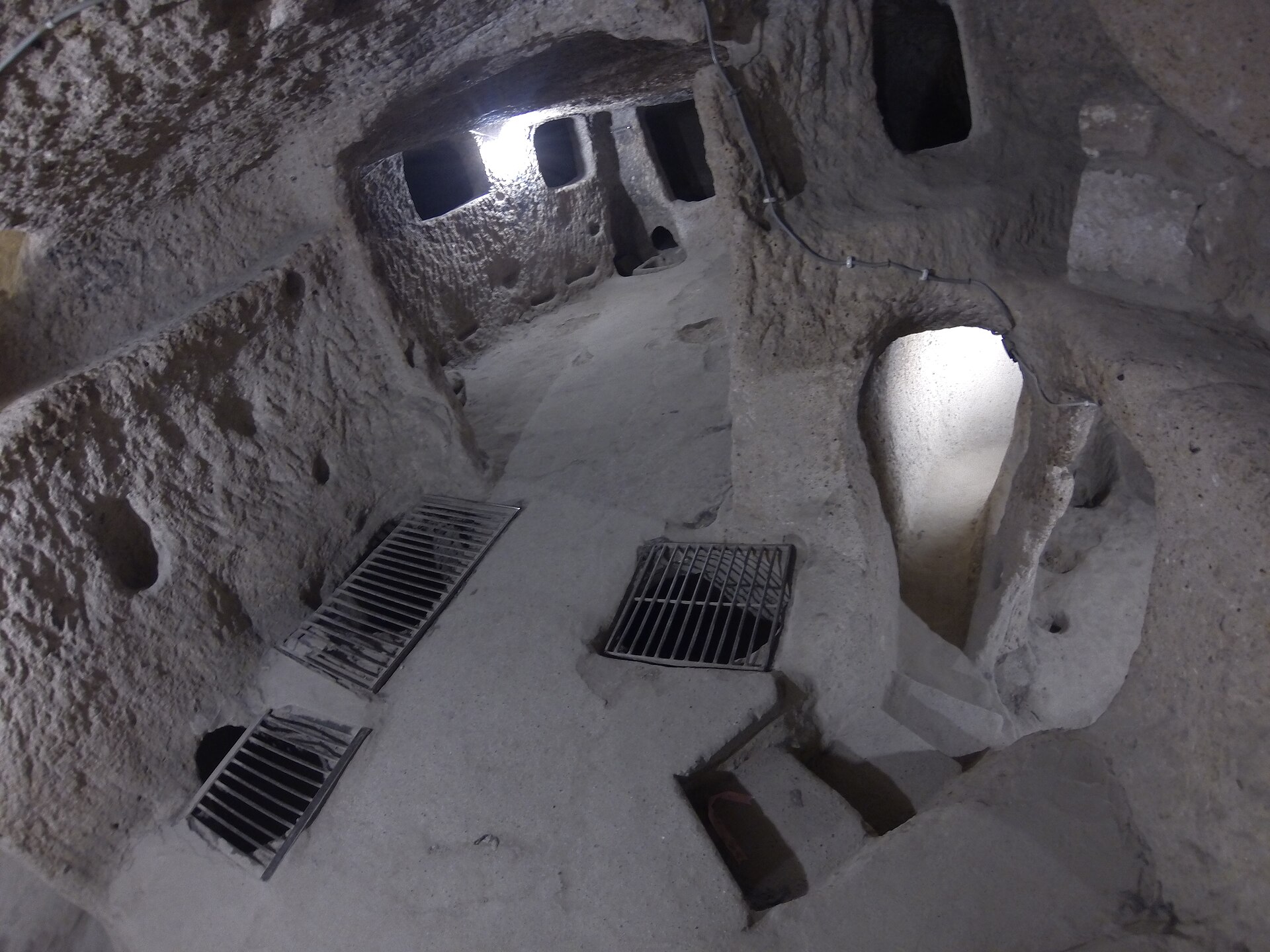
Kaymaklı makes you stop. Carved into Cappadocia’s soft volcanic rock, this underground city feels like a hidden world, untouched by time. The Hittites likely dug the first tunnels in the Bronze Age, but early Christians expanded it into the sprawling complex we see today. Back then, Cappadocia was a crossroads of empires—invaders and religious persecution forced people underground. Kaymaklı became their refuge, a place to wait, to live, to survive.
What makes Kaymaklı different? Its size and practicality. Of its eight levels, only the first four are open, but even these show how life thrived underground. This wasn’t just a shelter—it was a working city. Narrow passageways, barely wide enough for one person, connect living spaces, storage rooms, wine presses, stables, and chapels. The ceilings are low; you crouch, even crawl, to move forward. The design was deliberate—invaders would struggle, while defenders could block tunnels with massive stone doors.
Those doors are unforgettable. Weighing tons, carved from volcanic tuff, they could seal off entire sections. Some still pivot smoothly on their hinges. Ventilation shafts, some eighty meters deep, kept air flowing. Wells provided water. In the dim lower levels, you can still see niches where oil lamps once burned. Faded Greek inscriptions and fresco remnants hint at daily life—prayers, children playing, families sharing meals by lamplight.
Walking through Kaymaklı feels like stepping into the past. The deeper you go, the quieter it gets. The air cools, the light fades. There are no grand halls here—just raw, functional spaces. Wine presses with deep stone troughs show life persisted even in darkness. Grapes were crushed, bread baked, children born. You can almost hear the whispers, the hurried footsteps, the mix of fear and hope that once filled these tunnels.
Kaymaklı’s history mirrors Cappadocia’s. During the Byzantine Iconoclastic Controversy, Christians hid here, practicing their faith in secret. Later, under Ottoman rule, the tunnels sheltered those resisting conversion. The city saw countless conflicts, yet people always returned to the surface, leaving only echoes behind.
Visiting Kaymaklı isn’t like typical sightseeing. No crowds, no rushed tours. The silence and narrow passages force you to slow down. Without distractions, it’s easier to imagine life here—voices murmuring, tools clattering, fabric brushing against stone. It’s a reminder of how fragile, yet enduring, human life can be.
Kaymaklı hasn’t been polished for tourists. No bright signs, no reconstructed rooms—just the raw reality of an underground community. Other sites in Cappadocia may have better-preserved artifacts, but Kaymaklı offers something rarer: a direct connection to the past. Here, you don’t just learn history—you feel it.
If you’re in Cappadocia, visit Kaymaklı. It’s not a place to rush. You’ll need a few hours to explore even the open levels. Bring a light jacket—the deeper you go, the colder it gets. Be ready to crouch, squeeze through tight spaces, and let your imagination work. What stays with you isn’t just the tunnels or the stone doors, but the quiet understanding of how much lies hidden beneath the surface.