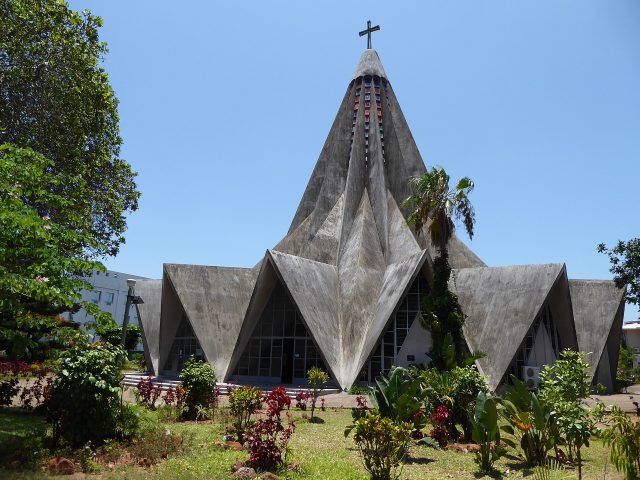
Republic Square in Mozambique Island is one of those places where history isn’t just remembered—it lingers in the air, in the weathered stones, in the way the light falls across the old buildings. The square sits at the heart of the island, a quiet witness to centuries of trade, conflict, and change. There are no grand monuments here, no polished tourist attractions, just the slow rhythm of a place that has seen empires rise and fall, where the past feels closer than the present.
Mozambique Island was once the capital of Portugal’s colonial empire in East Africa, a crucial stop on the maritime route to India. In the 16th century, it was a bustling hub where merchants from Europe, Africa, and Asia exchanged spices, gold, and enslaved people. Republic Square likely began as a gathering place—a market, a stage for official ceremonies, a crossroads where deals were struck and news was shared. No one knows exactly when it took shape, but the buildings around it tell the story of its evolution, layer by layer, over hundreds of years.
The most striking structure on the square is the former governor’s palace, built in the 17th century. Today, it stands empty, its grandeur faded, but the tall windows and heavy wooden doors still hint at its former importance. Nearby, the Church of Nossa Senhora do Baluarte, dating back to 1522, is one of the oldest European buildings in the Southern Hemisphere. It’s small, unassuming, with thick walls that have withstood pirate raids, earthquakes, and wars. The church’s simplicity contrasts with the more ornate colonial mansions around it, yet it has endured where others have crumbled.
Before Mozambique gained independence in 1975, the square was called Praça do Município. After the revolution, it was renamed in honor of the new republic, becoming a stage for celebrations, speeches, and the collective hope of a nation breaking free from colonial rule. The first leaders of independent Mozambique addressed crowds here, and for a time, the square was alive with the energy of change. Even now, you can almost hear the echoes of those moments if you listen closely.
These days, the square is part of everyday life. In the mornings, women sell fresh fish and fruit under the shade of ancient trees. Children play in the dust, chasing each other between the benches. In the evenings, the occasional concert or dance might spill out into the open, the rhythms of local music blending with the sound of the ocean. There’s no performance for tourists here—just the natural flow of a community that has made this place its own.
The architecture around the square is a mix of styles and eras. Colonial mansions with intricate balconies stand next to simpler, more modern buildings. Some structures are well-preserved, their facades still elegant, while others are crumbling, their walls patched with time. Yet even the ruins have a certain charm. Locals have adapted many of the old buildings—former warehouses now house cafes, guesthouses, or workshops where artisans carve wood or weave baskets.
What makes Republic Square special is how unassuming it is. There are no crowds, no souvenir stalls, no guides trying to sell you a story. Just the quiet hum of daily life—the cry of gulls, the murmur of conversations, the distant crash of waves. The island itself is small, and from the square, you can easily walk to Fort São Sebastião or the Sakalawa Museum of Art. But you don’t need to go far to feel the weight of history. Every building, every crack in the pavement, seems to hold a memory.
For those who take the time to look, the square offers more than just a glimpse into the past. It’s a place where you can sit on a bench and watch the world go by, where the locals might share a story if you show interest, but won’t bother you if you’d rather be left alone. The island attracts travelers who prefer authenticity over tourist traps, and Republic Square is a perfect example of that. It doesn’t promise luxury or entertainment, just a quiet connection to a history that’s still alive in the stones beneath your feet.