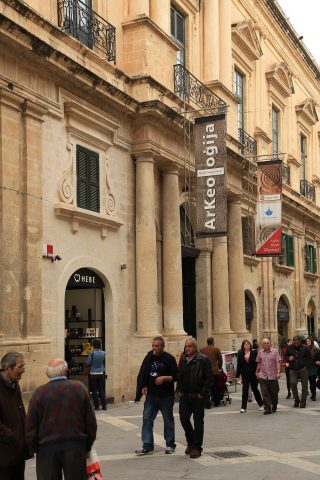
Republic Square in Lija is where Malta’s history feels tangible. It’s an open space in the heart of town, a crossroads where centuries of island life have unfolded. The square sits at the intersection of narrow medieval streets, old buildings, and the quiet rhythm of modern Maltese life. Past and present coexist here without fuss—no spectacle, just the steady pulse of a place always at the center.
The buildings around it are classic Maltese: tall, honey-colored stone facades with wooden balconies jutting over the pavement. These gallariji are a hallmark of the island, their carvings softened by sun and salt air. The limestone shifts color throughout the day, from pale gold in the morning to warm ochre by evening. You might glance up and notice a balcony you hadn’t seen before, its details revealed by the light.
At the center stands a monument to Malta’s independence, erected in 1974. It’s not imposing, but its presence matters—a marker of the island’s 20th-century journey. Locals and visitors gather around it, especially in the evenings. Conversations hum, a guitar strums, glasses clink from nearby cafés. Time slows here. People linger because there’s no rush.
Lija has never been Malta’s largest or most famous town, but it has always mattered. In the Middle Ages, it was home to one of the Knights of St. John’s key forts. Later, under British rule, it became an administrative hub. Republic Square likely existed even then, though its appearance would have differed. Records mention it as a site for fairs, public gatherings, and executions. Even quiet places have seen history.
The square is the heart of Lija’s daily life.
In the mornings, cafés set up tables where you can sip coffee with pastries like kannoli or qagħaq tal-għasel. Their sweetness contrasts with strong Maltese espresso. By midday, a market fills the square with stalls selling fresh produce, spices, and handmade crafts. The air smells of herbs, and vendors haggle over prices. As the sun sets, the mood shifts. Families gather, children play on cobblestones, laughter mixes with the clatter of cutlery from restaurants. Life unfolds in unscripted moments.
What makes Republic Square special is its lack of pretense. No tourist traps, no pushy vendors. Instead, it belongs to the people who use it—locals meeting friends, elderly men playing cards in the shade, teenagers sharing headphones on a bench. Sit here for an hour, and you might not notice time passing. Watch the light change on the stone walls or listen to church bells chime. Sometimes the square empties briefly, leaving only the echo of footsteps.
From the square, you can wander into Lija’s quieter corners. The 17th-century Church of St. Paul stands nearby, its baroque facade contrasting with humble homes. Old city gates remain, remnants of the town’s fortified past. But you don’t need landmarks to appreciate the square. It has its own significance, where history isn’t performed but simply exists, woven into everyday life.
Malta makes history feel immediate. The island is small enough that the past never feels distant, and Republic Square proves it. It doesn’t announce its importance, but if you pay attention, the weight of centuries lingers in its stones. The footsteps of knights, the voices of market traders, the peal of church bells—all of it remains just beneath the surface. Then there are the sounds of now: children laughing, chairs scraping pavement, conversations in Maltese and English. Here, the past isn’t just remembered. It’s still being lived.