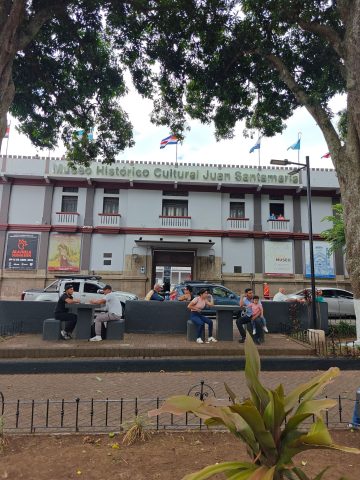
Parque Central in Alajuela is one of those places where the rhythm of daily life unfolds without hurry, where the past and present coexist in quiet harmony. This isn’t the kind of square that exists solely for tourists or grand ceremonies—it’s a living part of the city, a space where locals gather, children play, and the occasional visitor can sit on a bench and watch the world go by. The park has been here for generations, its trees shading the same benches where old men still meet to discuss politics or the latest football match, just as they might have done a century ago.
The square is framed by some of Alajuela’s most recognizable buildings, each with its own story. The neoclassical cathedral, with its white facade and twin bell towers, dominates the eastern side. It was built in the late 19th century after the original church was destroyed in an earthquake, and its sturdy columns and arched windows give it a sense of permanence. Inside, the high ceilings and simple wooden pews offer a cool respite from the tropical heat, though the real charm lies in the way the light filters through the stained glass, casting soft patterns on the stone floor.
Across from the cathedral, the old city hall stands as a reminder of Alajuela’s role in Costa Rican history. The building is modest compared to the grand municipal palaces of larger capitals, but its red-tiled roof and arched balconies are unmistakably colonial in style. It was here, in 1823, that Alajuela declared its support for Costa Rica’s independence from Spain, a decision that helped shape the country’s future. Today, the building houses local government offices, and while it’s not open to the public, its presence adds weight to the square, grounding it in the city’s past.
The park itself is a mix of carefully tended gardens and open spaces where people can wander or sit. The central fountain, a simple but elegant structure, was added in the early 20th century and has become a focal point. On weekends, vendors set up stalls selling everything from fresh fruit to handmade crafts, and the air fills with the scent of roasted plantains and the sound of laughter. During festivals, the square transforms entirely—strings of lights are hung between the trees, music spills from speakers, and the whole place takes on a festive energy that draws crowds from across the region.
What makes Parque Central special isn’t any single monument or event, but the way it feels like the heart of Alajuela. It’s where the city’s history is visible in the architecture, where its present is lived out in the daily routines of its people, and where the future is hinted at in the faces of the children running through the grass. There’s no grand spectacle here, no must-see attraction that demands attention. Instead, it’s a place that rewards those who take the time to slow down, to sit and observe, to let the rhythm of the city become their own.
The trees in the park are particularly worth noting. Many of them are decades old, their broad canopies providing shade that feels almost deliberate, as if the square was designed with the heat in mind. The most striking are the ceiba trees, their thick trunks and sprawling branches giving the park a sense of age and stability. In the early morning, when the mist still lingers over the nearby mountains, the square is quiet, the only sounds the rustling of leaves and the distant crow of a rooster. By midday, the benches fill up with office workers on their lunch breaks, students chatting between classes, and elderly couples sharing a newspaper.
Alajuela itself is often overshadowed by nearby San José, but Parque Central is one of the reasons the city feels distinct. It’s less polished than the capital’s grand plazas, more lived-in, with a character that comes from being used rather than admired. The square has seen its share of changes—new buildings have gone up around it, the streets have been repaved, and the city has grown outward—but it remains a constant, a place where the pace of life hasn’t been rushed by modernity.
For visitors, the best time to experience Parque Central is on a weekday morning, when the square is at its most authentic. The market stalls aren’t yet set up, the crowds are thinner, and the light has a soft, golden quality that makes the whole scene feel a little dreamlike. There’s a small café on the corner where you can get a strong cup of Costa Rican coffee and watch the city wake up. Later in the day, the square becomes livelier, but never overwhelmingly so. Even in the evening, when the streetlights flicker on and the air cools, it retains a sense of calm.
If you’re passing through Alajuela, Parque Central is worth a stop—not because it’s a destination in itself, but because it offers a glimpse into the soul of the city. It’s the kind of place where you might strike up a conversation with a stranger, or simply sit and listen to the sounds of a place that has been shaped by time and the people who call it home. There’s no need to rush. The square has been here for over a century, and it will still be here long after you’ve moved on.