Place Masséna is where Nice reveals itself in all its layers—where the city’s past and present coexist without effort, where grand boulevards meet the rhythm of everyday life, and where the warmth of the Mediterranean blends with a distinctly European sense of style. It isn’t just the geographical center of Nice; it’s a living space that shifts with the light, the season, and the people who pass through it.
The architecture here tells a story of gradual evolution rather than a single vision. The buildings, mostly in a neoclassical style softened by Provençal influences, wear the colors of the region—warm ochres, terracotta, and faded pinks—while their tall windows, framed by green shutters, give them a character that feels both elegant and lived-in. Along the northern edge, a long arcade offers shade from the midday sun, its arches sheltering cafés and small shops where locals and visitors linger over coffee or browse for souvenirs. The arcade isn’t just practical; it’s a quiet invitation to slow down, to step out of the sun and into the unhurried pace of the city.
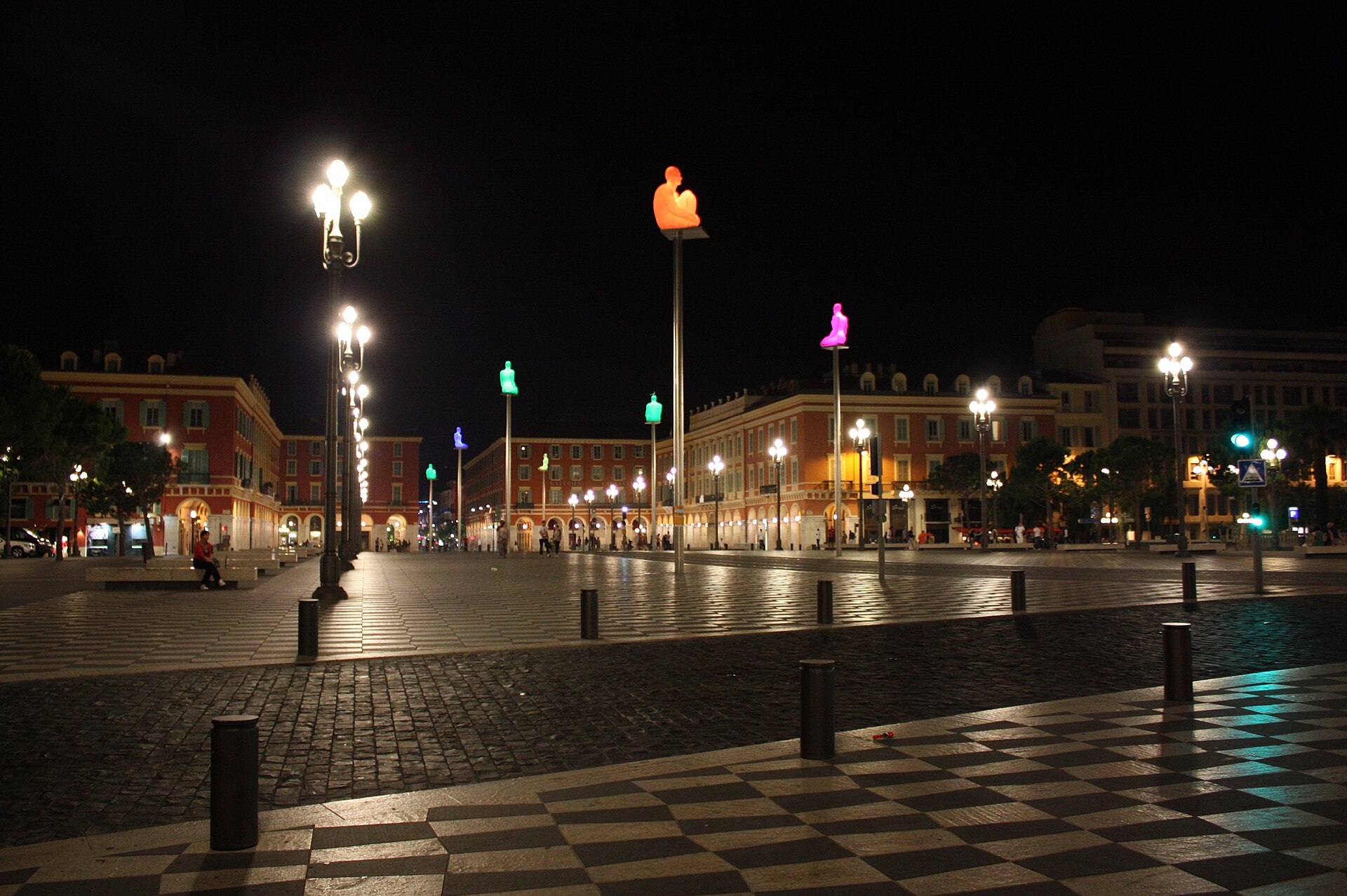
At the heart of the square, a broad expanse of pale stone stretches out, uncluttered and open. By day, it’s a place for quick steps and hurried conversations; by night, when the streetlamps cast a golden glow, it transforms into something more intimate, almost ceremonial. On summer evenings, the square becomes an extension of the city’s living rooms—students gather in small groups, families stroll with ice cream cones, and tourists pause to take in the scene. During festivals, the space fills with music, markets, and the hum of voices, turning it into a stage for the city’s celebrations.
One of the square’s most striking features is the series of seven white marble sculptures by Jaume Plensa, each perched atop a tall column. The figures, seated and contemplative, seem to watch over the square with a quiet presence. Installed in the early 2000s as part of a modernization project, they’ve since become a defining element of Place Masséna, adding a layer of modern art to its historic setting. Their abstract forms contrast with the classical architecture, yet they feel at home here, as if they’ve always been part of the square’s identity.
The history of Place Masséna is tied to Nice’s rise as a destination for Europe’s elite in the 19th century. When the square was laid out in the mid-1800s, the city was reinventing itself as a glamorous winter resort, and Masséna was designed as its grand entrance. Named after André Masséna, a local hero of the Napoleonic Wars, the square was meant to impress—hosting parades, receptions, and public events that showcased Nice’s newfound prosperity. Over time, it became a symbol of the city’s ambitions, a place where the old world met the promise of the modern.
Today, the square remains the crossroads of Nice, the point from which the city’s main arteries radiate. From here, you can wander into the labyrinthine streets of the Old Town, follow the curve of the Promenade des Anglais, or climb the hill to the ruins of the Château de Nice. It’s a natural starting point for exploration, but it’s also a destination in itself—a place where people return again and again, whether to meet friends, grab a quick espresso, or simply watch the world go by. The square is always busy, but it never feels crowded; there’s space for everyone, from the solo traveler with a book to the group of teenagers laughing over a shared pastry.
The character of Place Masséna shifts with the seasons. In winter, strings of lights drape the trees, casting a soft glow over the stone pavement. Summer brings the scent of blooming jasmine and the sound of cicadas, while spring fills the air with the freshness of new leaves. Autumn turns the square golden, the light slanting low across the buildings. No matter the time of year, the square retains its ability to capture the essence of Nice—a city that balances the carefree spirit of the Mediterranean with the sophistication of its European roots.
Walking across Place Masséna, it’s hard not to wonder about the lives that have intersected here over the past century and a half. Russian aristocrats who wintered on the Riviera in the 1800s may have strolled these same paths, as did American soldiers who arrived in 1944. The square has seen first dates, business deals, political rallies, and quiet moments of reflection. It’s a place where history isn’t just remembered—it’s still being written, one day at a time. More than just a public space, Masséna is a witness to the city’s changes, a stage where the past and present coexist without fanfare.