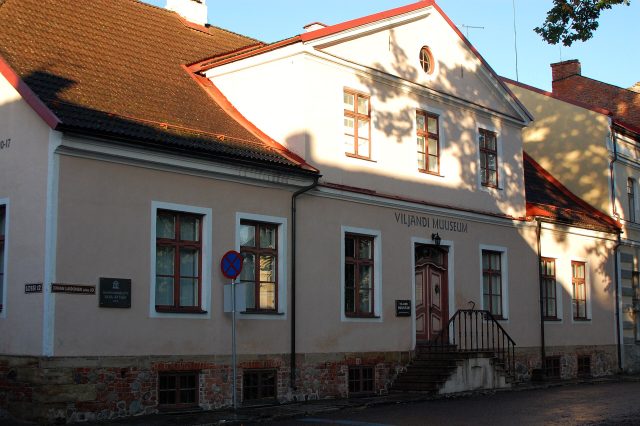
Johani Square in Viljandi is one of those places where the town reveals itself quietly, without fanfare or the pressure of tourist expectations. There are no grand monuments here, no crowds jostling for the best photo spot—just a gentle, almost intimate atmosphere that feels quintessentially Estonian. Tucked in the heart of Viljandi, where several streets converge toward the castle hill and the lake, the square is small but perfectly formed. Its modest size only adds to its charm, making it easy to imagine the bustle of medieval markets, the murmur of townsfolk gathering for news, or the sound of folk songs drifting through the evening air.
The history of Johani Square is woven into Viljandi’s identity as a trading and cultural hub. In the Middle Ages, the town was a key stop on the route between Riga and Pskov, and the square served as its commercial and social heart. Over the centuries, stone buildings rose around it, many of which still stand today, though their facades have been altered by time and taste. The mix of neoclassical and Art Nouveau architecture gives the square a slightly old-fashioned, provincial character, as if it has always been content to exist just outside the rush of progress. During the Soviet era, the square lost some of its significance, but since Estonia regained independence, it has gradually been restored to its former role as a gathering place.
Walking around Johani Square feels like flipping through the pages of a history book, where each building tells its own story. One of the most striking is the former inn, built in the early 19th century, its facade adorned with stucco details and tall windows that once welcomed merchants and travelers. Nearby, a house with intricately carved wooden balconies reflects the craftsmanship of early 20th-century Estonia. Some buildings still bear traces of their past lives—old signs, worn doorways, or decorative elements that hint at the lively trade that once filled these streets. Even newer structures blend seamlessly into the scene, respecting the square’s historic character rather than overshadowing it.
Today, Johani Square is a place where time slows down. Locals come here to meet friends, browse small shops, or simply sit on a bench and watch the world go by. In summer, the square often hosts small concerts and festivals, particularly during Viljandi’s annual folk music days, when the air fills with melodies and the scent of grilled sausages. Winter transforms the space entirely: a Christmas market springs up, twinkling lights wrap around the lampposts, and snow softens the edges of the old buildings, making them look like something from a postcard. The cafes and boutiques lining the square offer a chance to warm up with coffee or pick up a handmade souvenir, but the real draw is the unhurried pace of life.
What makes Johani Square special is its connection to the natural landscape just beyond its edges. The lake is a short walk away, its shores lined with paths perfect for a summer stroll or a quiet moment by the water. From the castle hill, the view stretches over the town and the surrounding countryside, a reminder of Viljandi’s strategic importance in centuries past. The square itself feels like a bridge between the town’s history and its present—a place where the past isn’t preserved in glass cases but lived in, day by day.
For first-time visitors, Johani Square might seem understated compared to more famous landmarks. But that’s precisely its appeal. There are no crowds, no rigid itineraries, no pressure to "see it all." Instead, there’s the quiet rhythm of a provincial town where life moves at its own pace. You can step into one of the old houses turned into museums or workshops, wander down the cobblestone streets, or just sit and soak in the atmosphere. Johani Square isn’t a must-see attraction in the traditional sense; it’s a place where Viljandi reveals itself honestly, without pretense.
Viljandi is often called the cultural capital of southern Estonia, and Johani Square plays a central role in that reputation. It’s a stage for folk music festivals, art exhibitions, and craft fairs, where local artisans demonstrate their skills in woodworking, pottery, or textile weaving. In summer, the square buzzes with activity, while in winter, the Christmas market offers a taste of traditional Estonian treats like black bread, mulled wine, and honey cakes. Even on ordinary days, the square has a way of drawing you in, inviting you to pause and appreciate the unhurried beauty of a town that refuses to be rushed by time.