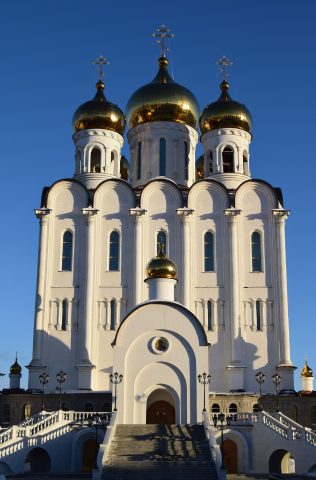
Gorky Square in Magadan is one of those places where the city seems to pause for a moment, revealing itself not just as a harsh northern outpost, but as a living organism with its own story. There are no crowds of tourists here, no flashy signs or pushy souvenir stalls—just a quiet authenticity that’s hard to find in places accustomed to visitors. Located at the intersection of the city’s main streets, the square serves as a kind of landmark for anyone trying to understand what makes Magadan tick today.
The architecture here isn’t grand or ornate, and that’s precisely what makes it interesting. The buildings surrounding the square are typical examples of mid-20th-century Soviet urban planning, where functionality took precedence over decoration. Gray facades, wide windows, and clean lines create an atmosphere of austere simplicity, though there’s a certain understated elegance to it—a kind of northern restraint. At the center stands a monument to Maxim Gorky, erected in 1956. The statue of the writer, facing the main street, seems almost detached, as if observing the city’s life from a distance. The monument itself is unadorned, blending seamlessly into the surroundings.
The square’s history is deeply tied to Magadan’s own past, a city that emerged during the industrial освоение of the Russian Far East. In the 1930s, this remote corner of the Okhotsk Sea coast became the site of Dalstroy, one of the largest Gulag camp systems. Magadan was its gateway, a city built to serve the needs of forced labor. Gorky Square appeared later, in the post-war years, when Magadan began to take shape as a real administrative and cultural center. It became a symbol of a new era, one where the city tried to step out of the shadow of its tragic history and define itself anew.
Today, Gorky Square is more than just a memorial—it’s a living part of the city. Locals gather here for events, protests, or simply to sit on a bench and watch the world go by. In winter, the square turns into a snowy expanse where people trudge quietly across its frozen surface. In summer, it comes alive with a few cafes and shops in the surrounding buildings, though even on the busiest days, the atmosphere remains calm, as if the city deliberately avoids the hustle.
For first-time visitors, Gorky Square might look like just another provincial plaza. But if you pay attention, you’ll notice details that hint at its deeper significance. A memorial plaque on one of the buildings honors the victims of political repression. A small fountain, turned on only for special occasions, adds a touch of life to the scene. These elements remind you that Magadan isn’t just a city at the edge of the world—it’s a place where history isn’t buried in the past but lingers in the present.
The square also serves as a starting point for those interested in the history of the Gulag. From here, it’s easy to explore the city’s memorial sites, including the famous Transport Square, where prisoners were once loaded onto trucks bound for the Kolyma camps. But even if you don’t delve into the darker chapters of the past, the square offers a glimpse into everyday life in Magadan. You might see locals rushing to work, children playing near the monument, or elderly men feeding pigeons while young couples arrange to meet by the fountain.
In recent years, Magadan has begun to attract travelers looking for off-the-beaten-path destinations. For them, Gorky Square can be a gateway to understanding what makes this northern city unique. There are no tourist traps here, no forced hospitality—just the chance to feel the rhythm of life shaped not by tour schedules, but by the harsh climate and the weight of history that hangs in the air.
When evening falls and the streetlights flicker on, the square takes on a different mood. The light softens the edges of the buildings and the monument, casting long shadows on the snow or pavement. In these moments, time seems to slow down, as if Magadan refuses to rush, living by its own pace, dictated more by nature than by clocks. Gorky Square, at the heart of the city, reflects that unhurried spirit, offering a quiet space for reflection—even in a place where life has never been easy.