Dushanbe’s Dusty Square, officially known as Dusty Square or Friendship Square, is one of those places where the city’s past and present intersect quietly, without fanfare. It’s not the kind of square that dominates postcards or draws crowds of tourists snapping photos, but that’s part of its charm. For locals, it’s a familiar landmark, a place to cross on the way to somewhere else, to meet friends, or simply to pause for a moment under the shade of the trees. The square sits at the heart of the city, framed by wide boulevards and government buildings, a space that feels both central and unassuming.
The name itself—Dusty, or Friendship—hints at the ideals of the Soviet era, when the square was first laid out. Back then, Dushanbe was still called Stalinabad, and the city was being reshaped into a showcase of socialist progress. The square was designed as a grand public space, a symbol of unity and modernity, with broad walkways and open vistas meant to impress. Over the decades, the name changed, but the square retained its role as a gathering place, even if its original purpose faded with time. Today, it’s a reminder of how cities evolve, how their meanings shift with politics and history.
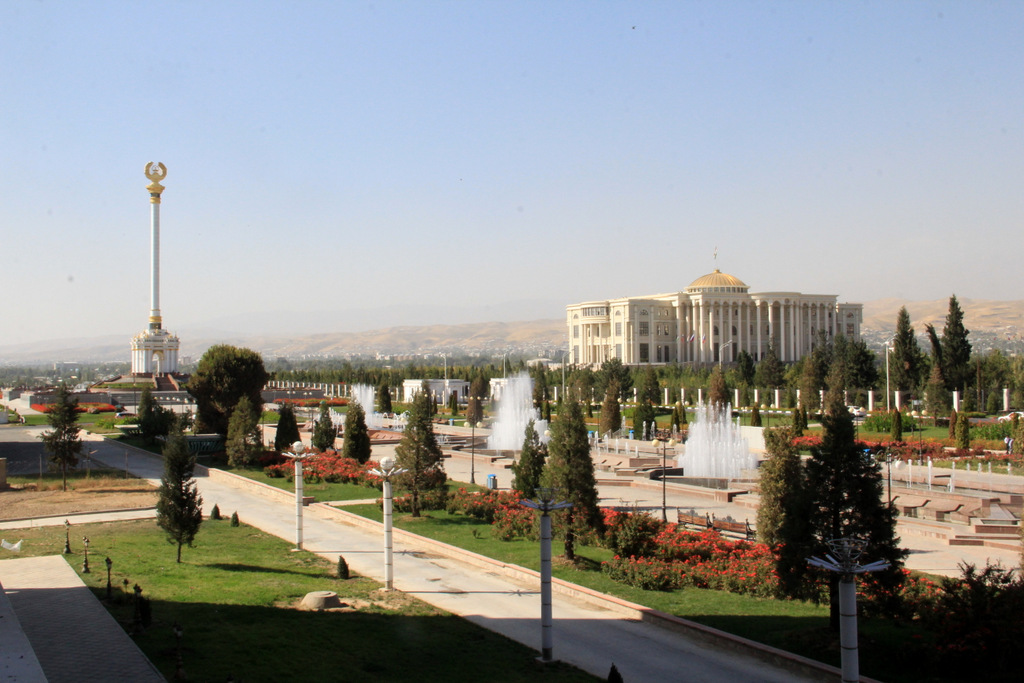
Architecturally, the square is a mix of styles that reflect Dushanbe’s layered identity. The most striking feature is the Palace of Nations, a massive government building that looms over the northern side. Its facade is a blend of Soviet monumentalism and local influences, with grand columns and a sweeping staircase that leads up to a terrace. The building’s scale is imposing, but it’s softened by the greenery around it—rows of trees and manicured lawns that break up the concrete. On the opposite side, the National Museum of Tajikistan stands as another anchor, its modernist design a contrast to the older structures nearby.
What makes Dusty Square interesting isn’t just its buildings, but the way people use the space. Unlike more tourist-heavy squares, this one feels lived-in. In the mornings, you might see groups of older men playing chess under the trees, their games unfolding slowly as the city wakes up. By midday, students from nearby universities cut across the square, their laughter mixing with the hum of traffic. In the evenings, families stroll along the paths, children darting between the lampposts while parents chat on benches. There’s no grand spectacle here, just the quiet rhythm of daily life.
The square has also been a stage for history, though not always in the ways its designers intended. During the civil war in the 1990s, it became a site of protests and gatherings, a place where people voiced their frustrations and hopes. Later, it hosted celebrations—parades, concerts, and festivals—when the country sought to redefine itself after the conflict. These days, it’s less of a political space and more of a social one, a backdrop for the small, unremarkable moments that make up a city’s character.
One of the square’s most enduring features is the fountain at its center. It’s not particularly elaborate, just a simple circular basin with water jets that rise and fall in a predictable pattern. But on hot summer days, when the temperature climbs above forty degrees, the fountain becomes a focal point. Kids run through the spray, their clothes damp and their faces flushed with excitement. For a few minutes, the square transforms into a playground, a brief escape from the heat. It’s these fleeting moments that give the place its warmth, far more than any official monument could.
If you visit Dusty Square, don’t expect a polished tourist experience. There are no guided tours, no souvenir stalls, no signs explaining its significance. Instead, it’s a place to observe, to sit on a bench and watch the city go by. The square doesn’t demand attention; it simply exists, a quiet witness to the changes around it. Over the years, Dushanbe has grown outward, with new neighborhoods and shopping centers drawing people away from the center. Yet Dusty Square remains, a steady presence in a city that’s always in motion.
For those who take the time to notice, the square offers a glimpse into Tajikistan’s recent past. The Soviet-era buildings, the wide boulevards, the way the space is used—all of it tells a story of a country that has navigated independence, conflict, and change. It’s not a story of grand achievements or dramatic events, but of ordinary life persisting, adapting, and finding its own rhythm. In that sense, Dusty Square is more than just a public space; it’s a reflection of the people who call Dushanbe home.