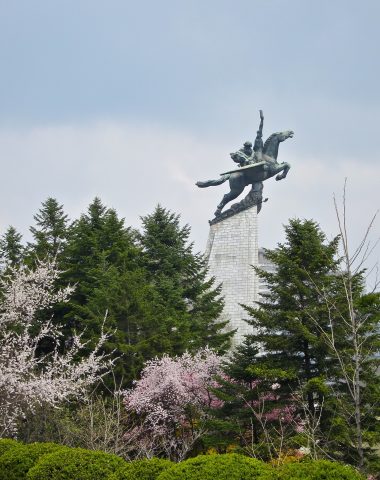
Nampo’s Chollima Square is where North Korea stages its public face. No one hurries here. Tourists stand at the edges, watching a space built for something larger than daily life. The square is named after the mythical winged horse Chollima, a symbol of rapid progress and collective labor that shaped the country’s ideology in the mid-20th century. The horse isn’t just decoration—it’s part of the city’s structure, a reminder that every stone and building serves a purpose.
The square is vast and symmetrical. At its center, a sculpture shows workers and farmers moving forward under the *juche* banner. The figures are bold, dramatic, almost theatrical. A tall flagpole flies the national flag, its fabric snapping in the wind. The surrounding buildings have massive columns and high ceilings, designed to impress. There’s no randomness here—every line and angle is deliberate.
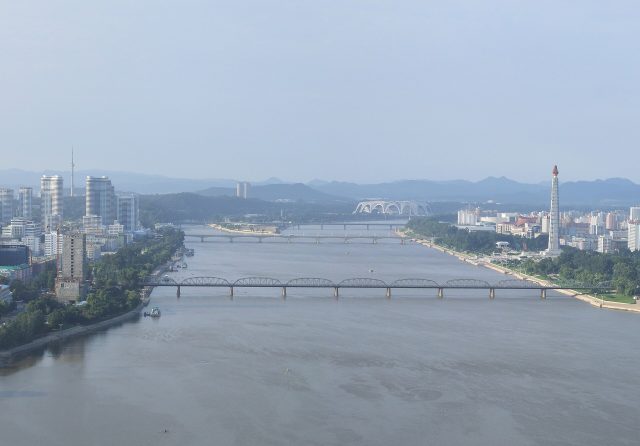
Nampo is an industrial city. The square’s location isn’t accidental. It sits at the mouth of the Taedong River, an area developed by Japanese colonial authorities in the early 20th century as a port and factory hub. After the Korean War, Nampo became key to North Korea’s industry, and the square grew into a symbol of labor-driven ambition. On certain days, it fills with uniforms, banners, and coordinated displays of patriotism. These events feel scripted—because they are.
The People’s Palace of Culture dominates the square. Its columns, staircases, and vast interiors host political gatherings, performances, and ceremonies. The building often appears in state photographs, its imposing presence framing leaders and officials. Nearby structures follow the same style—severe, symmetrical, stripped of unnecessary details. Everything here reflects discipline and unity.
For outsiders, Chollima Square shows North Korea as its government wants it seen. No detail is unplanned. Even the trees and flowerbeds are trimmed with precision. Most days, the square feels empty, but this stillness is deceptive. It’s always ready for a parade, a rally, or a display of state power. This is how North Korea’s public spaces work—they exist for those rare, orchestrated moments when the nation performs.
The Chollima myth isn’t confined to this square. In Pyongyang, a district bears its name. Museums across the country display paintings of the winged horse carrying workers toward the future. In Nampo, a city of shipyards and factories, the symbol fits. The square is where this ideology takes physical form—where abstract ideals become stone and steel.
Visiting Chollima Square isn’t sightseeing. There are no cafes or souvenir stalls. Instead, there’s silence and space. You feel like you’ve stepped onto a set where everything is placed with intention. Even when empty, the square hums with the potential for spectacle—a marching band, a procession, patriotic music. This is what makes North Korean squares unique. They’re not built for daily life but for those fleeting, controlled moments when the nation performs its identity.
Yet the square isn’t entirely rigid. Look closely, and you’ll see small, unscripted details. Locals glance at the sculptures as they pass, not with awe, but familiarity. Elderly men play chess under the trees while the square lies empty. These moments hint at ordinary lives beneath the monumental facades, even if constrained by the rules.
Chollima Square is more than architecture. It’s part of a system where every element carries meaning. It tells how North Korea sees itself and wants to be seen. There’s no spontaneity—everything is deliberate, measured, aligned with a vision. To an outsider, it may feel artificial, but that’s what makes it distinctive. The square doesn’t invite conversation. It sets the terms, offering a view through the lens of official history and ideology. Whether you find it fascinating or unsettling depends on how much you accept the performance.