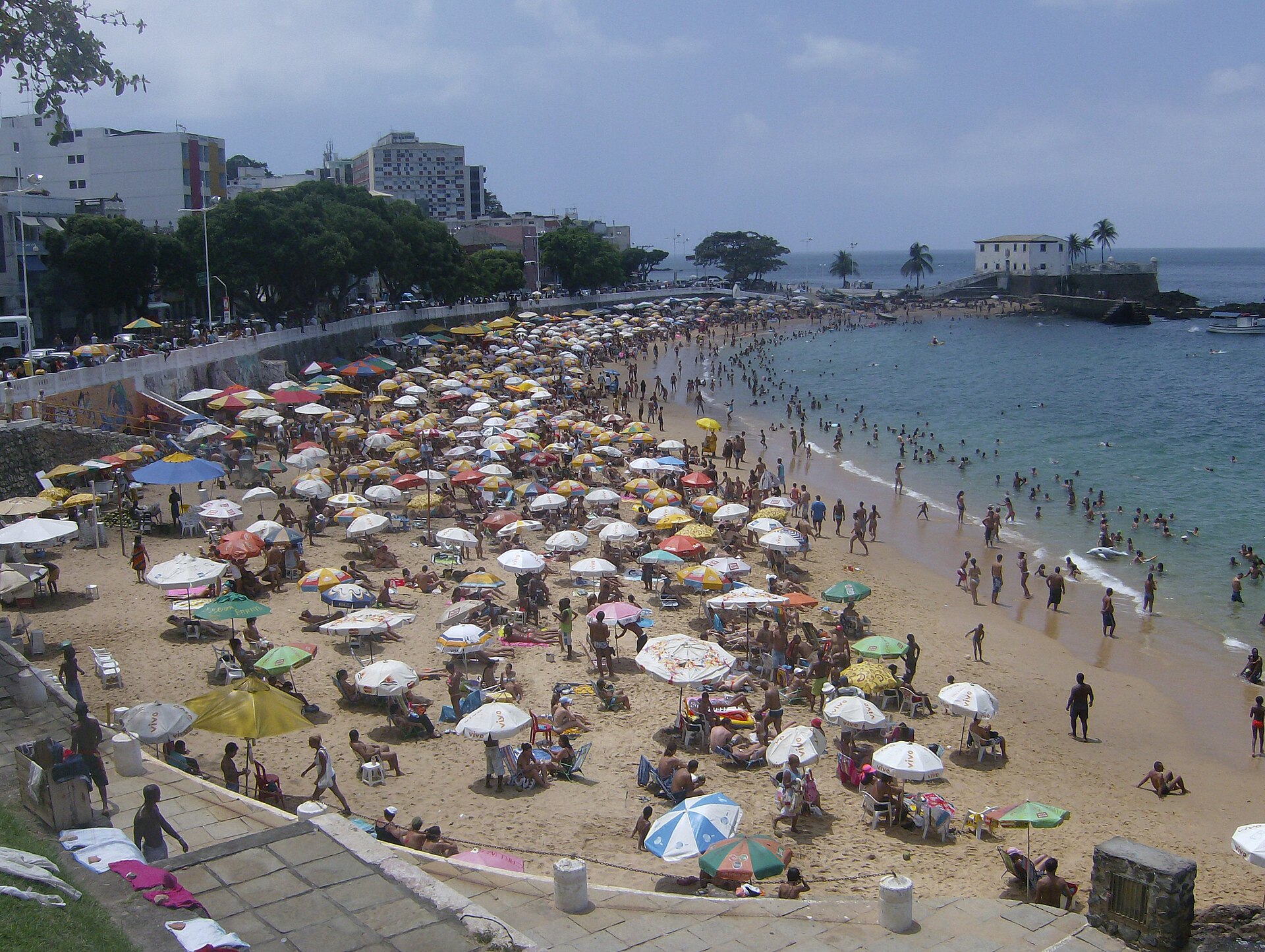
Porto da Barra is the kind of beach that lingers in your memory long after you’ve left Salvador. Tucked into a small, sheltered bay, it feels almost like a postcard come to life—soft golden sand, calm turquoise waters, and the kind of gentle curve that makes the whole scene look effortlessly picturesque. Unlike the more famous beaches of Rio, where crowds and high-rises dominate the shoreline, Porto da Barra has a quieter, more intimate feel. The water here is remarkably clear, shifting from pale aquamarine near the shore to deeper blues further out, while the sand, though not as powdery as the Caribbean’s finest, is smooth and warm underfoot. At low tide, you can wade across the shallows to nearby coves, and when the tide rolls in, the waves lap gently against the shore, making it perfect for a lazy swim.
This stretch of coast is deeply tied to Salvador’s history. It was here, in 1549, that the first Portuguese settlers landed, establishing the city as Brazil’s first capital. Back then, the area was simply called Barra—meaning "mouth" or "passage"—because the bay served as the natural gateway to the vast Baía de Todos os Santos. As the city grew and the port shifted to other districts, Porto da Barra remained a quiet retreat, a place where locals escaped the heat and bustle. Even today, the past isn’t hard to find. Flanking the beach are two historic forts, built in the 17th and 18th centuries to defend the city from maritime attacks, their weathered stone walls standing as silent witnesses to centuries of change.
The Fort of Santo Antônio da Barra, perched at the western end of the beach, is the oldest in Brazil. Constructed in 1583, not long after the city’s founding, it has been rebuilt and reinforced over the years, but its core remains intact. Now home to the Maritime Museum, the fort houses a collection of antique maps, navigational tools, and ship models that offer a glimpse into Brazil’s seafaring past. Even if you don’t step inside, the fort is worth visiting for the views alone. Climb its ramparts, and you’ll see the entire bay unfold before you—the curve of the beach, the expanse of the ocean, and the distant spires of Salvador’s old town. On the opposite side of the bay stands the smaller Fort of Santa Maria, less imposing but no less steeped in history. Together, these forts aren’t just relics; they’re living pieces of the city’s story, connecting the present to the days when Salvador was a fledgling colony.
Porto da Barra isn’t just a place to swim; it’s woven into the fabric of daily life in Salvador. Mornings here are peaceful, with locals jogging along the shore, practicing yoga on the sand, or sipping coffee at small kiosks near the water. By midday, families arrive, drawn by the shallow, calm waters that make it ideal for children. The atmosphere shifts as the day goes on—teenagers play soccer on the sand, fishermen mend their nets, and the scent of grilled fish and fresh fruit drifts from the modest food stalls. There are no high-end restaurants or beach clubs here, just simple spots serving *acara*—a traditional fish stew—or icy coconut water straight from the shell. It’s the kind of place where people come not for luxury, but for the easy rhythm of life by the sea.
The water in the bay is usually clean, though conditions can vary. During the rainy season, from April to July, the sea can be choppy, and the sand shifts with the currents. But in the dry months, especially between September and March, the bay transforms into a swimmer’s paradise. The clarity of the water makes it perfect for snorkeling, with small coral reefs just offshore teeming with colorful fish. On rare occasions, you might even spot a sea turtle gliding through the shallows. Locals recommend arriving early, when the water is at its clearest and the sun is still gentle. The beach is nearly empty at dawn, save for a few fishermen and the occasional early riser taking a morning dip.
Beyond the beach itself, Porto da Barra serves as a gateway to other parts of Salvador. From here, it’s an easy walk to the historic Pelourinho district, with its colonial churches and cobblestone streets, or to the Fort of Monte Serrat, which offers another stunning vantage point over the bay. Just past the Fort of Santo Antônio da Barra begins Farol da Barra beach, where the coastline stretches out in a long, sandy curve. For those willing to venture further, a short ferry ride takes you to Itaparica Island, where quiet beaches and old colonial churches await. The area isn’t well served by the metro, but buses and taxis are plentiful, and if you don’t mind the heat, the walk into the city center takes about half an hour.
What makes Porto da Barra special is its lack of pretense. There’s no aggressive beach service here, no vendors pushing overpriced drinks or souvenirs. Instead, you’ll find locals selling fresh coconuts, grilled shrimp, or handmade shell bracelets from small stalls. The vibe is more neighborhood than tourist hotspot—people come to relax, not to be seen. It’s the kind of place where you can spend hours doing nothing in particular, watching the light change over the water or listening to the laughter of children playing in the shallows. Porto da Barra doesn’t try to be perfect; it’s simply itself—a little noisy, a little slow, but undeniably alive.