Barra Lighthouse: Where Salvador’s Past Meets the Sea
Barra Lighthouse stands at the tip of the peninsula, where the Atlantic Ocean meets the Bay of All Saints. The wind carries salt and the scent of distant waters. Sunsets turn the sky gold and violet before vanishing into the sea. At night, the lighthouse beam sweeps through the dark—a steady signal that land is near.
This is where Salvador, Brazil’s first capital, began. The Portuguese built Fort Santo Antônio da Barra in the 16th century to guard the bay from pirates and rival fleets. Its thick white stone walls still stand, holding centuries of the city’s maritime history.
The fort dates to 1598. In the 17th century, the Dutch attacked Salvador twice, and the fort held them off. Its walls have seen slave ships from Africa, merchant vessels heavy with gold and sugar, and later, steamships bringing European immigrants. By the 19th century, its military role faded. One of its towers became the lighthouse that still guides ships today.
You can climb the narrow spiral staircase to the observation deck. From there, the view takes in the ocean, the curve of the coastline, and the colorful old city.
The fort’s architecture is classic Portuguese colonial—thick walls, narrow cannon embrasures, a central courtyard with a well. But the lighthouse is the centerpiece: a red-brick tower with a white stripe, rising like a sentinel. Inside, old lamp mechanisms and navigational instruments are on display. A small museum nearby holds maps, photographs, and artifacts that trace Salvador’s ties to the sea.
For locals, this place is just Barra. Fishermen mend nets on the rocks. Teenagers spread picnics on the grass. Elderly men sit on benches, watching the waves.
In the evenings, the waterfront fills with people. They come to watch the sunset. The light here is soft, almost liquid, as the sun sinks into the ocean, painting the sky in oranges and purples. The city’s noise fades, replaced by stillness.
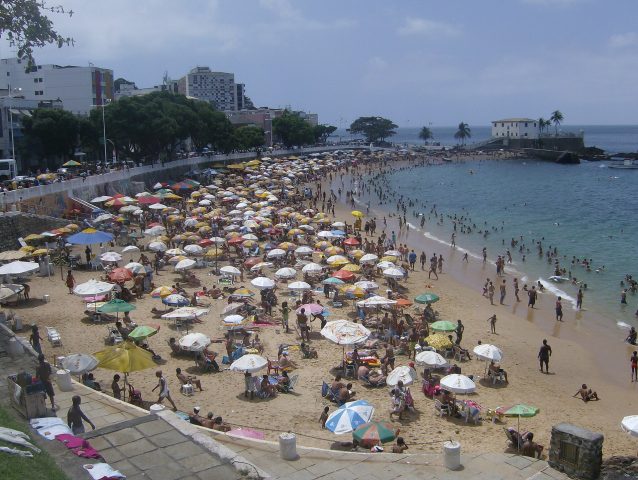
Barra Lighthouse is where past and present meet. The Atlantic breeze carries the cries of seagulls and the crash of waves. Sometimes, dolphins play near the shore. Around the fort, a small park with palm trees and benches offers shade. Nearby, Porto da Barra Beach has calm, clear waters for swimming.
You can lose track of time here—reading under a tree or staring at the horizon.
To Salvador, Barra Lighthouse is more than a landmark. It marks the city’s origins as a gateway to the New World, where empires clashed and trade routes began. Today, it lets you touch history without leaving the present. There’s no tourist hype, just an authentic sense of place. Most visitors don’t come to check off a list. They come to feel the weight of the past in the stones beneath their feet.
Climb the lighthouse early in the morning. The first light spills over the horizon. Fishing boats return to the harbor. Swimmers appear on the beach. A thin mist lingers over the water. The fort feels different at this hour—quieter, as if holding stories of sailors, soldiers, and travelers who once passed through its gates. The air is cool. The city is half-asleep. For a moment, you’re alone with the sound of the waves.
Here, history isn’t locked in museums. It’s in the air you breathe. You could wander the waterfront for hours, stop at a café for grilled fish, or sit on the sand watching the tide. It doesn’t try to impress. Some feel its pull. Others don’t. But those who do keep coming back—a quiet corner of Salvador where the sea, the sky, and the past come together.