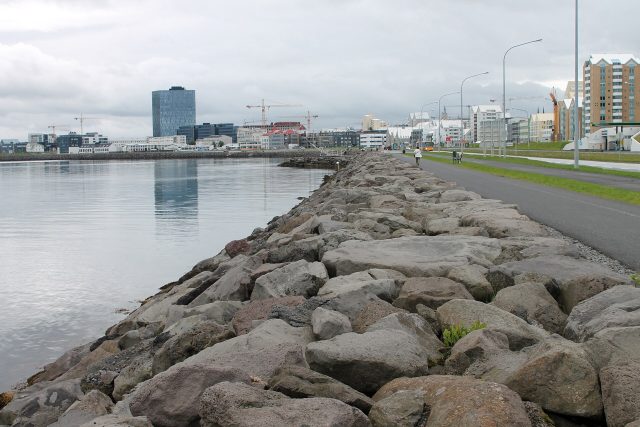
Álfanes Beach is one of those quiet corners of Iceland that doesn’t announce itself with grand landmarks or crowds of visitors. Just a thirty-minute drive from Reykjavík, it feels like stepping into another world—one of black volcanic sand, gentle Atlantic waves, and windswept lava fields covered in moss. On clear days, the distant peaks of the Snæfellsnes Peninsula rise on the horizon, while in winter, the faint glow of the northern lights sometimes flickers above the water. It’s not as dramatic as the displays deeper in the countryside, but there’s something intimate about seeing them here, so close to the capital.
This isn’t the kind of Icelandic shoreline you see on postcards. There are no icebergs drifting in glacial lagoons or thundering waterfalls framing the view. Álfanes is a place for slow walks along the water’s edge, where the only sounds are the rhythm of the waves and the cries of seabirds. In summer, Arctic terns and sandpipers dart along the shore, and if you’re lucky, you might spot a whale breaking the surface far out at sea. Winter empties the beach, leaving only the occasional local walking their dog or spreading out a picnic blanket with a thermos of coffee. The wind carries the scent of salt and damp earth, and the light—even in the middle of the day—has a soft, diffused quality, as if the sky itself is holding its breath.
The history of Álfanes is tied to the sea. Centuries ago, small fishing villages dotted this coastline, though little remains of them now. In the Middle Ages, these shores were part of the lands controlled by powerful Icelandic clans, and later, farmers grazed sheep on the coastal meadows. Today, Álfanes is technically a suburb of Reykjavík, but it hasn’t lost its wild character. The land here feels untamed, shaped more by the ocean and wind than by human hands. You won’t find grand ruins or museums, but there’s a quiet sense of continuity—of people living alongside the elements, rather than trying to tame them.
There’s no traditional architecture to speak of, but a few details hint at the area’s past. On one of the headlands, the crumbling remains of an old stone wall suggest the outline of a long-gone farmstead. Nearby, a modest lighthouse stands sentinel over the water. It’s not open to visitors, but its presence is reassuring—a small beacon guiding fishing boats through the dark. The lighthouse has become something of a local landmark, a reminder that even in a place as remote as this, people have always found ways to navigate the unpredictable.
The mood at Álfanes shifts with the seasons. In summer, the midnight sun casts a golden glow over the sand, and the air feels almost weightless. The waves lap lazily at the shore, and the only movement comes from the birds wheeling overhead. But when autumn arrives, the weather turns fierce. Storms roll in from the Atlantic, sending waves crashing against the rocks with a force that shakes the ground. The wind can be brutal, whipping across the open land with enough strength to knock you off balance. It’s in these moments that Álfanes feels most alive—raw, unfiltered, and utterly indifferent to human comfort.
For locals, this beach isn’t a tourist attraction but a part of everyday life. People come here to run, to walk their dogs, or to sit on the rocks with a thermos of coffee, watching the tide roll in. In recent years, it’s become a popular spot for photographers, especially those looking to capture Iceland’s landscapes without the crowds. There are no parking lots, no restrooms, no cafés—just the land and the sea. That lack of infrastructure is part of the appeal, though it also means visitors need to come prepared. The weather can change in an instant, and there’s no shelter if the wind picks up or the rain starts to fall.
What makes Álfanes special is its sense of solitude. There are no marked trails, no paved paths, no signs telling you where to go. You can walk for miles without seeing another person, a rare luxury in a world where so many places feel overrun. Even in summer, when more people visit, it’s easy to find a quiet stretch of shore where the only sounds are the waves and the wind. The beach doesn’t demand anything from you—no tickets, no guided tours, no Instagram-worthy poses. It simply exists, vast and unchanging, while the seasons pass over it.
If you find yourself in Iceland and want to experience something beyond the usual tourist trail without venturing too far from Reykjavík, Álfanes is worth the trip. It’s not a place for those seeking excitement or spectacle, but for those who appreciate the quiet beauty of a landscape shaped by time and the elements. There’s no grand narrative here, no story to unravel—just the steady pulse of the ocean, the endless sky, and the feeling of being small in the best possible way. That, in the end, might be the most Icelandic experience of all.