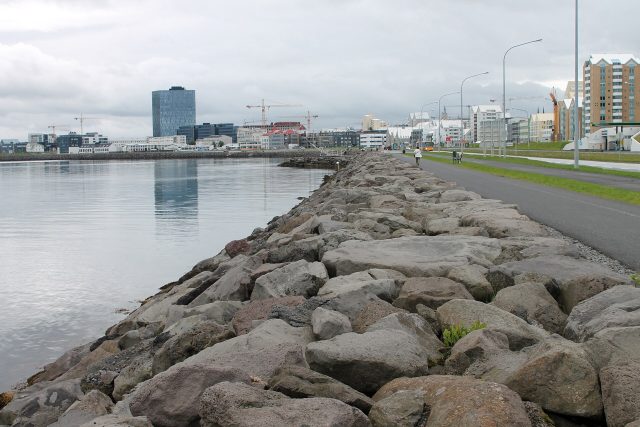
Garðakirkja sits quietly on a low rise in Álftanes, a small peninsula just beyond Reykjavík’s outer edges. From here, the view stretches across Faxaflói Bay, where the water meets the distant mountains on the far shore. The place feels removed from time, as if the hours pass more slowly than they do in the city. There are no crowds, no tour buses, no signs pointing the way—just the wind moving through the grass and the occasional car passing on the narrow road below.
The church was built in the mid-20th century, but its design carries the simplicity of older Icelandic churches. The wooden exterior is painted white, the roof a deep red, and a modest spire rises above the entrance. Inside, there’s little ornamentation—just wooden pews, a plain altar, and a few old religious objects. It’s not a place where visitors linger, though those who step inside often remark on the stillness, the way the space seems to hold its breath.
Álftanes was once its own municipality, and Garðakirkja served as the heart of the parish. In the past, the peninsula was home to farmers and fishermen, and the church was more than a place of worship—it was where the community gathered. Today, Álftanes is part of the greater Reykjavík area, but it hasn’t lost its rural character. Houses are scattered across the hills, roads wind between lava fields, and the church remains a familiar landmark.
There’s no tourist infrastructure here—no cafés, no gift shops, no neatly printed signs. The only way to reach Garðakirkja is by car or the infrequent bus that makes its way from Reykjavík. The drive takes about half an hour, but the landscape shifts so dramatically along the way that it feels like stepping into another world. One moment you’re passing suburban streets, the next you’re surrounded by open land where mist drifts over the grass and the mountains loom in the distance.
The church isn’t always open, and its schedule changes with the seasons. In summer, the doors might stay unlocked longer; in winter, they may close early, especially if the weather turns. Icelanders don’t leave churches unattended, so if you want to go inside, it’s best to check ahead. But even if you can’t enter, the spot is worth a stop. From here, you can watch the light shift over the bay, the clouds sliding across the mountains, the silence broken only by the cries of gulls.
Garðakirkja doesn’t appear in most guidebooks, and that’s part of its appeal. There are no crowds, no pressure to perform the role of a tourist. Just a church on a hill, surrounded by the same Icelandic landscape it has stood in for decades. Maybe that’s why locals still come here—not just for services, but to stand by the water, listen to the wind, and remember what quiet feels like.
The rest of Álftanes is just as unassuming. Nearby, there’s a farm where Icelandic horses graze, their thick coats ruffled by the wind, or a small black-sand beach where the waves roll in without an audience. The people who live here don’t treat these places as attractions; they simply exist alongside them, sharing them with those who happen to pass through.
If you find yourself in Reykjavík and need a break from the city, Garðakirkja is a good place to go. It’s not somewhere you come to take photos or tick off a list. You come to sit on the bench outside, watch the water, and realize how little it takes to feel content. Iceland has many such places, but here, on the Álftanes peninsula, that feeling is especially clear.