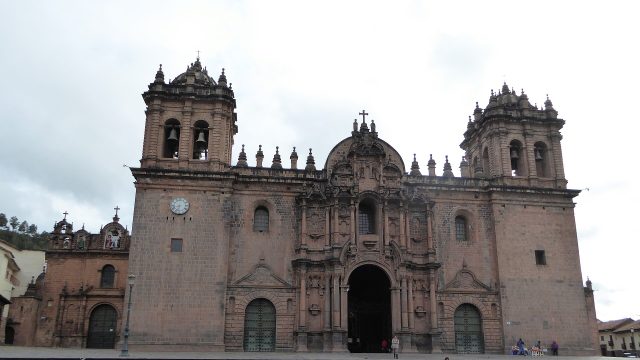
This square sits at 3,400 meters above sea level. It was the political and spiritual core of the Inca Empire before Spanish conquest turned it into the colonial heart of South America. Now, the stones, the faces of the people, and the wind carry stories from every era Cusco has known.
The architecture here is a conversation between two worlds. Inca walls, built with stones so precise no blade fits between them, still stand. These foundations, visible in the bases of colonial buildings, once supported the Qorikancha, the Inca’s most sacred temple, dedicated to Inti, the sun god. The Spanish built their own vision of power on top: ornate facades, carved wooden balconies, arched walkways, and the Cathedral of Cusco, which took nearly a century to complete. Inside, the cathedral’s walls display paintings from the Cusqueña School, where European techniques blend with indigenous motifs.
The square has always been a place of gathering.
In Inca times, it hosted ceremonies. Under Spanish rule, it became a stage for public executions and religious processions. Today, life unfolds here in real time. Locals meet under lamplight, tourists wander between arcades, and in the evenings, restaurants spill light onto cobblestones. During festivals like Inti Raymi or Cusco’s anniversary, the square fills with color—parades, music, and the scent of roasted cuy and chicha. Even on ordinary days, street musicians play pan flutes, vendors sell alpaca textiles, and conversation mixes with footsteps.
The buildings around the square each hold part of Cusco’s story. The Church of La Compañía de Jesús, built by the Jesuits in the 17th century, has a baroque facade and a gold-leaf altar. Nearby, the former palace of Inca Viracocha now houses a museum, its walls still marked by the city’s pre-Columbian past. In one corner stands the Chapel of El Triunfo, built where the Spanish claimed their decisive victory over the Inca.
The mood of Plaza de Armas changes with the light.
In the early morning, mist wraps the square. Locals hurry to work or sip hot cocoa in cafés. By midday, shadows stretch across cobblestones. Children play near the fountain, women in polleras sell flowers, and visitors pose for photos. As evening falls, the buildings glow under warm lights, and conversation grows louder in restaurants and bars.
From here, the city’s historic center unfolds. A short walk leads to San Blas, where narrow streets wind past artisan workshops. Another path takes you to Sacsayhuamán, where massive Inca stones frame the city below. Loreto Street still has original Inca walls, repurposed by the Spanish as foundations for their homes. The square keeps pulling you back.
You can run your fingers over stones that once bore witness to Inca rituals. Climb to a balcony in a colonial building for a view of the square. The past isn’t buried here—it’s woven into the light on the cathedral’s towers and the laughter echoing off the Inca walls.