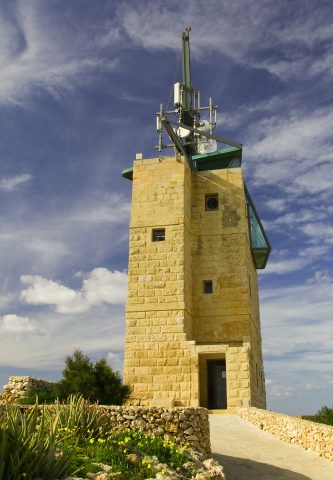
Nadur Park is one of those quiet corners of Malta where time seems to slow down, and the landscape feels deliberately designed for simply being in it. Tucked away on the outskirts of the small town of Nadur on the northeastern edge of Gozo, it isn’t vast or particularly famous, but it has a gentle charm all its own. Unlike the island’s more tourist-heavy spots, this isn’t a place of crowds or loud signage. Instead, it feels like a retreat for locals—a spot to escape the heat, wander shaded paths, or spread out a picnic on the grass.
The park is modest in size but thoughtfully laid out, with terraced levels connected by winding stone steps and pathways that dip and rise along the gentle slope. At the bottom, a wide lawn stretches beneath tall trees, while higher up, small platforms with stone benches offer views of the surrounding countryside. In the height of summer, the shade from old pines and eucalyptus trees is a welcome relief, and in spring or autumn, the air fills with the scent of blooming shrubs and wild herbs. The landscape here feels generous without being showy, as if Gozo’s nature knows how to offer beauty without demanding attention.
The park’s history is closely tied to Nadur itself, a town that has long been one of Gozo’s most peaceful and unassuming places. While nearby Victoria buzzes with activity, Nadur has always been a quiet settlement where life moves at its own pace, shaped by farming and fishing. The park wasn’t created until the mid-20th century, when local authorities decided to carve out a public space for relaxation. Many of the trees that now define the park were planted around that time, when Gozo was still largely untouched by tourism. Back then, the park was meant for residents, not visitors, and that sense of local intimacy lingers today.
There’s nothing grand about the park’s design—just simple, functional details that blend into the landscape. The retaining walls holding up the terraces are built from the same pale limestone that gives Maltese towns their distinctive glow. The pathways and steps, worn smooth by time, have patches of grass growing between the stones, adding to the sense of natural ease. There are no ornate fountains or statues here, just a few small gazebos where you can take shelter from the sun or rain. One sits at the highest point, offering a distant view of the sea, especially striking at sunset when the sky turns shades of pink and gold.
Nadur Park doesn’t try to be Gozo’s most iconic landmark, and that’s precisely what makes it special. There’s nothing forced or artificial about it—just a quiet agreement between nature and human hands to create a place where people can simply exist. In summer, it’s cooler than the town; in winter, it’s quiet and nearly empty. But in spring and autumn, the park comes alive with birdsong, blooming flowers, and the slow rhythm of seasons rather than clocks. Locals bring their children here, elderly residents settle onto benches with newspapers or books, and sometimes you’ll spot an artist sketching the light playing across the trees.
For travelers, the park might be a pleasant surprise, especially if they’re looking for something beyond beaches and historic sites. There are no tour groups here, no guides shouting over crowds, no ticket lines. You can bring a sandwich, lay out a blanket, and spend a few unhurried hours doing nothing at all. It’s an ideal spot for anyone tired of the usual tourist pace, a place to feel the real tempo of life on Gozo. There are no cafes or shops within the park, but Nadur’s small grocery stores, just a short walk away, sell fresh fruit, local bread, and cheese—enough for a simple, satisfying meal.
The park’s location is also worth noting, as it sits near the Church of St. Peter and St. Paul, one of Gozo’s most striking landmarks. Its white facade and tall towers are visible from a distance, and many visitors to the park stop by the church afterward. Built in the Baroque style and adorned with frescoes, the interior is a space of quiet reverence. Combining a visit to the park with a stop at the church offers a fuller sense of Nadur’s character—how everything here is connected, how even a small green space fits into the town’s larger story.
In recent years, Gozo has become a refuge for travelers seeking an alternative to Malta’s busier side. With fewer hotels and less noise, the island retains a slower, more authentic feel, and parks like this one help preserve that. There’s no need to take photos for social media or follow the crowd—just the chance to sit on a bench and watch the light shift over the hills, the wind rustle the leaves, or children play on the lawn. That’s the beauty of places like Nadur Park: they ask for nothing except the willingness to pause and be present.