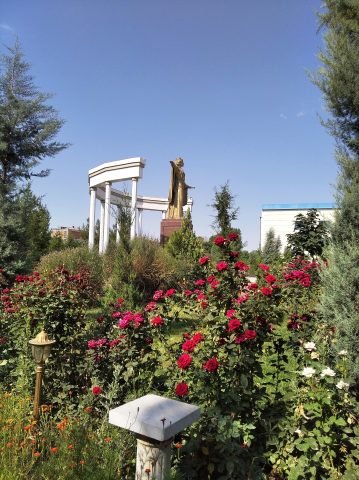
Rudaki Park in Isfara is the kind of place that doesn’t announce itself with fanfare. Tucked away in the heart of the city, surrounded by low-rise residential blocks where life moves at an unhurried pace, it offers something quieter—a pause from the rhythm of daily life. There are no flashy rides or neon signs here, just the shade of old trees, the murmur of leaves, and the sense that for a moment, the city steps back to make room for simpler things: a stroll, a conversation, the weight of memories.
The park takes its name from Abu Abdullo Rudaki, the revered Persian-Tajik poet often called the father of classical Persian literature. In Tajikistan, Rudaki isn’t just a historical figure; he’s a symbol of cultural continuity, a bridge between past and present. In Isfara, as in many towns across the country, his legacy is honored not only as a literary giant but as a reminder of the nation’s intellectual and spiritual depth. The park isn’t just named after him out of tradition—it’s a quiet acknowledgment that even in a small provincial city, there’s space for ideas that transcend time.
Isfara itself is an ancient place, though its modern identity was shaped during the Soviet era, when it became one of the industrial hubs of the Fergana Valley. Factories rose, roads were laid, and Rudaki Park emerged as one of the few green spaces where locals could escape the noise of progress. Today, it retains much of its original character—modest but well-kept, with neat pathways, benches, and small flowerbeds. In the summer, the park is a refuge from the heat, its trees offering shade while a breeze from the nearby mountains carries a hint of coolness.
The park’s design is simple and practical. At its center, a stage is often set up for concerts and celebrations, especially during national holidays or city festivals. Occasionally, poetry readings are held here, dedicated to Rudaki or other Tajik literary figures. On those evenings, the air fills with the cadence of recited verse, the soft strum of traditional instruments, and the scent of freshly brewed tea. Families gather, spreading out blankets on the grass, sharing food and stories under the open sky.
For the people of Isfara, Rudaki Park is more than just a place to relax—it’s woven into the fabric of the city. Couples walk its paths, children play, and elderly residents feed the pigeons or sit on benches, watching the world go by. On weekends, the park comes alive with small, everyday rituals: someone reading a book, a group playing chess, neighbors catching up over tea. There’s nothing extraordinary about it, and that’s precisely what makes it feel alive.
Winter transforms the park. The trees stand bare, the paths dusted with snow, and the air grows still. Yet even in the cold, you’ll find people here—those who’ve made it a habit, who return regardless of the season. Some come for the crisp air, others just to stretch their legs. The quiet of winter has its own charm, different from the warmth of summer but no less inviting.
Rudaki Park doesn’t claim to be Isfara’s most famous landmark. It’s not grand or extravagant, and that’s part of its appeal. This is a place where the city exhales, where the weight of daily life lifts, if only for a little while. There are no crowds of tourists, no rush—just the unhurried pace of a small Tajik town.
In recent years, like many cities across Central Asia, Isfara has begun paying more attention to its public spaces. Rudaki Park has seen some updates—new benches, lights, a playground—but its essence remains unchanged. The real draw isn’t the improvements; it’s the sense of peace that lingers here. To visitors, the park might seem ordinary, but for locals, it’s a familiar retreat, a small oasis in the midst of everyday routines.
If you ever find yourself in Isfara, don’t hurry past. Step inside, sit on a bench, listen to the rustle of leaves. Maybe here, in this unassuming corner of the city, you’ll catch a glimpse of something intangible—the quiet soul of the place.