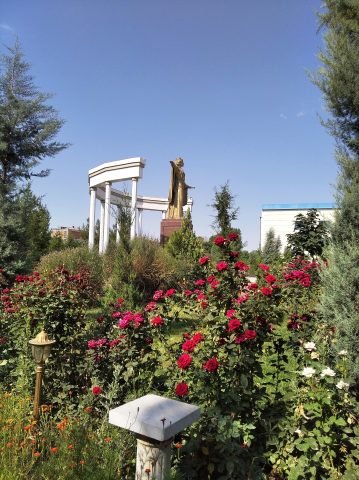
Isfara’s central square is where the city quietly gathers, not with grand monuments or tourist crowds, but with the unhurried rhythm of daily life. Here, the past and present blend into something unassuming yet deeply familiar. The square doesn’t demand attention—it simply exists, a stage for the small, ordinary moments that make up the life of a town.
The architecture is modest, shaped by the practicality of Soviet-era design. Low-rise buildings with large windows line the perimeter, their facades worn but welcoming. The most prominent structure is the city administration building, its columns and broad steps giving it a slightly formal air, though it’s rarely the focus of anyone’s day. Nearby, a small park with a fountain offers a place to sit, though the fountain only runs in warmer months. Even when dry, it draws people—parents with children, old men playing backgammon, or just those looking for a moment of shade.
Isfara has roots that stretch back centuries, and the square was once part of a bustling bazaar where silk, spices, and ceramics from the Fergana Valley changed hands. The market is gone now, but its spirit lingers in the way the square still functions as a hub. On any given day, you might find stalls selling fresh bread, seasonal fruit, or the sticky-sweet halva that locals love. On weekends, the space sometimes transforms into a small fair, with vendors offering homemade cheese, woven textiles, or simple crafts. It’s not a spectacle, just the quiet commerce of a town that knows itself well.
For those who live here, the square is the heart of the city. It’s where people meet, where news travels, where celebrations and gatherings unfold. In Soviet times, it hosted May Day parades with grandstands and speeches; today, it’s more likely to see a local concert or a festival, though the scale is always intimate. There are no grand announcements, no crowds of strangers—just the familiar faces of neighbors and the easy flow of conversation.
The square changes with the seasons. In spring, the trees burst into bloom, filling the air with the scent of fresh leaves. Summer brings heat, but the towering poplars cast long shadows, making the afternoons bearable. Evenings are the liveliest time, with streetlights flickering on, children playing, and the murmur of voices carrying across the open space. Winter quiets everything—the square empties, the benches dusted with snow, the bare branches of the trees giving the place a different kind of beauty.
Around the square, life moves at its own pace. There’s a post office, a bank, a few small shops, and a handful of cafes where men sip tea and debate the day’s events. A modest market sells everyday goods—vegetables, bread, household items—nothing flashy, just what people need. There’s no clamor, no push of a big city bazaar. Instead, there’s the comfort of recognition, the way everyone seems to know each other, even if only by sight.
Isfara doesn’t try to impress visitors. There are no luxury hotels, no guided tours, no carefully curated experiences. The square isn’t a destination; it’s just a place where life happens. That’s what makes it feel real. It doesn’t perform for outsiders—it simply is, a quiet corner of the world where time moves differently.
If you find yourself in Isfara, take a seat on one of the benches. Watch the children kick a ball across the pavement, listen to the clatter of backgammon pieces, or the low hum of conversation. The square won’t offer grand revelations, but it might give you something rarer: a glimpse of a town living at its own pace, unhurried and unpretentious. That’s what makes it worth lingering over—not the things you see, but the way it makes you feel.