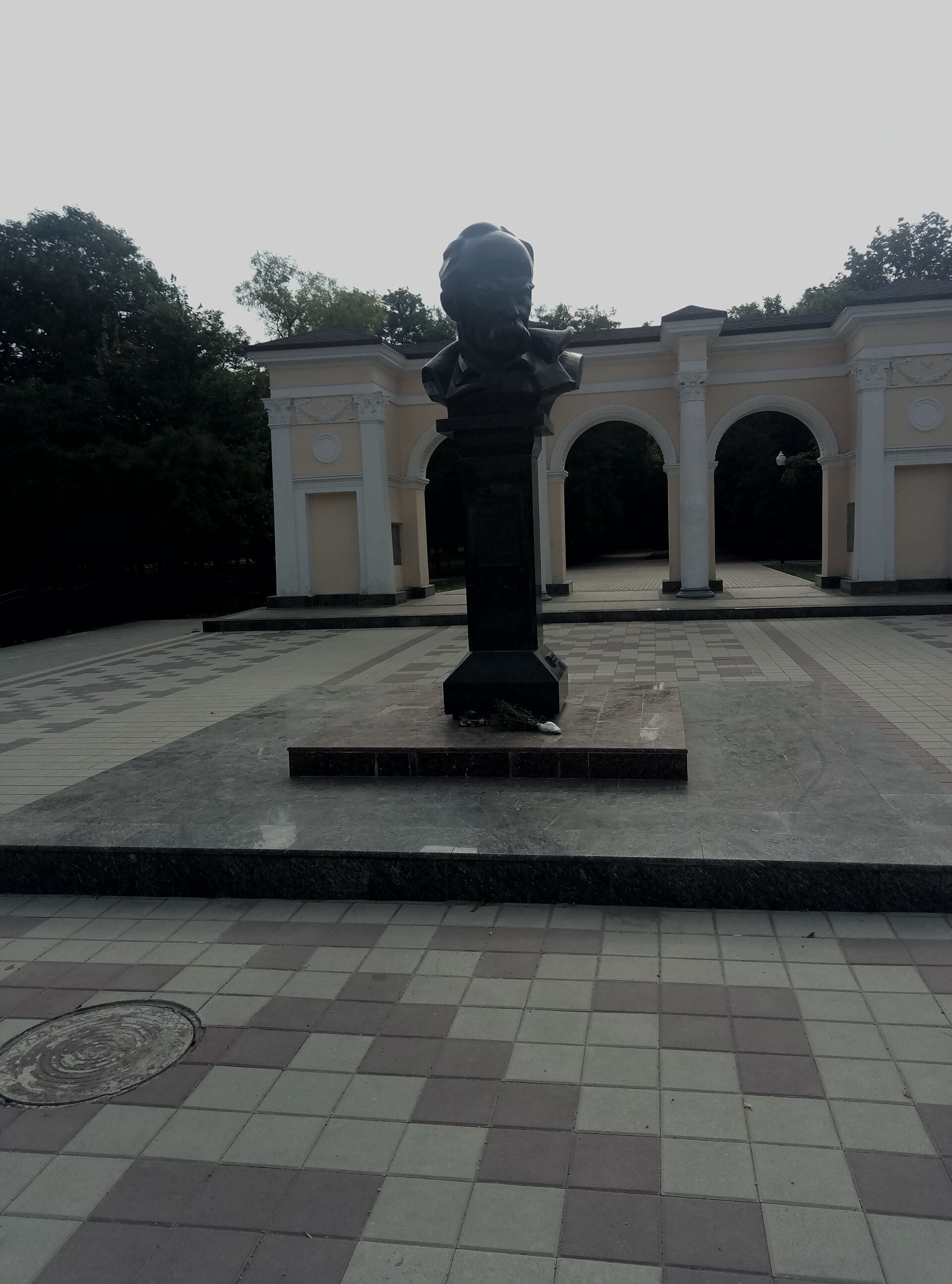
Great Znamyanka’s Taras Shevchenko Park sits in the village center. It doesn’t stand out with grand monuments or manicured gardens. Instead, it blends into daily life—where people walk dogs, meet friends, or let children run along the paved paths. Linden, maple, and chestnut trees shade the ground in summer, their leaves moving with the breeze that carries the scent of warm earth and cut grass.
The park appeared after World War II, when communities rebuilt public spaces. A bronze bust of Taras Shevchenko was installed on a tall pedestal around that time. His name matters in Ukraine, but here it feels like a quiet acknowledgment of shared identity. His poetry—about land, labor, and belonging—fits a place like Great Znamyanka, where life has long been tied to the soil. The monument shows Shevchenko gazing into the distance, his expression thoughtful.
Paths curve around a central plaza where a fountain once ran. Now, the fountain is often dry, its basin cracked, but it still draws the eye. In summer, marigolds, petunias, and roses fill the flowerbeds. In winter, snow covers the same beds. Behind the monument, trees grow thicker, their branches muffling village sounds. Time slips away easily here, especially in late afternoon when the light slants low.
Older residents remember May Day parades winding through the park. They recall the open-air stage where musicians played and the kiosk that sold ice cream. The stage is now weathered, its planks warped, and the kiosk is gone. Still, the park remains part of village life. In the evenings, teenagers gather near the fountain. During the day, pensioners stroll and chat on benches. In summer, women sit knitting, needles clicking as they talk.
Great Znamyanka began as a Cossack settlement in the late 18th century. It later became part of the Kherson Governorate. Over time, it grew into a farming community where Ukrainian and Russian traditions mixed. The park reflects that history in its own way—no grand gates or sculpted hedges, just a place shaped by the village. Paths show wear from footsteps, benches hold conversations, and trees have grown alongside the people who planted them.
Winter changes the park. The fountain freezes, its edges dusted with snow. Bare branches form a lattice against the gray sky. Paths may be icy or muddy, but people still come—walking dogs, cutting through to work, or pulling sleds. The beauty is quiet, the kind you notice only if you look.
Summer brings warmth. The air smells of roses and fresh grass. Families picnic on blankets, children run around the fountain, and folk music drifts from nearby windows. The park holds small moments—birthdays on benches, couples holding hands, old men playing dominoes under a chestnut tree.
Shevchenko’s poetry, rooted in the Ukrainian countryside, belongs here. For many, he represents the bond between people and land. In Great Znamyanka, where life follows agricultural rhythms, his words matter. The monument isn’t just a tribute; it reminds people of what lasts—family, work, the land, and stories passed down.
The park isn’t special because of any single feature. It’s part of everyday life—no tours, no souvenirs, no attractions. Locals have taken their first steps here, said goodbyes, and sat in silence after long days. Outsiders see a side of Ukraine that’s often missed—ordinary, unpolished, but deeply human. History isn’t just remembered here; it’s lived, one quiet afternoon at a time.