In the heart of Nowy Sącz, where the rhythm of the city softens into the quiet rustle of leaves, there’s a place where time seems to slow down. Mikołaj Kopernik Park isn’t a grand tourist attraction or a bustling hub of activity—it’s something far simpler, and perhaps more meaningful. Here, the everyday life of the city unfolds under the shade of old trees, where locals come to escape the noise, to think, or to simply be. The park doesn’t demand attention; it invites you to linger, to notice the small things—a bench worn smooth by decades of use, the way sunlight filters through the branches, the laughter of children playing near the central path.
The park’s history is woven into the fabric of Nowy Sącz itself. Established in the late 19th century, it was one of the first public spaces in the city designed for leisure, a place where residents could step away from their daily routines without leaving the urban landscape. In an era when parks were more than just decorative green spaces, they served as vital social hubs—venues for conversations, strolls, and even quiet political debates. Over the years, the park has absorbed the stories of the city, becoming a living archive of its past. There’s a local tale, passed down through generations, that in the early 1900s, intellectuals and thinkers would gather here to discuss the future of the region, their voices blending with the murmur of the nearby river.
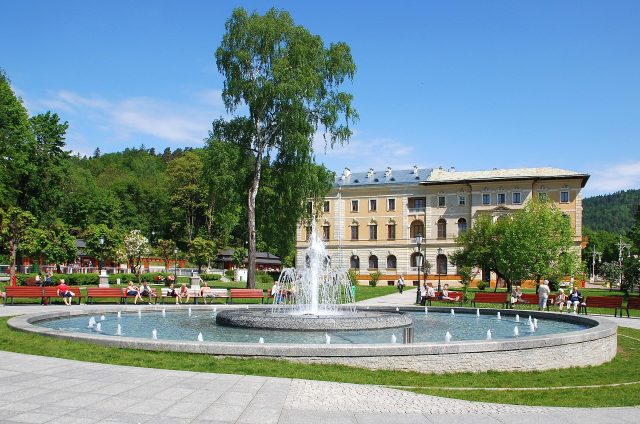
What makes the park special isn’t its architecture or its monuments—there are no towering statues or ornate fountains here. Instead, its charm lies in its understated harmony. The paths are neatly paved, the trees—many of them planted over a century ago—form a natural canopy that offers respite from the summer heat. At the center stands a modest stage, occasionally used for concerts or community events. It’s unassuming, almost blending into the surroundings, yet it’s precisely this simplicity that makes it feel like a natural part of the park’s character. The design doesn’t compete with nature; it complements it.
The park’s name carries a deeper significance. Mikołaj Kopernik, the renowned astronomer whose legacy reshaped our understanding of the universe, never set foot in Nowy Sącz. Yet his influence on Polish culture is so profound that his name graces parks, streets, and squares across the country. In a way, naming this park after him feels symbolic. It’s not just a tribute to a historical figure but a quiet reminder of the importance of perspective—of looking beyond the immediate, of seeing the world as a whole. Perhaps that’s why the park has a way of making you feel both grounded and expansive at the same time, as if the sky above is just a little wider here.
For the people of Nowy Sącz, the park is a familiar presence, a constant in the ebb and flow of daily life. Mornings often begin with elderly residents taking slow, measured walks along the paths, their conversations drifting softly through the air. By midday, the park fills with the sounds of children playing, their parents watching from nearby benches, enjoying a moment of quiet. As evening falls, the atmosphere shifts again. The lampposts cast a warm glow over the paths, and couples stroll hand in hand, the park transforming into a place of quiet intimacy. On weekends, it becomes a gathering spot for families, friends strumming guitars, or readers losing themselves in books under the open sky.
Though unassuming, the park plays a subtle but important role in the city’s cultural life. Throughout the year, it hosts events that bring the community together—festivals, fairs, and open-air concerts that turn the stage into a focal point for local talent. Summer evenings are particularly lively, with music spilling across the lawns, drawing people of all ages. In winter, the park takes on a different character, its trees dusted with frost, the paths quiet underfoot. Small holiday markets appear, offering handmade crafts and warm drinks, their stalls adding a touch of warmth to the crisp air. These events aren’t grand spectacles, but they’re the kind of gatherings that matter to the people who call Nowy Sącz home.
There’s a sense of continuity here, as if the park holds the memories of those who walked its paths long before. The old lampposts, the benches that have seen generations come and go, even the trees that have weathered the storms of the past century—all of them carry traces of the city’s history. It’s easy to imagine that the same conversations, the same laughter, have echoed through these trees for decades. The park doesn’t just exist in the present; it connects the past to the future, offering a space where time feels less linear and more layered.
Walking through Mikołaj Kopernik Park isn’t just about getting some fresh air—it’s a way to experience the soul of Nowy Sącz. This isn’t a city that draws crowds of tourists or makes headlines for its attractions. It’s a place where life moves at its own pace, where the most meaningful experiences often happen quietly, without fanfare. The park embodies that spirit. There’s no need to rush, no pressure to see or do anything in particular. You can wander the paths, sit on a bench, or lie on the grass and watch the clouds drift by. The park doesn’t ask for your attention; it offers you the freedom to simply be.
One of the park’s quiet pleasures is how seamlessly it blends into the city around it. There are no rigid boundaries here—just a gradual transition from the streets to the green space, as if the park is an extension of the neighborhood rather than a separate destination. You can enter from any direction, stay for a few minutes or a few hours, and leave whenever you’re ready. In summer, the park is a haven of shade and cool breezes, perfect for reading, daydreaming, or listening to the birds. In winter, it becomes a serene landscape of frost and quiet, the paths inviting slow, reflective walks.
Mikołaj Kopernik Park isn’t a place that tries to impress. It doesn’t need to. Like Nowy Sącz itself, it’s unpretentious, steady, and quietly beautiful. There’s no grand statement here, no spectacle to behold—just the quiet assurance that some things don’t need to be extraordinary to be deeply meaningful. The park reminds us that sometimes the most valuable experiences are found not in the loud or the monumental, but in the simple, the ordinary, the everyday. A shady spot under a tree, a conversation on a bench, a moment of stillness—these are the things that make a place feel like home.