Perched on a hill overlooking Liège, Parc d’Avroy is one of those rare urban spaces where the city seems to exhale. From its upper terraces, the view stretches across the old quarters and the slow curve of the Meuse River, its banks lined with the ghosts of Liège’s industrial past—warehouses now repurposed as museums, lofts, and cafés. But the park is more than just a vantage point. It carries the quiet weight of history in its pathways, its trees, and the faded grandeur of the neoclassical villa that still stands at its heart.
The park took shape in the late 19th century, when Liège was expanding rapidly and, like many European cities at the time, sought to create green spaces for its growing population. The villa was built first, its columns and symmetry a nod to classical ideals, and around it, gardens were laid out with careful precision. Over the decades, the park became a stage for the city’s life—hosting exhibitions in the early 1900s, serving military purposes during the wars, and gradually settling into its current role as a place of refuge. What remains today is a softened version of its former self, its edges worn smooth by time, but that only adds to its charm.
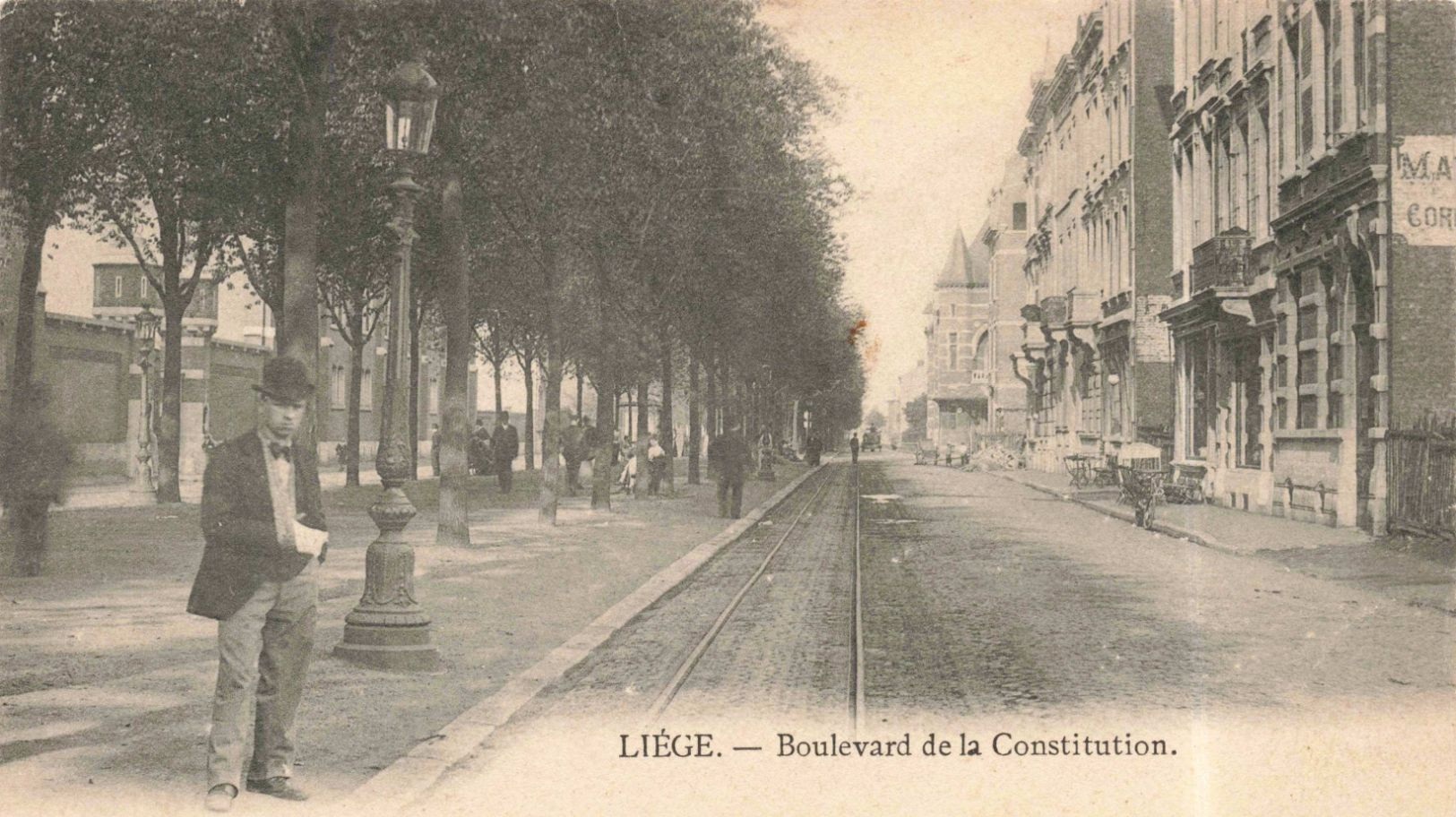
The main avenue cuts through the park like a spine, leading from the entrance straight to the villa. Tall trees arch overhead, their leaves filtering the sunlight into shifting patterns on the gravel below. In summer, the shade offers relief from the heat, while autumn turns the paths into a mosaic of gold and crimson. Benches line the way, often occupied by students with books or elderly locals who come here out of habit. On weekends, the park hums with life—families spread out picnics, children chase each other across the lawns, and teenagers gather by the fountain, their laughter mixing with the sound of water. There’s no formality here, no sense of being on display. It’s just a place where people come to unwind.
One of the park’s quietest corners is the small pond, home to ducks and swans that glide across the water in slow circles. A path encircles it, and in winter, when the surface freezes, it becomes an impromptu skating rink. Nearby stands an old greenhouse, its glass panes clouded with age and its iron framework rusting at the joints. Once used to cultivate exotic plants for exhibitions, it now sits empty, its air of gentle decay lending it the atmosphere of a forgotten garden from a novel. Occasionally, it hosts temporary art installations or small concerts, but more often, it simply exists, a relic of another era.
Parc d’Avroy has always been tied to Liège’s cultural life. In warmer months, it becomes an open-air venue for film screenings, lectures, and music festivals. Local musicians practice on the terraces, their notes drifting through the trees, while artists set up easels to capture the play of light on the villa’s facade. In recent years, the park has also become a favorite spot for wedding photos—its manicured lawns and historic details make for a romantic backdrop. Yet despite its growing popularity, it hasn’t lost its local character. This is still a place for Liège’s residents, a green oasis where the city’s usual pace slows down.
Winter transforms the park entirely. Snow dusts the statues and settles in the crevices of the villa’s stonework, while the paths grow quiet, the usual crowds replaced by the occasional solitary walker. The villa, lit from within, takes on a warmer glow, its windows like eyes watching over the empty lawns. Sometimes, a small Christmas market sets up near the entrance, with steaming mugs of glühwein and the scent of waffles in the air, but even without it, the park retains its magic. There’s something about the stillness of winter that makes it feel even more like a secret, a place where time moves differently.
For those who enjoy longer walks, the park serves as a gateway to the surrounding area. From here, you can descend to the Meuse’s riverfront, where old barges have been converted into cafés and galleries, or climb higher to the fort that overlooks the city. But many visitors never leave the park’s boundaries, content to wander its paths at their own pace, pausing to admire a particularly old tree or a weathered sculpture. There’s no rush here, no prescribed route. You can sit on the grass, take photos, or simply watch the life of the park unfold around you.
What makes Parc d’Avroy special is its lack of pretension. There are no tourist traps, no loud attractions, no guides herding visitors from one spot to the next. It’s just a patch of green in the middle of the city, a place where people come for different reasons—some for solitude, others for inspiration, or simply to escape the noise for a while. That’s why Liège’s residents hold it in such affection. It doesn’t try to be anything more than what it is, and in that simplicity lies its greatest appeal.